






Definition and Overview of the Residential Tenancy Agreement Template
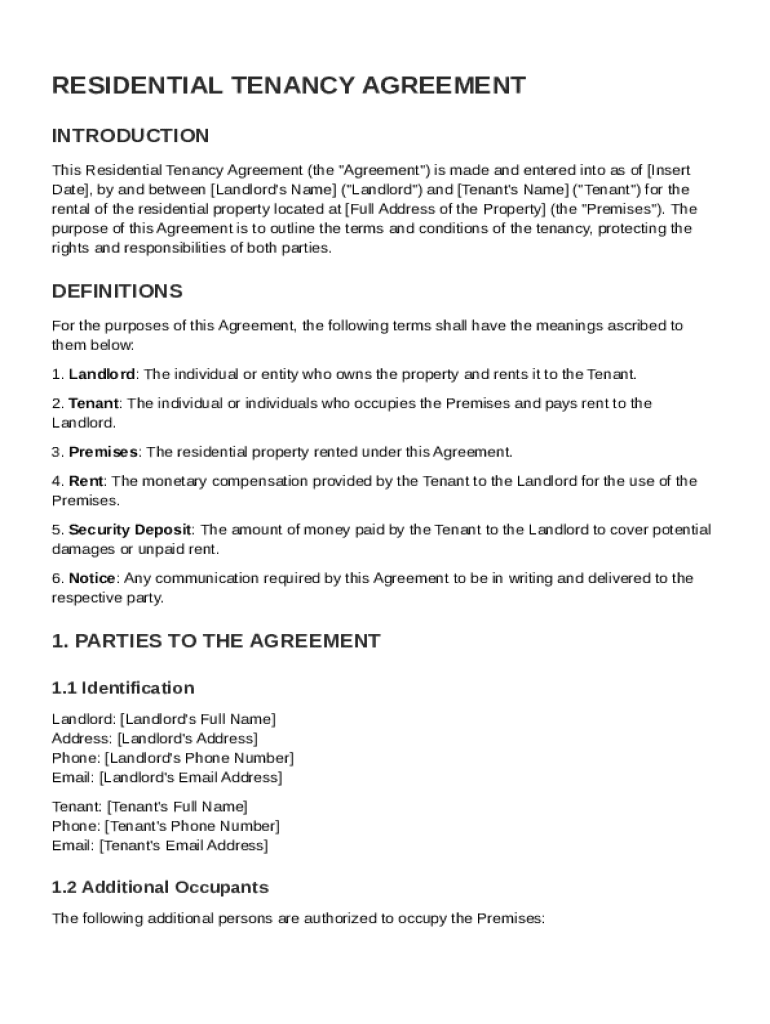
The Residential Tenancy Agreement Template is a legally binding document that details the terms and conditions agreed upon by a landlord and tenant for renting a residential property. It includes critical components such as identifying the involved parties, lease duration, rental payment specifics, and responsibilities regarding property upkeep. This template is a standardized form designed to streamline the document creation process, allowing for efficient customization to suit specific tenancy arrangements while providing a clear framework for the rights and responsibilities of both parties.
Key Components of the Agreement
- Party Identification: Clearly outlines the landlord and tenant by including full names and contact details.
- Property Description: Provides a detailed description of the rental premises, including address and any included fixtures or movable property.
- Lease Duration: Specifies the start and end dates of the tenancy or conditions under which it is renewed.
- Rent and Payment Terms: Details the amount of rent, due dates, and acceptable payment methods.
- Security Deposit: Includes conditions related to the security deposit, such as amounts, use, and the process for its return.
Important Terms Related to the Residential Tenancy Agreement Template
Several terms are pivotal when drafting or analyzing a Residential Tenancy Agreement Template. Understanding these terms ensures both parties are clear about their obligations and rights.
Common Terms Explained
- Subletting: Refers to the tenant's ability to lease the property to another party. The agreement should specify whether this is permissible and under what conditions.
- Maintenance Responsibilities: Details the obligations for repairs and maintenance between the landlord and tenant.
- Utility Obligations: Defines which utilities must be paid by the tenant and which, if any, are included in the rent.
- Termination Procedures: Outlines how either party can legally terminate the agreement, including notice periods and potential penalties.
Steps to Complete the Residential Tenancy Agreement Template
Filling out the Residential Tenancy Agreement Template accurately ensures a valid and enforceable contract. Following a systematic approach simplifies the process.
- Gather Information: Collect necessary details from both parties, including full names, contact information, and any specific terms agreed upon verbally.
- Specify Lease Details: Clearly define the lease term, including the start date, duration, and any options for extension or renewal.
- Detail Rent and Deposit Terms: Document the rent amount, payment schedule, and security deposit conditions.
- Include Additional Provisions: Address any other terms, such as pet policies or property modifications, in this section.
- Review Legal Requirements: Check compliance with local regulations and state-specific rules to ensure legality.
- Sign and Date: Both parties should sign and date the agreement for it to be enforceable.
Practical Example
Consider a tenancy agreement for a one-bedroom apartment in California outlining a twelve-month lease. The rent is listed at $1,200 per month, payable via electronic transfer, with a $1,200 security deposit to be held until the lease ends.
Legal Use of the Residential Tenancy Agreement Template
Employing the Residential Tenancy Agreement Template responsibly ensures its legality and enforceability. It's crucial to comply with all applicable laws to protect both parties' interests.
State Compliance
Every state may have specific requirements. For instance, California mandates the inclusion of a disclosure about the existence of lead-based paint for properties built before 1978, while New York might have rent-control guidelines that alter typical agreement terms.
Conducting Legal Reviews
To mitigate risks, it's advisable to have the completed agreement reviewed by a legal professional, especially if the terms are complex or if the property is in a jurisdiction with intricate rental laws.
Examples of Using the Residential Tenancy Agreement Template
Analyzing real-world scenarios helps in understanding how the Residential Tenancy Agreement Template can be adapted to various situations. This flexibility is essential for addressing different rental arrangements.
Scenario Variations
- Short-term Rentals: When leasing a property for a few months, the agreement would focus on temporary occupancy, with clear exit provisions.
- Roommates: The template can be adapted to delineate responsibilities between co-tenants, such as dividing rent payments and allocating utilities.
- Commercial Conversion: While primarily for residential use, with appropriate amendments and compliance checks, it can serve in mixed-use properties where residential and commercial spaces coexist.
State-Specific Rules for the Agreement
Different states impose varying regulations that must be adhered to within the Residential Tenancy Agreement Template. These rules ensure the agreement remains compliant with local laws.
Notable State Varieties
- Security Deposit Caps: Some states, such as Washington, limit the amount landlords can charge for security deposits.
- Termination Notices: In Illinois, landlords must provide at least thirty days' notice for termination of a month-to-month rental agreement, while others might require more or less advance notice.
Software and Compatibility Considerations
Using DocHub to handle the Residential Tenancy Agreement Template introduces flexibility and efficiency, especially when managing legal documents. The platform's rich feature set enhances document processing and management.
DocHub's Features
- Editing and Annotation: The agreement can be straightforwardly customized to include required terms using DocHub's robust editing tools.
- Real-Time Collaboration: Multiple stakeholders, such as lawyers or co-tenants, can collaboratively revise or review the document to ensure accuracy and agreement.
- Legally Binding Signatures: DocHub offers options for creating and saving digital signatures, ensuring that the agreement can be authenticated legally.
This comprehensive discussion provides a detailed insight into the Residential Tenancy Agreement Template, ensuring that parties involved are fully informed and able to maximize their document functionality.