01. Edit your form online
Type text, add images, blackout confidential details, add comments, highlights and more.

Type text, add images, blackout confidential details, add comments, highlights and more.

Draw your signature, type it, upload its image, or use your mobile device as a signature pad.

Send it via email, link, or fax. You can also download it, export it or print it out.
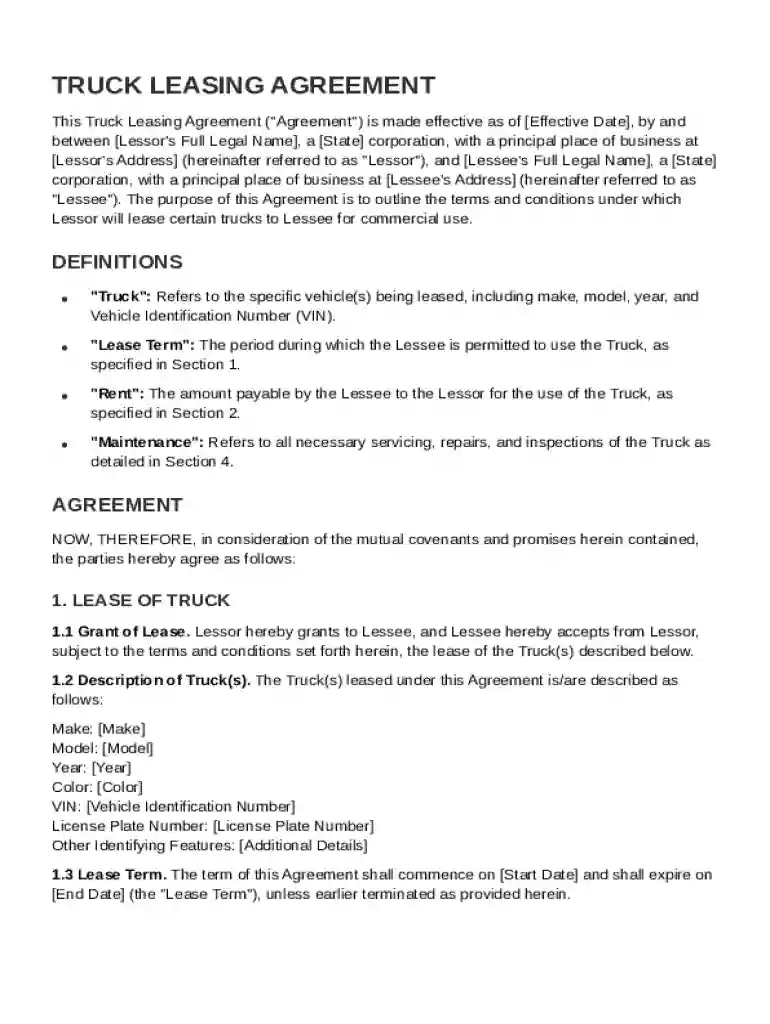
A Truck Leasing Agreement Template is a legally binding document that outlines the terms and conditions under which a lessor leases trucks to a lessee for commercial purposes. It serves as the framework for the lessor and lessee's relationship, covering all essential aspects of the lease, such as payment terms, duration, maintenance responsibilities, and more. Typically, this document is used to ensure that both parties have a clear understanding of their respective rights and obligations, minimizing the risk of disputes and misunderstandings.
Within the agreement, important sections such as definitions of key terms play a vital role in ensuring precision and consistency. These definitions help clarify specific terminology used throughout the document, ensuring that each party interprets the terms in a uniform manner. This section is particularly crucial in legal documents where misinterpretations can lead to complications.
The Truck Leasing Agreement Template encompasses several key elements that are critical to a well-structured and legally sound lease. Among these elements are:
Lease Duration: Specifies the time frame for which the lease is valid, including start and end dates. This section ensures both parties are aligned on how long the agreement will last.
Payment Obligations: Details the lessee's obligations regarding lease payments, including the amount, frequency, and method of payment. It may also outline any penalties for late payments.
Permitted Uses: Describes acceptable uses for the leased trucks, ensuring that they are used solely for agreed-upon purposes, which often pertain to commercial activities.
Maintenance Responsibilities: Outlines responsibilities related to the upkeep and repair of the trucks. This section clarifies who is accountable for routine maintenance and repair expenses.
Insurance Requirements: Details the insurance coverage that the lessee must maintain on the leased trucks. This is necessary to protect both parties in the event of damage or accidents.
Termination Conditions: Specifies the conditions under which the lease can be terminated by either party, including procedures for termination notice and any potential penalties.
The legality of a Truck Leasing Agreement Template is rooted in its adherence to relevant laws and regulations. The document must comply with federal, state, and local regulations to be considered valid and enforceable. For example, the agreement must include clauses that adhere to the Uniform Commercial Code (UCC) where applicable, ensuring fair leasing practices.
Legally compliant agreements often feature indemnification provisions that protect each party from liability claims arising from the other party’s actions. Legal conformity also requires that both the lessor and lessee carefully review all agreements to ensure that they fully comprehend their legal rights and obligations.
Various entities utilize Truck Leasing Agreement Templates as part of their standard operations. Primarily, these agreements are employed by:
Transportation Companies: Businesses that require a fleet of trucks for delivery or hauling services.
Independent Trucking Operators: Small trucking businesses or owner-operators who might lease additional trucks to expand their service capabilities.
Logistics Providers: Companies involved in supply chain operations that rely on truck leasing to optimize their transport capacity without incurring the overhead costs of purchasing vehicles.
These users benefit from leasing as it provides them with operational flexibility, financial predictability, and the ability to upgrade their fleet without needing large capital investments.


Specific requirements for truck leasing agreements can vary from state to state, dictating certain clauses and stipulations that must be included. Differences may arise in areas such as:
Interest Rate Caps: Some states impose caps on the interest rates that can be charged in lease agreements related to financing charges.
Lease Disclosure Obligations: States might have requirements for disclosing specific information regarding the lease that parties are obligated to fulfill.
Insurance Minimums: States may require different minimum levels of insurance coverage, impacting the insurance clauses in the agreement.
It's essential for parties entering into a truck leasing agreement to familiarize themselves with the laws of the state where the lease is executed to ensure compliance.
Completing a Truck Leasing Agreement Template involves a step-by-step process to ensure all necessary details are covered comprehensively:
Identify Parties Involved: Clearly state the names and addresses of the lessor and lessee.
Detail the Vehicle Description: Provide a thorough description of the vehicles included in the lease, specifying make, model, year, and VIN.
Clarify Payment Terms: Outline the payment schedule, amount, and method, and include any related financial terms such as deposits or fees.
Stipulate Maintenance Obligations: Define who is responsible for vehicle maintenance and how it will be conducted.
Outline Permitted Uses: Specify the acceptable uses for the leased vehicles.
Draft Termination Conditions: Include conditions under which the lease may be terminated and any associated penalties.
Obtain Legal Review: Have an attorney review the template to ensure all legal bases are covered.
Sign the Agreement: Both parties should sign the document to formalize the lease legally.
Essential terms related to truck leasing agreements help provide clarity and facilitate understanding between the lessor and lessee. Some key terms include:
Lessor: The party that owns the truck and leases it to the lessee.
Lessee: The party that takes possession of the truck under the lease agreement.
Residual Value: The estimated worth of the truck at the end of the lease term.
Mileage Limits: Restrictions on the number of miles a truck can be driven during the lease period.
Understanding these terms can help both parties better navigate their respective obligations and rights under the agreement.
Real-world scenarios where a Truck Leasing Agreement Template proves beneficial include:
A logistics firm looking to quickly expand its fleet during peak retail season by leasing additional trucks.
An independent owner-operator leasing a truck to service a new long-distance contract with a major retailer, helping meet delivery schedules without purchasing new vehicles.
A startup transportation company utilizing leased trucks to mitigate initial capital expenses while gradually building its business presence.
These examples illustrate the versatility and necessity of having a comprehensive leasing agreement in place to support business operations efficiently and effectively.
At DocHub, your data security is our priority. We follow HIPAA, SOC2, GDPR, and other standards, so you can work on your documents with confidence.