
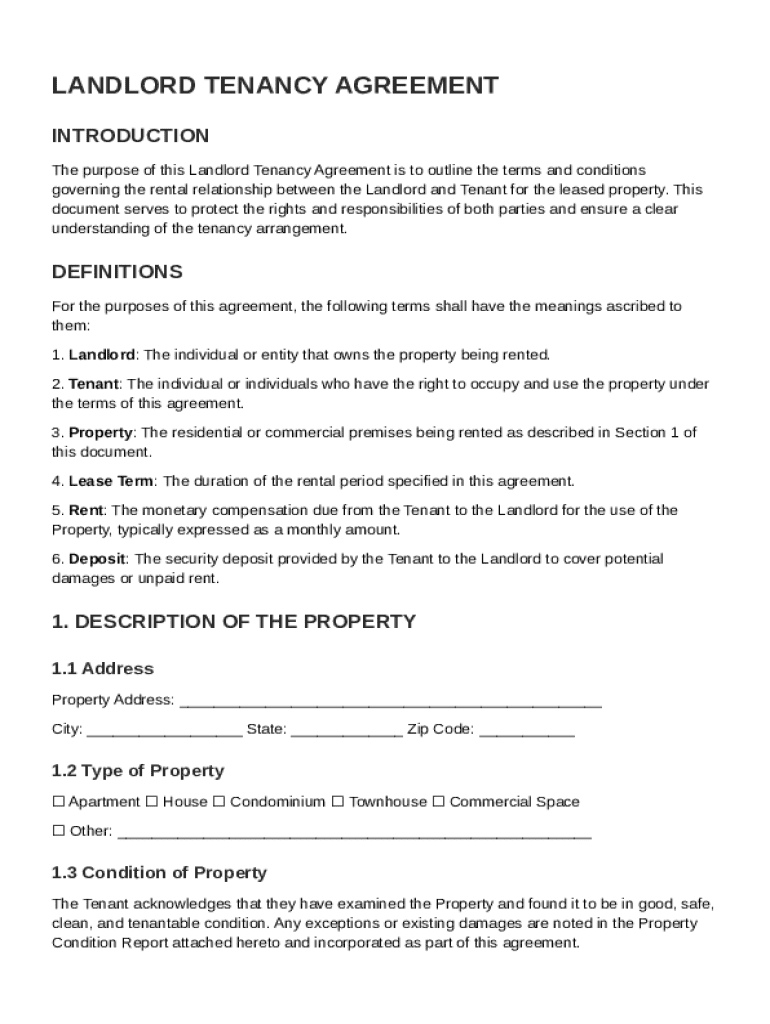







Definition & Meaning
The Landlord Tenancy Agreement Template is a legal document that establishes the terms and conditions between a landlord and tenant. It details their respective rights and responsibilities, which may include the property description, lease duration, rent payment specifics, and security deposit terms. This template serves as a comprehensive guide to ensure clarity and understanding between both parties, reducing the likelihood of disputes.
Key Features
- Property Description: Clearly defines the rental property, including address and any included amenities.
- Lease Term: Specifies the duration of the tenancy, highlighting start and end dates.
- Rent Payment Details: Outlines the amount, due date, and acceptable methods of payment.
Examples of Clauses
- Maintenance Responsibilities: While tenants typically manage routine cleaning, landlords handle structural and significant repairs.
- Pet Policies: Details if pets are allowed and any associated fees or conditions.
Key Elements of the Landlord Tenancy Agreement Template
A comprehensive Landlord Tenancy Agreement Template generally includes several critical sections to safeguard both parties' interests and comply with legal standards.
Essential Components
- Security Deposit: Clarifies the amount, conditions for return, and potential deductions.
- Termination Conditions: Describes how the agreement can be legally ended by either party, including notice periods.
- Governing Law: Specifies the jurisdiction's laws that govern the agreement, usually the state where the property is located.
Practical Scenarios
- Late Fees: If rent is late by a certain number of days, a specified fee may be applied.
- Utilities: The template may stipulate which party is responsible for utility payments like water or electricity.
Steps to Complete the Landlord Tenancy Agreement Template
Completing a Landlord Tenancy Agreement Template involves several steps to ensure accuracy and compliance. Each step should be followed meticulously to produce a legally sound document.
Procedure
- Gather Required Information: Collect all necessary personal and property information, including addresses, names, and contact details.
- Fill In Sections: Carefully complete each section of the template, ensuring clarity and precision.
- Review Terms & Conditions: Both parties should review to confirm understanding and agreement on all terms.
- Add Signatures: Each party should sign the agreement to signify consent.
Additional Tips
- Legal Consultation: Consulting a legal professional can help verify the agreement's compliance with local laws.
- Digital Options: Consider using electronic signing tools for convenience and efficiency.
Who Typically Uses the Landlord Tenancy Agreement Template
Various parties can benefit from using the Landlord Tenancy Agreement Template to formalize rental arrangements and set clear expectations.


Primary Users
- Individual Landlords: Often use these templates to ensure their rental agreements are comprehensive and legally compliant.
- Property Management Companies: Frequently use templates to maintain consistency across multiple rental properties.
Use Case Scenarios
- First-Time Landlords: Benefiting from a guided template that suggests essential legal components.
- Tenants: Gaining clarity on their rights and responsibilities through a structured agreement.
Legal Use of the Landlord Tenancy Agreement Template
The legal application of a Landlord Tenancy Agreement Template ensures that the document is enforceable and aligns with applicable laws.
Legal Considerations
- Compliance with State Law: The template must adhere to specific state regulations and statutes that govern rental agreements.
- Validity After Signature: Becomes legally binding once all parties have signed the document involved.
Common Legal Provisions
- Dispute Resolution: Typically includes methods for resolving issues, such as mediation or arbitration.
- Modification Clauses: Outlining processes for making legal amendments to the agreement.
Important Terms Related to Landlord Tenancy Agreement Template
Understanding certain key terms in a tenancy agreement is crucial for both landlords and tenants.
Terminology Explained
- Leasehold: Refers to the tenant's right to use and occupy the property.
- Subletting: The act of a tenant renting out the property to another party with the landlord's permission.
Examples
- Fixture: Permanent attachments to the property which cannot be removed by the tenant.
- Default: Failure to adhere to agreement terms, such as late rent payments.
State-Specific Rules for the Landlord Tenancy Agreement Template
Landlord tenancy agreements must comply with state-specific laws that govern residential leases. This ensures legality and enforceability.
Regional Variations
- Security Deposit Limits: Some states have caps on the amount landlords can charge as a deposit.
- Notice Periods for Eviction: Varies by state, commonly ranging from 30 to 60 days depending on the violation.
Noteworthy State Examples
- California: Requires landlords to provide specific disclosures related to environmental hazards and pest control.
- Texas: Allows landlords to withhold portions of security deposits for unpaid rent without providing advance notice.
Digital vs. Paper Version
The choice between a digital and paper version of the Landlord Tenancy Agreement Template affects convenience, accessibility, and efficiency.
Advantages of Digital Templates
- Ease of Access: Easily accessed and edited from any location via online platforms.
- Environmentally Friendly: Reduces paper waste and the associated ecological footprint.
Benefits of Paper Versions
- Tangible Record: Provides a physical contract that parties can reference without technical devices.
- Signatures: Some users prefer a handwritten signature for perceived authenticity and reassurance.




