






Definition and Meaning
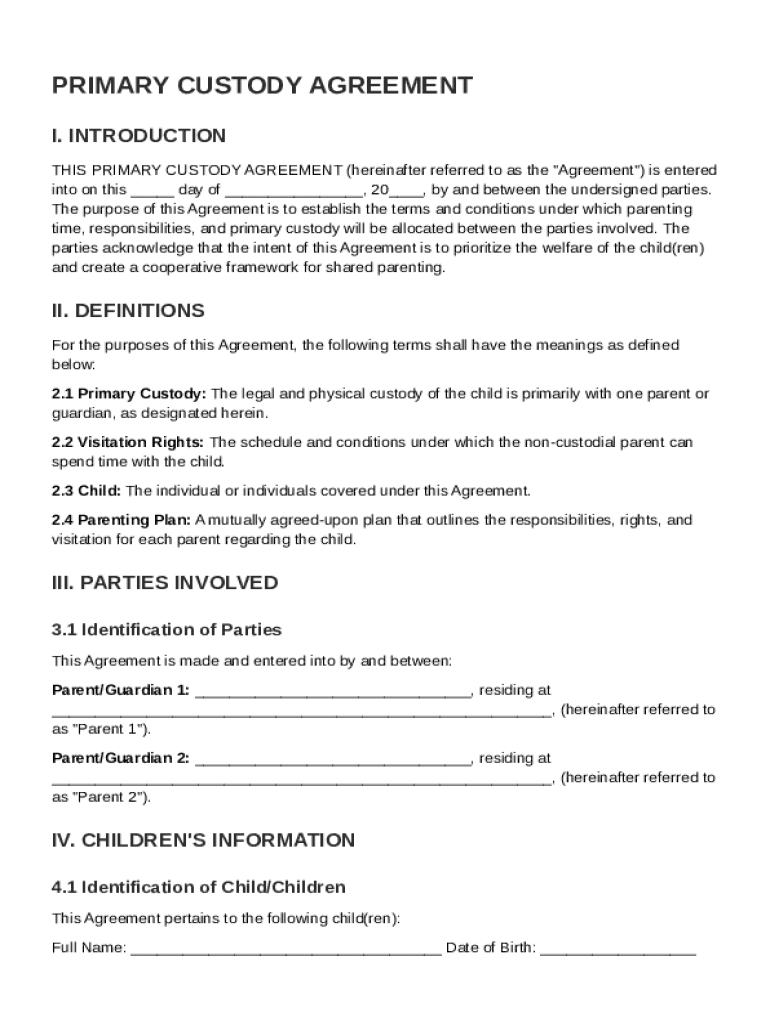
The "Primary Custody Agreement Template" is a legal document that articulates the terms regarding the custody, parenting time, and responsibilities between two parties over their child or children. It lays out crucial definitions such as what constitutes primary custody and visitation rights. Additionally, it identifies the parties involved and specifies the children covered under the agreement. The document serves to establish a primary custodial parent while allowing for joint decision-making related to major aspects of the child’s life. Throughout the agreement, the welfare and best interests of the child are emphasized as the paramount priority.
How to Use the Primary Custody Agreement Template
To effectively use the Primary Custody Agreement Template, you should follow these steps:
-
Download the Template: Obtain the latest version of the template from a reliable source or legal services provider, ensuring it meets the legal standards of your specific jurisdiction.
-
Review the Document: Carefully read through the entire document to understand all the terms and provisions. This will help you familiarize yourself with the expectations and responsibilities.
-
Customized Details: Tailor the sections to fit the specific circumstances of your custody arrangement. This includes inserting personal information, defining custody terms, and outlining visitation schedules.
-
Legal Consultation: It is advisable to consult with a legal professional to interpret any complex clauses and ensure that the agreement complies with state-specific laws.
-
Finalize and Sign: After all adjustments and necessary consultations, both parties should agree on the final version. The document should then be signed in the presence of a notary public for it to be legally binding.
Key Elements of the Primary Custody Agreement Template
The Primary Custody Agreement Template includes several crucial components that structure the custody arrangement:
-
Parenting Time and Schedule: Specifies the scheduled times each parent is allocated with the child, including weekdays, weekends, holidays, and vacations.
-
Decision-Making Authority: Details if the decision-making is joint or if one parent has more authority in certain domains like education, health, and welfare.
-
Child Support Obligations: Identifies the financial responsibilities regarding child support and how these financial duties will be administered.
-
Dispute Resolution Process: Outlines the methods to address any disagreements that might arise, ensuring they can be addressed amicably and efficiently.
-
Modification Provisions: Establishes the conditions under which the agreement can be modified, allowing adjustments to be made as situations change over time.
Steps to Complete the Primary Custody Agreement Template
Completing the Primary Custody Agreement Template requires detailed attention to several components to ensure clarity and legality:
-
Identify the Parties Involved: Clearly list the names and contact details of both parents and the children covered.
-
Define Custody Terms: Specify who will have primary custody and outline the visitation rights of the other parent.
-
Establish a Visitation Schedule: Create a comprehensive schedule that accounts for regular parenting time and special occasions.
-
Outline Financial Arrangements: Set forth any child support payments, including the amount and frequency, based on state guidelines.
-
Include Additional Provisions: Add any other necessary clauses, such as travel consent and communication guidelines.
-
Verification and Signature: Ensure all information is accurate, then both parties, and witnesses if applicable, should sign the document.
Legal Use of the Primary Custody Agreement Template
The Primary Custody Agreement Template must be used legally and ethically to avoid potential pitfalls:
-
Comply with State Laws: Ensure the template adheres to the legal standards and requirements relevant to the state of jurisdiction.
-
Notarization: Where necessary, ensure the agreement is notarized to enhance its legal standing.
-
Fair Representation: Both parties should have an opportunity to seek independent legal advice to confirm fair representation in the agreement.
-
Document Retention: Keep copies of the signed agreement accessible for future reference, as it serves as a legal framework for the custody arrangement.
Important Terms Related to Primary Custody Agreement Template
Understanding the legal terminologies within the Primary Custody Agreement Template is vital:
-
Custodial Parent: Refers to the parent with whom the child resides the majority of the time.
-
Joint Custody: Involves both parents sharing legal authority and decision-making responsibilities for the child.
-
Non-Custodial Parent: The parent who does not have the child living with them full time but has visitation rights.
-
Legal Custody: Grants a parent the right to make significant decisions concerning the child’s welfare, including education and healthcare.
-
Visitation Rights: These are schedules and conditions under which the non-custodial parent may spend time with the child.
State-Specific Rules for the Primary Custody Agreement Template
Laws concerning custody agreements often vary by state, influencing how the template should be structured and applied:
-
State Guidelines: Each state has its own child custody laws and visitation guidelines. You must consult these to ensure the template is appropriately customized.
-
Jurisdictional Variations: Be aware of the differences in jurisdictional law which could affect elements such as child support calculations and enforcement mechanisms.
-
Court Approval: Some states require that custody agreements be reviewed and approved by a family court to ensure they meet the state's standards for the child’s best interests.
Examples of Using the Primary Custody Agreement Template
Here are scenarios showcasing how the template is utilized in real-world situations:
-
Divorce Proceedings: Two parents in the process of divorce utilize the template to amicably agree on shared custody and establish a structured visitation schedule to maintain stability for the child.
-
Revisiting an Agreement: Parents who initially had an informal arrangement may choose to formalize their custody plan using the template to ensure legal enforceability and clarity.
-
Court Mandated Modification: After a significant change in circumstances, such as a relocation or change in employment, the template helps parents adjust the custody arrangement to reflect their new situations.