
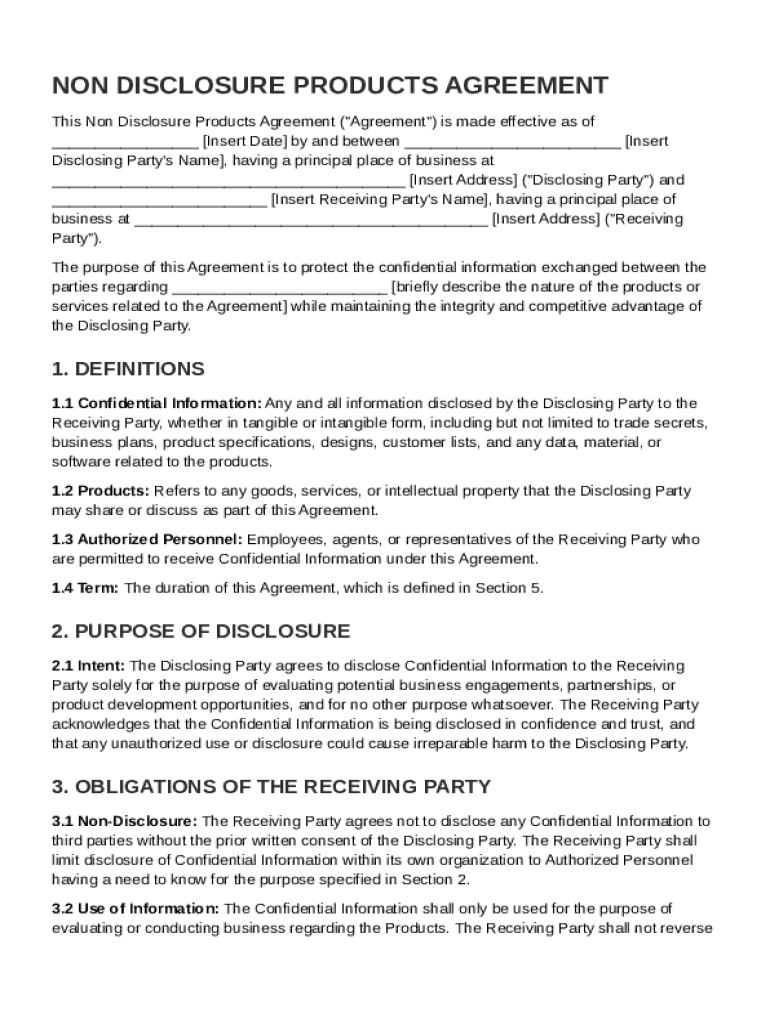







Definition & Meaning
The Non Disclosure Products Agreement Template is a legal framework designed to facilitate the protection of confidential information between parties engaging in discussions about specific products or services. This template ensures that sensitive information, shared during a business relationship, remains protected. Typically, this agreement involves a Disclosing Party, which shares the information, and a Receiving Party, which is bound to confidentiality constraints. By establishing clear definitions, obligations, exclusions, and terms, this document is instrumental in safeguarding proprietary and sensitive data from misuse or unauthorized disclosure.
Key components
- Disclosing and Receiving Parties: The agreement specifies the parties involved, clarifying their roles and responsibilities in handling confidential information.
- Confidential Information: Definitions of what constitutes confidential data are explicitly outlined to avoid ambiguities.
- Granted Rights: Any rights or permissions granted to the Receiving Party, such as the right to use the shared information within certain limitations, are detailed.
Key Elements of the Non Disclosure Products Agreement Template
The template outlines several crucial elements that ensure the confidentiality of the information shared. Each element is tailored to enforce stringent confidentiality and protect the interests of both parties.
Confidentiality Obligations
Receiving Party's obligations include:
- Non-disclosure: The Receiving Party must not disclose any confidential information to third parties without prior consent.
- Limited Use: Information should only be used for the intended purpose outlined in the agreement and not beyond the specified scope.
Exclusions from Confidentiality
Certain types of information may be excluded from confidentiality obligations, such as:
- Public Domain Information: Information already publicly available or independently developed without using the confidential data.
- Prior Knowledge: Information already known to the Receiving Party from a source other than the Disclosing Party.
Steps to Complete the Non Disclosure Products Agreement Template
Completing the Non Disclosure Products Agreement Template requires careful attention to detail to ensure all critical elements are addressed. The following steps outline the process for crafting a robust agreement.
-
Identify the Parties: Clearly define the Disclosing and Receiving Parties, including their legal names and address.
-
Specify Confidential Information: Detail what constitutes confidential information and what is expected to be kept secret.
-
Outline Obligations and Exclusions: Clarify the obligations of the Receiving Party and any information that might be excluded from confidentiality.
-
Establish Ownership Rights: Define the intellectual property rights associated with the disclosed information.
-
Include Term and Termination Clauses: Specify the duration of the confidentiality obligations and conditions for termination.
-
Detail Remedies for Breaches: Outline what actions will be taken in case of a confidentiality breach.
Who Typically Uses the Non Disclosure Products Agreement Template
The Non Disclosure Products Agreement Template is widely used across various sectors where the protection of proprietary information is crucial.

Common Users
- Technology Companies: Often share sensitive product development data with partners or contractors.
- Healthcare Organizations: Use NDAs when collaborating on research and innovative treatments.
- Manufacturing Firms: Protect proprietary processes and designs when entering partnerships.

Real-World Scenarios
- Collaborative Projects: When businesses collaborate on a new product, a Non Disclosure Products Agreement can prevent unauthorized sharing of design specifics.
- Vendor Relationships: Ensures vendors do not disclose sensitive client data they access during service delivery.
Legal Use of the Non Disclosure Products Agreement Template
The legal enforceability and application of the Non Disclosure Products Agreement are paramount for its effectiveness.
Governing Law
- Jurisdiction: The agreement should specify the governing law and jurisdiction, often based on the location of the Disclosing Party. This clarifies which legal standards apply.
Enforcement
- Dispute Resolution: Typically includes clauses regarding how conflicts will be handled, often through arbitration or mediation.
Compliance
Adhering to U.S. laws means including provisions that respect privacy, security, and intellectual property guidelines.
Important Terms Related to Non Disclosure Products Agreement Template
Clarity in terminology is crucial for a mutual understanding of the agreement's implications.
Common Terms
- Proprietary Information: Data owned by the Disclosing Party, which is protected under the agreement.
- Term of Agreement: Defines the duration the confidentiality obligations are enforceable.
Contextual Definitions
- Trade Secrets: A sub-category of confidential information that includes business processes, formulas, or strategies.
Examples of Using the Non Disclosure Products Agreement Template
Using a Non Disclosure Products Agreement Template can simplify the process of drafting agreements. Here are practical examples:
Scenario Examples
- Partnership With a Supplier: A company shares detailed product specifications with a supplier to manufacture components. The NDA ensures specifications remain confidential.
- Outsourcing Software Development: A tech company outsourcing to a development team uses an NDA to protect specific coding processes.
Business Collaborations
When two companies consider merging operations or working on joint ventures, a carefully drafted NDA can protect competitive advantages.
Business Types That Benefit Most from Non Disclosure Products Agreement Template
Some businesses inherently rely heavily on confidentiality and benefit significantly from Non Disclosure Products Agreements to protect their competitive edge.
Beneficiaries
- Startups: Particularly those in tech or biotech, where intellectual property is a major asset.
- Consulting Firms: Protect client strategies and proprietary methodologies disclosed during engagements.
Sector Analysis
Industries that deal heavily in innovation—such as pharmaceuticals, AI technology, and investment firms—often incorporate NDAs as a standard part of their business operations.
Digital vs. Paper Version
With the advancement of technology, the Non Disclosure Products Agreement can exist in both digital and traditional formats. Each format offers distinct advantages.
Digital Format
- Efficiency: Easier to distribute and store, facilitating quicker execution and access.
- Integration: Works seamlessly with digital signature platforms like DocHub, enabling legally binding e-signatures.
Paper Version
- Physical Verification: Some parties might prefer tangible agreements, providing a sense of security and authenticity through physical documentation.
Both formats should comply with applicable laws to ensure enforceability and protection of confidential information.




