
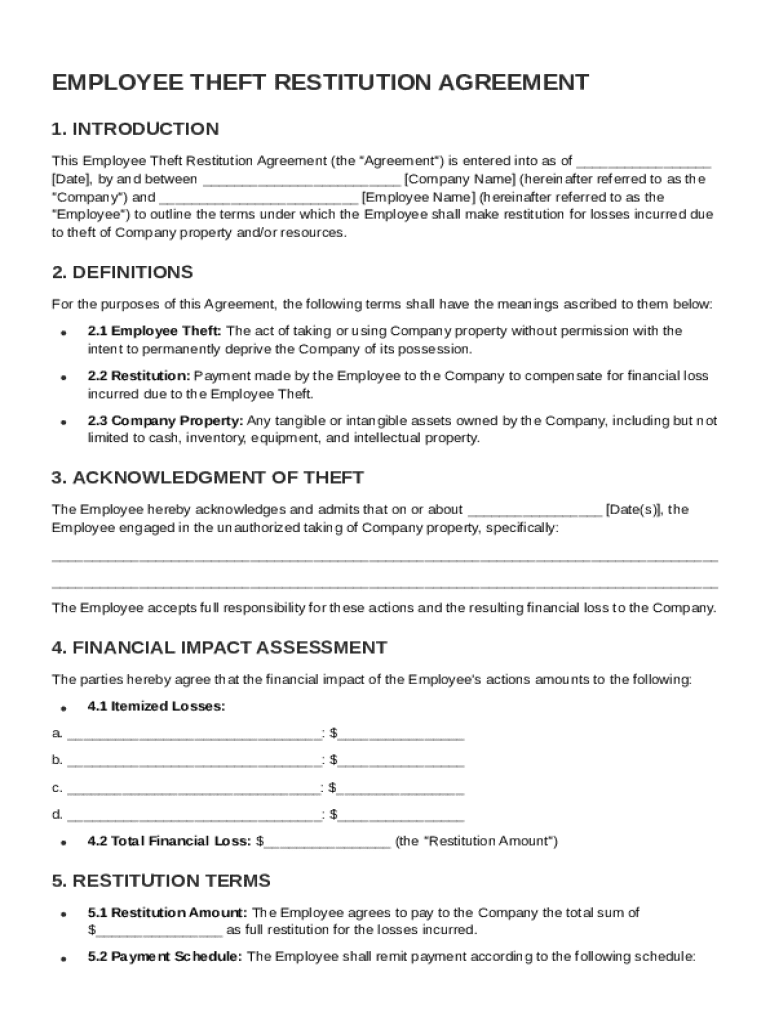







Definition & Meaning
The Employee Theft Restitution Agreement Template is a legal document designed to outline the terms and conditions under which an employee must compensate their employer for losses resulting from theft. This document serves as a formal acknowledgment of the theft by the employee and provides a structured approach to making restitution. Typically, it includes clear definitions of employee theft and restitution, ensuring that both parties have a mutual understanding of the terms involved. The agreement is essential for employers who need a formal record of the incident and the agreed-upon method of recovering assets or cash lost due to theft.
Key Components
- Definitions: Includes clear descriptions of terms like "employee theft" and "restitution" to avoid ambiguity.
- Acknowledgment: Requires the employee to formally acknowledge the theft and accept responsibility.
- Restitution Terms: Specifics regarding the amount to be repaid, how it was calculated, and the repayment schedule.
Steps to Complete the Employee Theft Restitution Agreement Template
Completing the Employee Theft Restitution Agreement Template involves several important steps to ensure all necessary information is recorded and both parties are in agreement.
- Review the Incident: The employer should first review the incident to assess the full extent of the loss.
- Consult Legal Counsel: Before drafting the agreement, consultation with legal counsel is recommended to ensure compliance with local laws.
- Draft the Agreement: Use the template to draft the agreement, including all relevant sections such as definitions, payment terms, and legal considerations.
- Employee Review: Allow the employee to review the draft agreement, ensuring they understand their obligations and rights.
- Negotiate Terms: If necessary, negotiate terms with the employee, such as repayment schedules or reductions in owed amounts.
- Finalize and Sign: Both parties should sign the agreement, with copies provided to each.
Detailed Sections
- Incident Review: A detailed analysis of what occurred and the resulting financial impact.
- Legal Consultation: Steps to ensure that the agreement complies with state and federal laws.
- Employee Consent: Ensuring that the employee willingly agrees to the terms.
Legal Use of the Employee Theft Restitution Agreement Template
The legal use of this template ensures that the restitution process is handled within the framework of the law, protecting both the employer and the employee.
State-Specific Considerations
- Compliance: The agreement must comply with state-specific employment and contractual laws.
- Enforceability: Ensures that the agreement can be enforced in a court of law if necessary.
- Governing Law: Clearly identifies which state’s laws will govern the interpretation and enforcement of the agreement.
Potential Legal Challenges
- Employee Rights: Ensures that the agreement respects the employee’s rights and is not coercive.
- Validity of Terms: All terms must be clear, fair, and legally valid to prevent future disputes.
Key Elements of the Employee Theft Restitution Agreement Template
This section highlights the crucial elements that must be included in an effective Employee Theft Restitution Agreement Template.
Core Elements
- Financial Assessment: Accurately calculate the financial losses incurred due to theft.
- Payment Terms: Define the amount, schedule, and method of restitution.
- Employment Status: Stipulate any changes to the employee’s status during and after restitution.
- Confidentiality Clause: A section that maintains privacy of details regarding the incident.
- Waiver of Claims: A clause that releases the employee from further claims upon fulfillment of the agreement.
Detailed Examples
- Repayment Plan: Structured over time or a lump sum repayment.
- Employment Termination: Clause detailing whether employment continues post-agreement.
- Legal Binding Language: Ensures agreement is enforceable.
Important Terms Related to Employee Theft Restitution Agreement Template
Understanding legal and contractual terminology is crucial for both parties involved in the agreement.
Defined Terms
- Employee Theft: The act of stealing or misappropriating company property or assets.
- Restitution: Compensation paid by the employee to the employer to cover losses from theft.
- Indemnity: Protection against potential legal liabilities arising from the incident.
Practical Context
- Use of Terms in Agreement: Detailed definitions help prevent misinterpretation.
- Clarity in Language: Legal terms are explained in layman's terms for clarity.
State-Specific Rules for the Employee Theft Restitution Agreement Template
Different states may have specific rules and requirements when creating and enforcing restitution agreements.
State Variations
- Employment Law Differences: Variations in employment law that may affect the terms of restitution.
- Statutory Limits: Some states may have limits on deductions from wages for restitution.
- Applicable Local Laws: Important to ensure that restitution terms conform to applicable local statutes and regulations.
Examples of Differences
- Wage Deductions: Legal considerations in states where wage garnishment laws differ.
- Notarization Requirements: Some states require agreements to be notarized for them to be valid.
Examples of Using the Employee Theft Restitution Agreement Template
Real-world scenarios and examples can illustrate the practical use of the template.
Case Studies
- Small Business Scenario: A small retail business implementing the agreement after discovering an employee had stolen merchandise.
- Corporate Scenario: A large corporation using the agreement as part of its formal disciplinary procedures following theft.
- Non-Monetary Compensation: Instances where services in lieu of monetary repayment was negotiated.
Benefits Highlighted
- Resolution Efficiency: Speedy and amicable resolution of theft issues.
- Clarity and Documentation: Provides clear documentation of agreements and expectations.
Digital vs. Paper Version
In today’s digital age, the choice between digital and paper versions can impact ease of use and accessibility.
Advantages of Digital Versions
- Ease of Access: Can be distributed and signed electronically, saving time.
- Security Features: Digital storage includes encryption and password protection.
- Integration with Platforms: Compatibility with document management systems like DocHub for editing and signing.
Paper Version Benefits
- Traditional Approach: Some prefer physical documents for their aesthetic or formal nature.
- No Tech Dependency: No reliance on digital platforms for storage or retrieval.
Making the Choice
- Consideration Factors: Level of tech savviness, current document management setup, and legal requirements for format recognition.




