
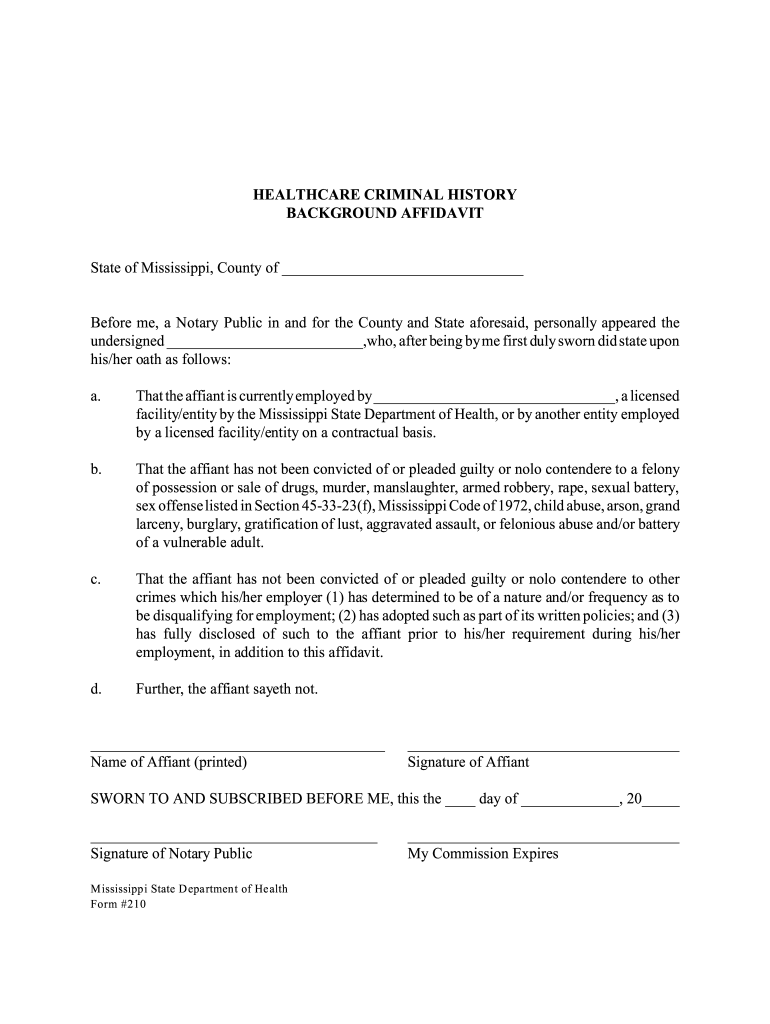







Overview of the Healthcare Criminal History Background Affidavit
The Healthcare Criminal History Background Affidavit in Mississippi requires individuals employed by licensed healthcare facilities to affirm their criminal history. This affidavit is essential for ensuring that employees do not have disqualifying felony convictions, which could pose a risk to patient safety. The affidavit's legal implications emphasize the importance of compliance with state guidelines.
Required Information for the Affidavit
The affidavit requires specific information to be disclosed, including:
- Full name and address of the affiant.
- A declaration of whether the individual has been convicted of certain disqualifying offenses.
- Disclosure by the employer regarding any relevant criminal history of the affiant.
- Notarization details to validate the document.
This information is crucial for maintaining high standards in healthcare environments and ensuring that only qualified individuals have access to vulnerable populations.
Notarization Requirement
To bolster the document's credibility, notarization is a mandatory step in the process. The notarization process involves:
- The affiant presents valid identification to the notary.
- The affiant signs the affidavit in the presence of the notary, who then affixes their seal to the document.
- The signed and notarized affidavit is submitted to the appropriate healthcare facility.
This requirement not only reinforces the legal weight of the affidavit but also acts as a safeguard against fraudulent claims.
Submission Process
Once completed, the Healthcare Criminal History Background Affidavit must be submitted to the employing licensed facility. The submission process typically includes:
- Providing the original notarized affidavit.
- Including any additional documents requested by the employer, such as identification or prior background checks.
- Ensuring the submission adheres to the facility’s guidelines for documentation.
Employers are responsible for reviewing these affidavits to assess the suitability of employees within the healthcare environment.
Related Documentation and Background Checks
In conjunction with the affidavit, the Mississippi Department of Health may require further background checks. These often involve:
- Criminal history background checks conducted by the Mississippi Department of Health (MDH).
- The issuance of a suitability letter from MDH, which confirms whether an individual meets the criteria for employment in a healthcare setting.
- Specific documentation required for the Safer Mississippi Background Check, which may include fingerprinting.
Employers should stay informed about the latest requirements from MDH to ensure thorough compliance.
Implications of Non-Compliance
Failure to provide accurate information or complete the affidavit process can result in significant repercussions for both the employee and employer. Potential implications include:
- Ineligibility for employment in licensed healthcare facilities.
- Legal action against the individual for providing false information.
- Revocation of licensure for employers who fail to comply with state regulations.
Adhering to all guidelines and accurately reflecting one’s background is critical to safeguarding against these serious outcomes.
State-Specific Regulations and Considerations
Each state, including Mississippi, has unique regulations governing healthcare criminal history disclosures. Important points include:
- Specific criteria defining disqualifying offenses, which may vary by state.
- Variations in the application or submission processes across different healthcare facilities.
- Local variations in statutes concerning confidentiality and the handling of criminal records.
Understanding these distinctions is essential for both employees and employers to navigate the complex regulatory landscape of healthcare employment.
Conclusion
The Healthcare Criminal History Background Affidavit is a crucial document for individuals seeking employment in Mississippi’s healthcare sector. It ensures compliance with state regulations and helps maintain safety and integrity within healthcare facilities. By thoroughly understanding the requirements and implications of this affidavit, both employees and employers can better navigate the employment process in the healthcare field.




