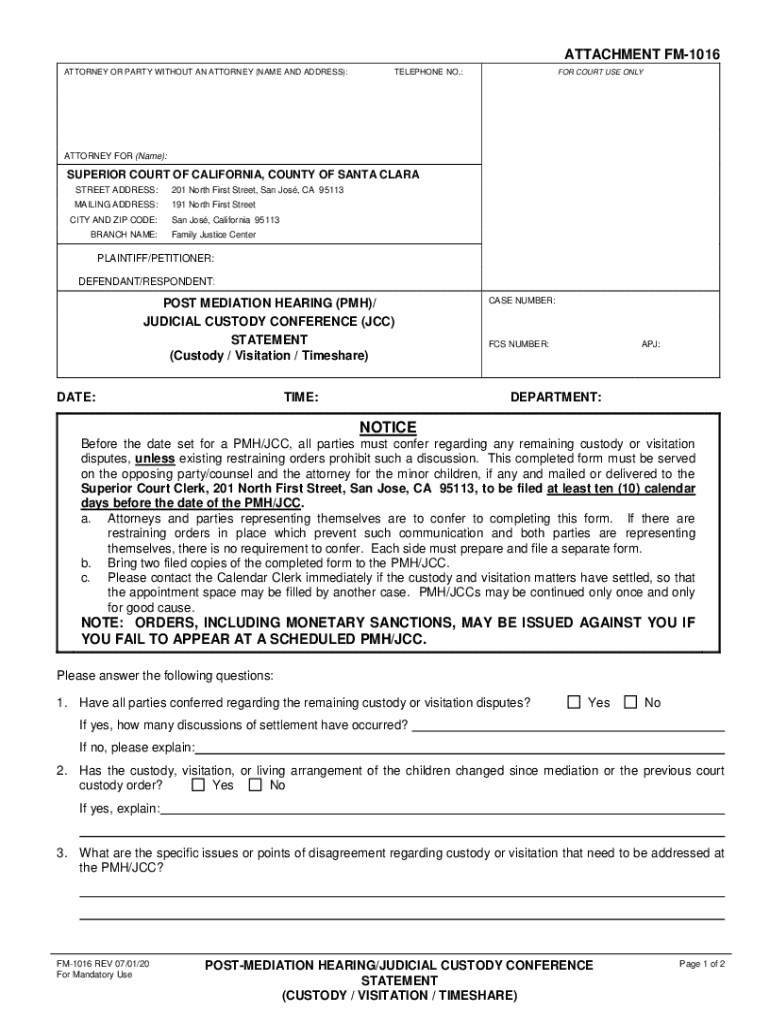







Definition and Purpose of Attachment Fm-1016
Attachment Fm-1016 is a legal form associated with the Superior Court of California, specifically within the County of Santa Clara. This document serves as an ancillary attachment to primary forms related to custody or visitation disputes, including the Post Mediation Hearing (PMH) or Judicial Custody Conference (JCC). The purpose of this attachment is to provide the court with detailed information regarding changes in custody arrangements and to document the discussions held during mediation.
Primary Functionality
- Mediation Summary: The form captures key elements discussed during mediation, ensuring all insights are documented.
- Custody Details: Outlines any changes to custody agreements that parties have tentatively agreed upon.
- Dispute Documentation: Records questions and disputes that may have arisen since previous court orders.
How to Obtain the Attachment Fm-1016
The form is typically distributed by the local family court in California. You may obtain a copy in the following ways:
- Court Visit: It can be picked up directly at the family court where your case is being heard.
- Court’s Website: Many California courts offer downloadable PDF versions on their official websites for convenience.
- Legal Counsel: Attorneys working on custody or visitation cases can provide this form to clients as part of case preparation.
Steps to Complete the Attachment Fm-1016
Filing Attachment Fm-1016 requires careful attention to detail to ensure accurate representation of all parties' agreements and disputes. Here's how:
- Gather Necessary Information: Collect details regarding current custody arrangements and any proposed modifications.
- Engage All Parties: Ensure that both parties or their legal representatives have contributed to the information being provided.
- Answer Mandatory Questions: Respond comprehensively to the questions detailed on the form regarding ongoing disputes, completed programs, and interventions.
- Review Compliance: Double-check for accuracy and alignment with any court directives.
Key Preparation Tips
- Advance Filing: Ensure the form is submitted at least ten days before the hearing.
- Consult Legal Advice: If unsure about responses, it's advisable to consult your attorney to avoid discrepancies.
Key Elements of the Attachment Fm-1016
Several vital components need to be filled out precisely on the form:
- Section A: Identify Parties: Includes names and roles of all parties involved in the mediation or custody conference.
- Section B: Custody Arrangement Proposal: Details any proposed changes in custody schedules or responsibilities.
- Section C: Dispute Chronology: Accurate recording of disputes or changes in parental conditions since the last court order.
- Section D: Program Completion: Lists any required parent programs completed by either party.
Who Typically Uses the Attachment Fm-1016
This form is predominantly used by individuals involved in custody or visitation disputes within the Superior Court of California:


Common Users
- Parents: Individuals seeking to modify existing custody arrangements.
- Legal Representatives: Attorneys who assist clients in custody and visitation mediation.
- Court Mediators: Professionals facilitating mediation sessions and needing official documentation.

Filing Deadlines and Important Dates
Adhering to specific deadlines is crucial in legal processes:
- Submission Deadline: Must be filed with the court at least ten days before the scheduled hearing or judicial conference.
- Court Notification: Ensure any changes or corrections to the form are communicated promptly to the court or opposing parties.
Required Documents for Attachment Fm-1016
Completing this form may require additional documentation:
- Current Custody Orders: Provides context and reference for proposed changes.
- Mediation Reports: Detailed records from prior mediation sessions.
- Parenting Plans: Existing outlines of schedules, responsibilities, and expectations related to the child's welfare.
State-Specific Rules for the Attachment Fm-1016
While the form is guided by California state law, there can be regional nuances to address:
- Santa Clara County Guidelines: Specific procedures and requirements unique to the Family Court of Santa Clara.
- Compliance with California Family Code: Ensure that all provided information adheres to state family code standards.
Examples of Using the Attachment Fm-1016
Practically, this form plays a crucial role in several scenarios:
- Case Study: Joint Custody Dispute: A parent seeking modifications to a shared custody agreement can document proposed changes and mediators’ notes.
- Example: Post-Mediation Review: After a successful mediation, the form records agreed-upon adjustments for court approval.
This comprehensive exploration into the Attachment Fm-1016 provides a detailed understanding of its function, acquisition process, filing requirements, and the crucial role it plays in the context of California's legal proceedings related to custody and visitation disputes.