






Definition & Meaning
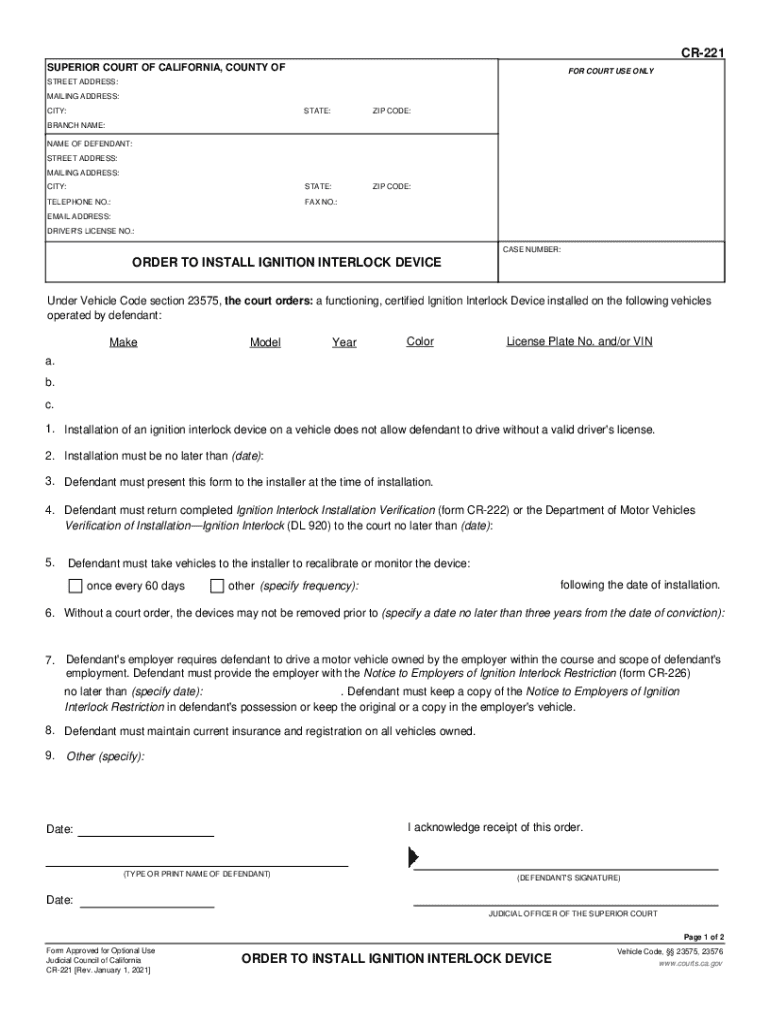
The CR-221 is a legal document issued by the Superior Court of California that mandates the installation of a certified Ignition Interlock Device (IID) in vehicles operated by a defendant. This form is crucial for monitoring compliance with Vehicle Code section 23575, which aims to enhance road safety by ensuring that individuals convicted of certain offenses cannot operate a vehicle unless it has an IID installed. By understanding the purpose and requirements outlined in the CR-221, defendants and legal practitioners can better navigate the obligations imposed by the court and ensure adherence to the legal framework governing IID installation.
How to Use the CR-221
Using the CR-221 involves understanding its specific directives, which include the installation, maintenance, and proof of compliance concerning the Ignition Interlock Device. The form outlines key steps such as selecting an approved provider for the IID installation, adhering to regular maintenance schedules to ensure the device remains functional, and providing timely documentation to the court as evidence of compliance. Additionally, the CR-221 serves as a guide for understanding the repercussions of failing to comply with the installation requirements, which can include legal penalties and extended IID mandates. This document is essential in guiding defendants through their obligations and ensuring the successful completion of court-ordered actions.
Steps to Complete the CR-221
Completing the CR-221 requires careful attention to detail and an understanding of the procedural steps involved:
- Understand the Order: Review the form thoroughly to comprehend what is being mandated.
- Select an Approved IID Provider: Choose a provider certified by the state to ensure compliance with regulatory standards.
- Schedule Installation: Arrange for the IID to be installed on all vehicles you operate, according to the timeline specified in the order.
- Maintain the Device: Follow the maintenance schedule to ensure the IID is functioning correctly.
- Submit Proof: Provide the court with proof of installation and regular maintenance, usually through a certificate from the service provider.
- Monitor Deadlines: Be aware of and adhere to deadlines laid out in the order for each of these steps.
- Address Violations: Understand the protocol if any violations occur and promptly handle them to avoid penalties.
Important Terms Related to CR-221
Several critical terms are associated with the CR-221 that are crucial for comprehending and fulfilling the form's requirements:
- Ignition Interlock Device (IID): A breathalyzer for a vehicle that requires the driver to blow into it before the engine will start.
- Compliance: Adhering to the specific legal mandates outlined in the CR-221, including installation and maintenance of the IID.
- Defendant: The individual ordered by the court to comply with the CR-221.
- Vehicle Code section 23575: The legal code specifying conditions under which an IID is required.
- Proof of Installation/Compliance: Documentation confirming that the IID has been installed and maintained per court orders.
Legal Use of the CR-221
The CR-221 is legally binding and governs the installation of an IID under the jurisdiction of California’s legal system. Its primary function is to enforce safe driving practices by reducing the likelihood of repeat offenses related to impaired driving. The legal implications of the CR-221 include a mandatory IID installation period, monitoring of compliance, and potential penalties for violations, such as fines or additional legal action. This legal provision aids in maintaining public safety by ensuring only those who meet safety requirements can operate a vehicle.
State-Specific Rules for the CR-221
While the CR-221 is specific to California, similar forms exist in other states with variations in their requirements and enforcement. It's critical to understand the state-specific rules that apply, such as the duration of mandatory IID installation and the list of approved service providers for installation and maintenance. California law outlines specific guidelines for compliance, ensuring that defendants are aware of their requirements under the state’s legal system. Variation in these rules between states necessitates a thorough understanding of local laws to ensure adherence and avoid legal repercussions.
Penalties for Non-Compliance
Non-compliance with the CR-221 can lead to significant penalties. These include:
- Fines: Monetary penalties imposed by the court for failing to install or maintain the IID.
- Extended IID Period: Additional time that the IID is required if deadlines are missed or compliance is not shown.
- Legal Action: Further legal consequences, such as additional charges or revocation of driving privileges. Understanding these consequences is crucial for defendants, ensuring they remain compliant and avoid further legal challenges.
Form Submission Methods (Online / Mail / In-Person)
Submissions for proof of compliance with the CR-221 can be accomplished through several methods:
- Online: Many jurisdictions allow digital submission of documents via email or court websites, streamlining the process.
- Mail: Physical copies of the form and evidence of compliance can be mailed to the relevant court addresses.
- In-Person: Defendants may be required to submit documents in person at a court office, providing an opportunity for verification or addressing any immediate concerns.
Each method ensures that proof of compliance reaches the appropriate legal authorities, affirming adherence to the CR-221 and avoiding penalties.