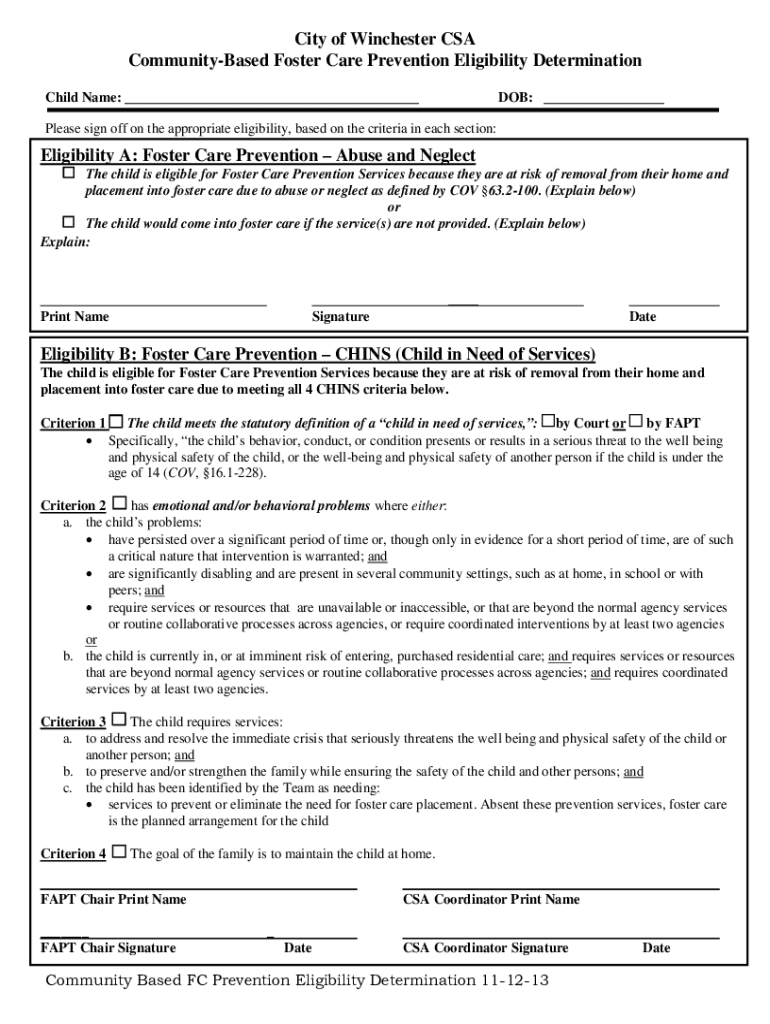







Definition and Purpose of the City of Winchester Children's Services Act Policy
The City of Winchester Children's Services Act (CSA) Policy is an essential framework designed to support and improve the welfare of children and families within Winchester. It primarily focuses on providing preventive services to at-risk children and those in need of services. The CSA Policy outlines the guidelines for eligibility, types of services provided, and the procedures for accessing support. It serves as a legal and operational guide for social workers, counselors, and other service providers in delivering comprehensive child welfare services.
Key Objectives
- Prevention of Family Disruption: Aims to provide services that prevent conditions leading to the removal of children from their homes.
- Support for Children in Need: Focuses on children identified as 'Children in Need of Services' (CHINS) due to behavioral or emotional issues.
- Improvement of Service Delivery: Enhances the quality and efficiency of services provided to eligible families.
Application in Practice
Services under the CSA are designed to be integrated into existing social service frameworks, allowing professionals to use the policy as a tool for assessing and responding to cases effectively.
Steps to Complete the City of Winchester Children's Services Act Policy
Completing the CSA Policy involves several critical steps that ensure compliance and efficiency in service delivery.
-
Eligibility Assessment: Determine if the child meets the criteria for services based on risk factors such as abuse, neglect, or CHINS designation.
-
Documentation Gathering: Collect necessary documents and evidence that support the eligibility and need for services. This may include court orders, psychological evaluations, or school reports.
-
Service Planning: Develop a service plan tailored to the child's needs, detailing the types of support required. This step requires collaboration between the service provider, the family, and other stakeholders.
-
Signing and Authorization: Obtain necessary signatures from authorized personnel, which could include the agency's director or a designated signing authority, to confirm the eligibility and approval of services.
-
Ongoing Review and Adjustment: Regularly review the service plan and adjust as necessary to ensure the needs of the child and family are continually met.
Considerations
- Ensure all forms are signed by appropriate authorities to avoid delays.
- Regular monitoring and review are vital to adapt services to changing needs.
Eligibility Criteria and Legal Considerations
To receive services under the CSA Policy, specific eligibility criteria must be met, focusing on children at risk and those needing specialized support.


Criteria Overview
- At Risk of Removal: Children who are likely to be removed from their homes due to abuse or neglect.
- CHINS Designation: Children exhibiting severe behavioral or emotional issues requiring structured intervention.
Legal Framework
- The policy operates under state and federal laws ensuring that all procedures adhere to legal standards. It requires compliance with local statutes concerning child welfare services.
Common Scenarios
- Children experiencing domestic violence at home.
- Those with significant academic or behavioral challenges threatening their academic placement.
Important Terms Related to the Policy
Understanding the terminology within the CSA Policy is crucial for all stakeholders involved.
Key Definitions
-
Community-Based Services: Programs aimed at preventing family disruption by addressing issues within the community before necessitating more severe interventions.
-
Case Manager: A designated professional responsible for coordinating the services outlined in the service plan.
Usage and Context
- Professionals should regularly update their knowledge of terms as changes in law or policy could alter definitions and uses.
Required Documents for Policy Implementation
Accurate and complete documentation is foundational for the proper execution of the CSA Policy.
Essential Documents
-
Eligibility Certification: Verification from professionals indicating that a child meets the necessary criteria for service.
-
Service Plan: A detailed plan of the services to be provided, the expected outcomes, and the timeline for service delivery.
-
Signature Page: Accumulation of all required signatures from authorized parties approving the service plan and its execution.
Submission Guidelines
- Ensure all documents are consistently formatted and presented to facilitate quick review and approval.
Who Typically Uses the City of Winchester Children's Services Act Policy
The CSA Policy serves various professionals within the child welfare system.

Primary Users
- Social Workers and Counselors: Utilize the policy to assess eligibility and deliver services.
- Legal Professionals: Use it as a framework for legal proceedings involving child welfare.
- Healthcare Providers: May be involved when addressing the medical needs outlined in a service plan.
Role Expectations
- Each professional's role involves a unique set of responsibilities, from conducting in-depth assessments to ensuring ongoing communication among service providers.
Examples of Using the City of Winchester Children's Services Act Policy
Case studies and practical examples highlight the policy's application in real-world scenarios.
Illustrative Scenarios
- Family Reunification: A case where structured in-home support was provided to facilitate the safe return of a child previously removed due to neglect.
- Behavioral Interventions: Implementation of counseling services for a child with behavioral issues threatening school expulsion, successfully preventing the need for more drastic measures.
Benefits Observed
- Successful deferral of potential foster care placements.
- Improved behavioral outcomes through targeted intervention strategies.
Application Process and Approval Time
Understanding the application and approval timeline is vital for effective planning and execution of services.
Process Overview
- Initial Consultation: Conduct a preliminary meeting to understand the child's needs and the context of the request.
- Formal Application: Complete and submit the application with all required supporting documents to the local CSA office.
Approval Timeframe
- Approval typically takes several weeks depending on the complexity of the case and the speed of obtaining necessary documentation and signatures.
Factors Affecting Timelines
- Delays can occur if documentation is incomplete or if there are resource constraints within the agency handling the applications.
State-specific Rules for the City of Winchester Children's Services Act Policy
While the CSA Policy is guided by overarching state regulations, there can be important state-specific nuances that affect its application in different jurisdictions.
Virginia-Specific Guidelines
- Virginia mandates specific reporting requirements that influence how services are documented and delivered under the CSA Policy.
- Regional differences in available services can impact how the policy is applied, making it critical to understand local variants.
Adaptation to Local Contexts
- Agencies must tailor policy application to the unique demographics and resources of each locality to maximize effectiveness and compliance.
Key Elements of the City of Winchester Children's Services Act Policy
Several central elements constitute the policy's backbone, guiding its execution and ensuring its efficacy.
Core Components
- Family-Centered Approach: Strategies emphasize family involvement in service planning and implementation.
- Individualized Service Planning: Development of customized plans that address the unique needs and circumstances of each child and family.
- Interagency Collaboration: Essential for resource sharing and ensuring comprehensive service delivery to meet the complex needs of children and families.
Implementation Challenges
- Balancing policy guidelines with practical limitations such as funding and resource availability requires ongoing assessment and adjustment.