




01. Edit your form online
Type text, add images, blackout confidential details, add comments, highlights and more.

Type text, add images, blackout confidential details, add comments, highlights and more.

Draw your signature, type it, upload its image, or use your mobile device as a signature pad.

Send it via email, link, or fax. You can also download it, export it or print it out.
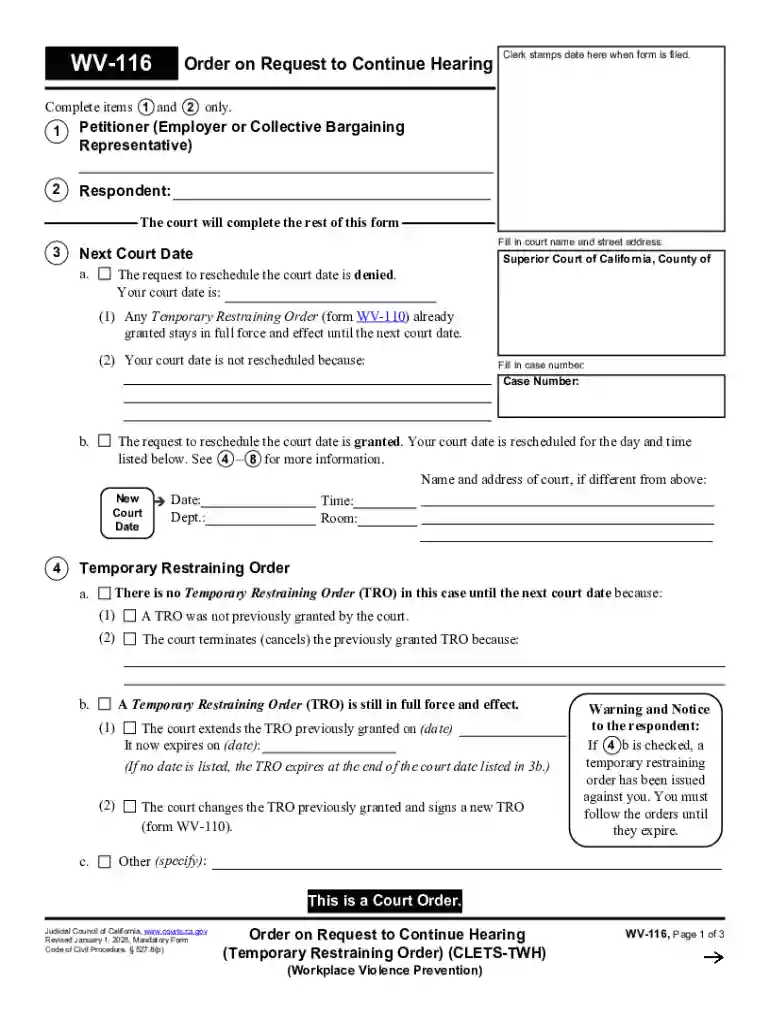
The WV-116 is a legal document specifically designed for use in workplace violence prevention cases. It acts as a court order that enables parties to request the continuation of a hearing regarding a Temporary Restraining Order (TRO). This form outlines the specific conditions under which a hearing date may be rescheduled, providing crucial information on existing TROs and detailing the procedure for serving the order to involved parties. The form includes essential provisions to accommodate individuals with disabilities, ensuring it is accessible to all users.
Using the WV-116 form requires a thorough understanding of its sections to ensure proper completion. To begin, users must fill in their personal information and details pertinent to the case. Following this, the form should detail the circumstances under which a TRO continuation is being requested. It is crucial to ensure all requested information is accurate and complete; omissions can lead to processing delays. Provide a clear explanation of your reason(s) for requesting a continuance. Finally, submit the form to the appropriate court, adhering strictly to defined procedures.
Completing the WV-116 form involves several precise steps:
Understanding the key elements of the WV-116 is critical for its correct application. The form comprises several sections:
Legally, the WV-116 serves as an official court document within workplace violence prevention contexts. It ensures due process by allowing involved parties adequate time to prepare for hearings or comply with court obligations. Failure to submit WV-116 in accordance with legal standards can result in the denial of the continuance request. The form is a vital part of maintaining the integrity and fairness of workplace violence proceedings.
The WV-116 is primarily used by legal professionals, including attorneys representing clients in workplace violence cases, as well as individuals who are involved in such cases. These may include employees, employers, or anyone directly affected by the circumstances outlined in a workplace Temporary Restraining Order. The form is crucial for those seeking extensions in court proceedings due to scheduling conflicts or insufficient preparation time.


State-specific rules may govern how the WV-116 is used and processed. Different states might have varying filing deadlines, submission methods, and requirements for the form's completion. It is essential for applicants to be familiar with the specific rules applicable in their jurisdiction. This ensures compliance with local laws and the court's procedural requirements, which can differ significantly from one region to another.
Understanding real-world applications of the WV-116 can enhance comprehension:
Each scenario underscores the form's utility in managing workplace violence legal proceedings effectively.
We've got more versions of the Wv-116 form. Select the right Wv-116 version from the list and start editing it straight away!
At DocHub, your data security is our priority. We follow HIPAA, SOC2, GDPR, and other standards, so you can work on your documents with confidence.




2.1. To apply for financing through the Authority, a hospital must provide the Authority the following items: (a) A letter of intent that (1) briefly summarizes
Jan 1, 2026 (1) Any Temporary Restraining Order (form WV-110) already granted stays in full force and effect until the next court date. (2) Your court dateRead more


