




01. Edit your form online
Type text, add images, blackout confidential details, add comments, highlights and more.

Type text, add images, blackout confidential details, add comments, highlights and more.

Draw your signature, type it, upload its image, or use your mobile device as a signature pad.

Send it via email, link, or fax. You can also download it, export it or print it out.
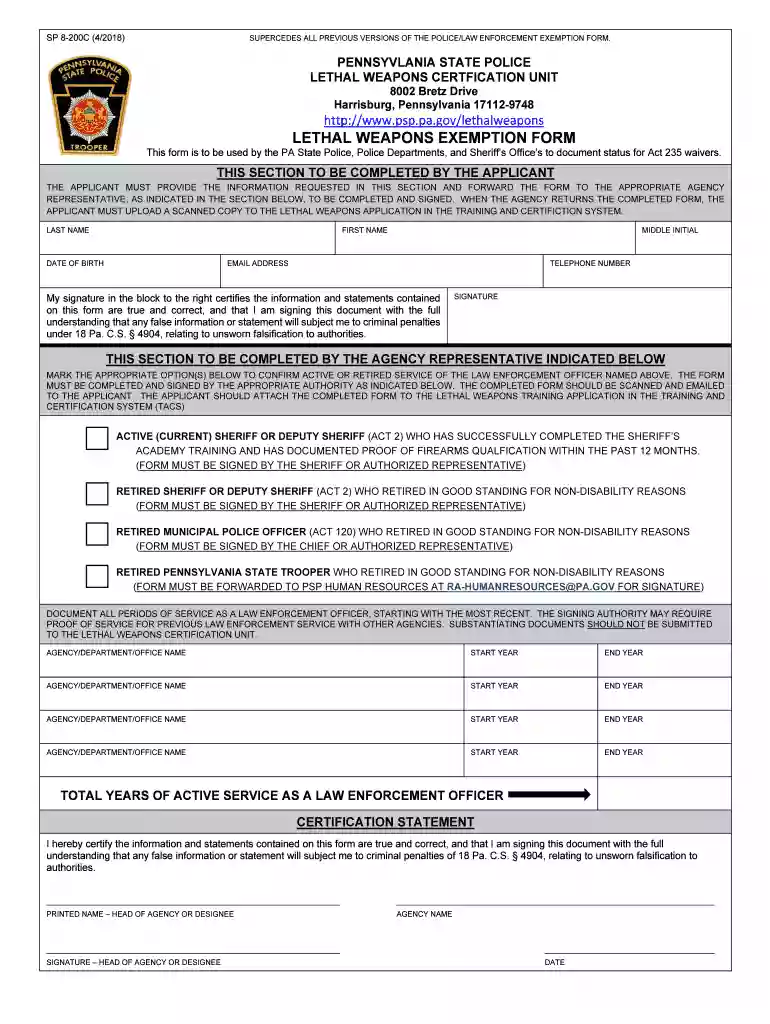
The "Initial Application for Certification - Pennsylvania State Police" serves as an official document used by individuals seeking certification by the Pennsylvania State Police (PSP). The form is typically utilized by personnel aiming to comply with specific state regulations or to qualify for roles necessitating PSP certification. This form is essential for providing standardized information on applicants, which is used in evaluating their eligibility for certification related to law enforcement roles or other regulated positions within the state.
An example of the form in use includes new recruits in the Pennsylvania police force applying for initial certification as part of their onboarding process.
Completing the application requires careful attention to detail, ensuring thoroughness and accuracy.
Applicants with gaps in employment or atypical service histories may need to provide additional documentation or explanations.
Candidates intending to complete the "Initial Application for Certification - Pennsylvania State Police" must meet predetermined eligibility criteria, which are pivotal in determining their candidacy status.
Certain types of certifications might have additional requirements or exceptions, such as waivers for military veterans.


Understanding the terminology used in the application can aid applicants in properly completing the form.
Ensuring legal compliance in completing and submitting the form is crucial for certification approval.
Gaining access to the application form is the first step in the certification process.
Applicants can choose from several methods to submit their completed form.
The application and approval procedure involves several stages that determine the applicant's eligibility.
The application is commonly used by a range of individuals pursuing state certification.
Each applicant's specific context determines the relevance and necessity of utilizing the application form. Understanding these varied applications highlights the form's broad usability across different roles within the state's regulatory framework.

We've got more versions of the Initial Application for Certification - Pennsylvania State Police form. Select the right Initial Application for Certification - Pennsylvania State Police version from the list and start editing it straight away!
At DocHub, your data security is our priority. We follow HIPAA, SOC2, GDPR, and other standards, so you can work on your documents with confidence.


Mountaintop removal mining (MTR) is a form of surface mining increasingly being used to replace underground mining to extract coal from the Appalachian
In order to be certified, the applicant must pass a physical, psychological examination, and a criminal history check. Appropriate PSP application forms must beRead more
Step 1 - review eligibility 18 years of age or older Pass a physical examination by a medical doctor. Uncorrected vision of at least 20/70 in one eye and 20/Read more


