




01. Edit your form online
Type text, add images, blackout confidential details, add comments, highlights and more.

Type text, add images, blackout confidential details, add comments, highlights and more.

Draw your signature, type it, upload its image, or use your mobile device as a signature pad.

Send it via email, link, or fax. You can also download it, export it or print it out.
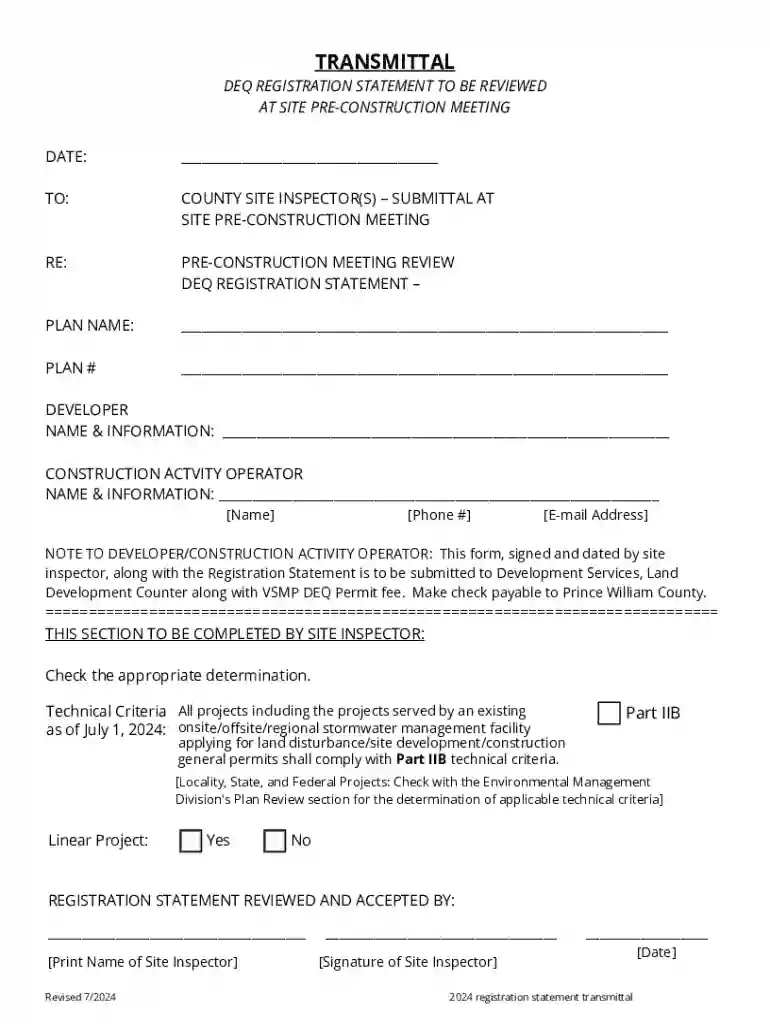
The "DEQ Registration Statement to Be Reviewed" is a crucial document used in the context of land disturbance and construction activities. It primarily serves as a transmittal form that must be assessed during a site pre-construction meeting. The purpose of this document is to collect and organize essential information about the developer and the construction activity operator. It also includes a checklist that a site inspector uses to verify adherence to technical criteria relevant to land disturbance and construction permits.
Securing the DEQ Registration Statement can be initiated through several pathways. It's essential to reach out to your state's Department of Environmental Quality (DEQ) office or visit their official website for detailed instructions and resources. They often provide downloadable forms directly from their site. Some states might also offer a physical mailing option or make forms available at local government offices. It's crucial to ensure that you are accessing the most current version of the form to comply with state-specific guidelines and updates.
Gather Required Information: Start by collecting pertinent details about the developer and construction activity operator. This includes basic identification information and detailed descriptions of the activities planned for the site.
Complete Developer and Operator Sections: Fill out these sections with precise and accurate information. Ensure that all contact information and descriptions reflect the latest project plans and personnel.
Checklist for Site Inspector: Go through the checklist that helps site inspectors verify compliance with technical criteria. This step involves reviewing requirements for land disturbance, waste management, and permit acquisitions.
Attach Necessary Documentation: Include any additional documentation that supports the registration statement. This could be maps, site plans, and any previously secured permits.
Review and Submit: Thoroughly review the completed form to ensure all information is accurate. Submission instructions will vary by state, but typically include options for online submission, mail, or in-person drop-off at a specific government office.
The DEQ Registration Statement is predominantly utilized by developers, construction managers, and land use operators engaged in projects that involve significant land disturbance. It is also frequently used by environmental consultants tasked with ensuring that a project complies with local environmental regulations and standards. Additionally, government inspectors and regulators analyze these documents to maintain oversight of construction activities within their jurisdictions.


While the core components of the DEQ Registration Statement are generally consistent, there can be state-specific variations that impact how the form should be completed and submitted. These variations may pertain to:
Adhering to specific filing deadlines is critical to avoid project delays. These deadlines ensure that environmental impacts are reviewed before construction begins. Typically, the DEQ or a similar state agency will publish official deadline dates, which are often mandatory for inclusion in pre-construction project plans. Missing these deadlines can result in fines or delays in project approvals.
Failing to submit the DEQ Registration Statement or submitting inaccurate information can lead to severe penalties. These may include fines, cessation of construction activities, or legal action. Ensuring compliance through accurate and timely submission is essential to avoid these repercussions. States may impose stricter penalties for projects that proceed without necessary review, emphasizing the importance of handling this form correctly.
Forms can be submitted through diverse channels depending on state infrastructure and resources:
We've got more versions of the DEQ REGISTRATION STATEMENT TO BE REVIEWED form. Select the right DEQ REGISTRATION STATEMENT TO BE REVIEWED version from the list and start editing it straight away!
| Versions | Form popularity | Fillable & printable |
|---|---|---|
| 2024 | 4.8 Satisfied (41 Votes) |
At DocHub, your data security is our priority. We follow HIPAA, SOC2, GDPR, and other standards, so you can work on your documents with confidence.


