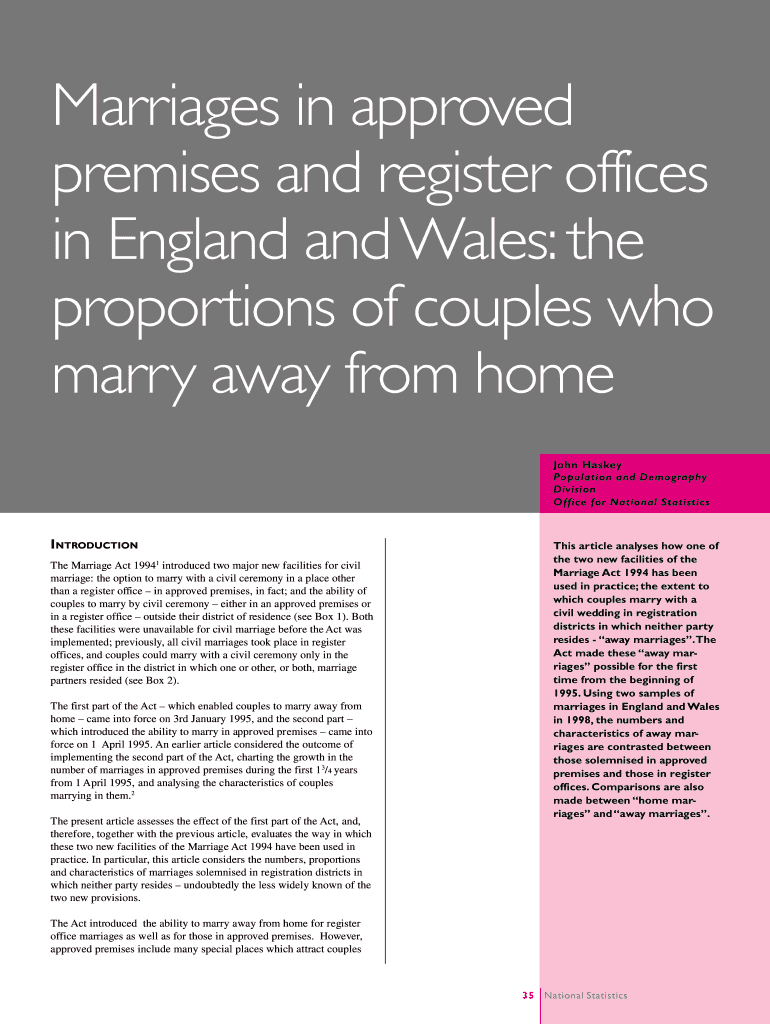







Definition and Meaning of "Population Trends - Marriages in Approved Premises and Register"
"Population Trends - Marriages in Approved Premises and Register" refers to the analysis of marital occurrences within specific venues that have received formal approval as well as traditional registry offices. This analysis may cover factors such as demographic characteristics, the frequency of marriages conducted outside residential districts, and shifting societal preferences towards marriage settings. The term helps identify emerging trends in matrimonial patterns, particularly how legal changes—such as those introduced by the Marriage Act 1994 in England and Wales—have influenced these trends.
Steps to Complete the Population Trends - Marriages in Approved Premises and Register
Completing the form for "Population Trends - Marriages in Approved Premises and Register" involves several systematic steps:
- Gather Necessary Information: Collect data on marriage demographics, including age, location, and venue type (approved premises vs. register office).
- Select the Relevant Category: Determine whether the marriage qualifies as an 'away marriage' or 'home marriage' and note any potential implications of this classification.
- Fill in Demographic Details: Include information about both parties, such as ages, residential addresses, and any other demographic markers relevant to population studies.
- Provide Venue-Specific Details: Record the type and location of the approved venue or register office where the marriage occurred.
- Review for Accuracy: Ensure that all data fields are correctly filled, particularly those involving legal identifiers and demographic notes.
Key Elements of the Population Trends - Marriages in Approved Premises and Register
The form includes critical components that should be thoroughly understood:
- Demographic Data: Captures age, residence, and potentially cultural background.
- Venue Information: Details whether the premises are officially approved and differentiates between register offices and other sanctioned venues.
- Marriage Classification: Identifies marriages either as 'away' or 'home' marriages based on where they are conducted relative to the couple's place of domicile.
- Legal Compliance: Assures adherence to legal requirements, including those set by the Marriage Act 1994.
Important Terms Related to Population Trends - Marriages in Approved Premises and Register
Understanding the terminology used in this context is crucial:
- Approved Premises: Venues that have met official criteria for hosting legal marriages outside traditional church or registry office settings.
- Away Marriage: A marriage that occurs in a location where neither of the parties resides.
- Population Trends: Statistical analyses revealing shifts in marital patterns over different time periods and locations.
Examples of Using the Population Trends - Marriages in Approved Premises and Register
Practical applications of this analysis include:
- Research Studies: Utilizing statistical data to analyze how recent changes in marriage laws affect societal behavior and preferences.
- Policy Development: Informing governmental bodies on emerging patterns to adapt marriage laws and venue approvals accordingly.
- Societal Studies: Contributing to academic research regarding changing cultural attitudes toward marriage settings.
State-Specific Rules for the Population Trends - Marriages in Approved Premises and Register
Although the Marriage Act 1994 applies primarily to England and Wales, states in the U.S. may have differing regulations and laws regarding marriage venues:
- Venue Approval: Each state may have specific criteria for what constitutes an officially approved marriage venue.
- Residency Requirements: Variability exists in whether parties need to marry within their state of residence or have the option to marry out-state.
Why You Should Understand the Population Trends - Marriages in Approved Premises and Register
Studying this form offers valuable insights:
- Predictive Analysis: Enables forecasting future trends in marriage settings and preferences.
- Cultural Understanding: Provides a lens into evolving social norms and legal influences in society.
- Policy Influence: Aids lawmakers and stakeholders in making informed decisions to accommodate new marital preferences.
Who Typically Uses the Population Trends - Marriages in Approved Premises and Register
The following groups may find this analysis particularly useful:
- Demographers: Those specializing in population studies and societal trends.
- Policy Makers: Individuals responsible for drafting and revising laws associated with marriage venues.
- Academic Researchers: Those exploring the effects of legislation on social behavior and cultural shifts.


Penalties for Non-Compliance Concerning Marriage Registration
Failure to comply with legal requirements associated with marriage registration could result in:
- Invalid Marriage Licenses: Without properly completed forms, marriages might not be legally recognized.
- Legal Repercussions: Couples may face fines or legal challenges if found to be married against state-specific rules.
- Impediments to Legal Rights: Lack of proper registration could affect property, tax, and other legal rights ordinarily accorded to married couples.
Required Documents for Submitting the Population Trends - Marriages in Approved Premises and Register
When preparing to complete and submit this form, ensure you have:
- Identification Records: Valid ID for each party involved in the marriage.
- Proof of Residence: Documentation confirming the residential status of both parties.
- Venue Approval Certification: Proof that your chosen marriage venue is officially sanctioned.