







Definition and Meaning
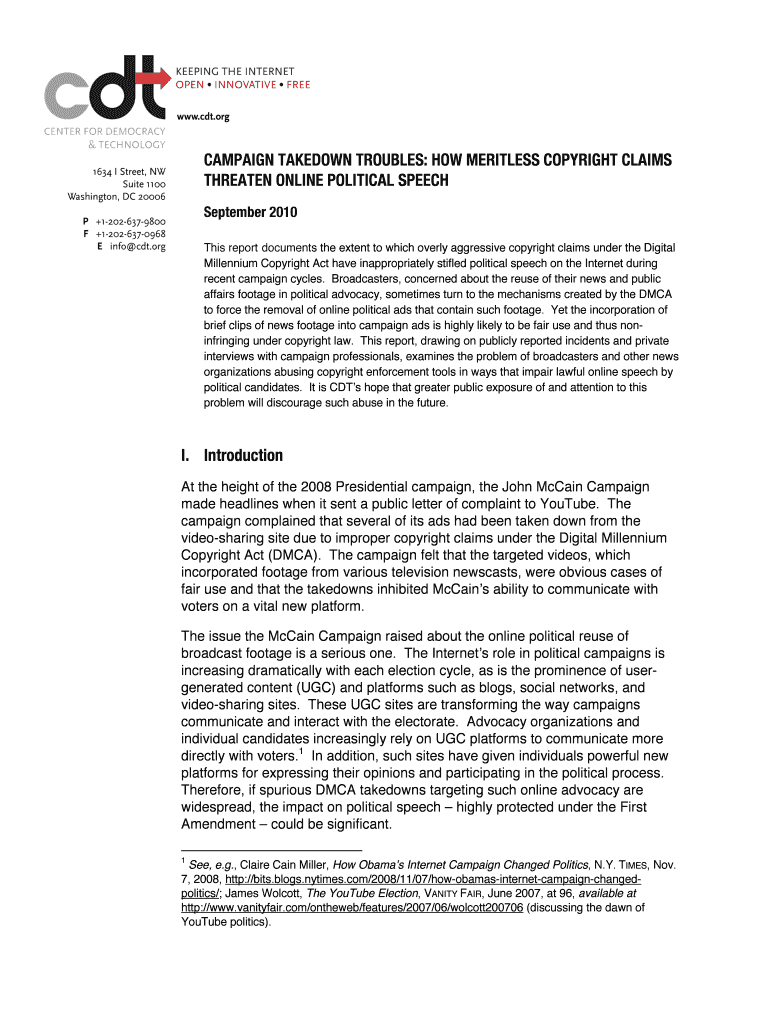
"Campaign Takedown Troubles: How Meritless Copyright Claims" refers to the challenges posed by unfounded copyright claims under the Digital Millennium Copyright Act (DMCA), specifically regarding political speech during election campaigns. These campaigns run the risk of being overshadowed and disrupted by broadcasters who issue takedown notices for political ads that reuse news footage. Although such uses often qualify as fair use, broadcasters sometimes act to protect their reputation rather than address genuine copyright infringement. Understanding this form involves recognizing the balance between copyright enforcement and protecting free speech in political campaigns.
Key Elements of the Form
The form's vital elements revolve around several aspects of copyright challenges:
-
Fair Use Doctrine: Central to the discussion is the fair use provision that often protects the use of news footage in political ads. This principle allows limited use of copyrighted material without permission under specific conditions.
-
Takedown Notices: These are issued when a copyright holder claims infringement. In political contexts, they can be weaponized to suppress speech.
-
Reputational Concerns: Beyond actual legal claims, broadcasters may issue takedown notices to avoid negative publicity or misinterpretation.
Exploring these elements reveals a nuanced dialogue between legal standards and the strategic use of copyright laws.
Examples of Using the Form
Real-world examples illustrate the form's implications:
-
During an election, a political ad may incorporate clips from a televised news segment. Even if covered under fair use, the broadcaster might issue a copyright takedown due to perceived damage to their reputation.
-
In another case, a political figure's campaign might use a news interview to highlight their platform. The broadcaster could claim a violation, despite the content being publicly available and relevant to public discourse.
These examples highlight the recurring tension between copyright claims and political expression rights.
Legal Use of the Form
Navigating this form legally involves understanding both copyright laws and exceptions:
-
DMCA Compliance: Political entities must tailor media use to align with DMCA stipulations without violating broadcaster rights.
-
Understanding Fair Use: Entities must work within this legal framework, employing content that meets the criteria for fair use when feasible.
Legal advice is often necessary to navigate these complex issues without overstepping legal boundaries.
Steps to Complete the Form
To complete and address issues with the form effectively:
-
Identify the Content: Determine if the content falls under potential DMCA action.
-
Assess Fair Use: Evaluate whether the content fulfills fair use criteria, including purpose, nature, amount used, and market effect.
-
Document Evidence: Maintain records to support fair use claims should a dispute arise.
-
Consult Legal Experts: Engage with legal professionals to formulate a robust strategy against unfounded claims.
Following these steps ensures a proactive approach to potentially meritless copyright claims.
Who Typically Uses the Form
The form is commonly used by:
-
Political Campaigns: Protecting campaign materials and ensuring the right to communicate political messages without undue censorship.
-
Legal Advocates: Organizations advocating for fair use and free speech often find themselves engaged in these discussions.
-
Broadcasters: Those issuing takedown notices aiming to protect proprietary content.
These groups form the ecosystem handling the balance and conflicts within copyright claims.

Important Terms Related to the Form
Understanding certain key terminologies is crucial:
-
DMCA: The Digital Millennium Copyright Act establishes the basis for digital copyright enforcement and associated challenges.
-
Takedown Notice: A formal request to remove allegedly infringing content.
-
Fair Use: A doctrine that permits limited use of copyrighted work without permission under specific conditions.
Familiarity with these terms aids in comprehending and addressing claims accurately.
State-Specific Rules
Though the DMCA operates under federal jurisdiction, state-specific considerations can influence how claims are addressed:
-
Local Jurisdictions: Variances might exist in how state courts interpret fair use in practice, affecting strategic responses.
-
State Regulations: Unique state laws might impact the severity and process of addressing takedown notices.
Examining these rules ensures thorough preparation for region-specific contingencies.
Penalties for Non-Compliance
Failure to adhere to DMCA regulations can result in several consequences:
-
Legal Action: Non-compliance might lead to lawsuits, financial penalties, or mandated removal of infringing content.
-
Public Backlash: Beyond legal penalties, reputational damage can occur if perceived as disregarding copyright laws intentionally.
Awareness of these penalties aids in weighing the risks of content use that might border on infringement.
Software Compatibility
To handle the form effectively, compatibility with tools like DocHub is beneficial:
-
Document Editing: Enables easy modification and annotation of reference documents or legal filings.
-
Form Management: Users can create and manage responses to legal notices efficiently with integrated digital solutions.
Leveraging software enhances management of copyright-related documentation and correspondence.
Business Entity Types
Different types of entities might engage with these issues:
-
Political Organizations: Often directly impacted by takedown notices, requiring strategic legal guidance.
-
Media Companies: May issue or defend against notices to protect or utilize content.
Understanding the structure and interests of these entities guides appropriate strategic responses.




