






Definition and Meaning
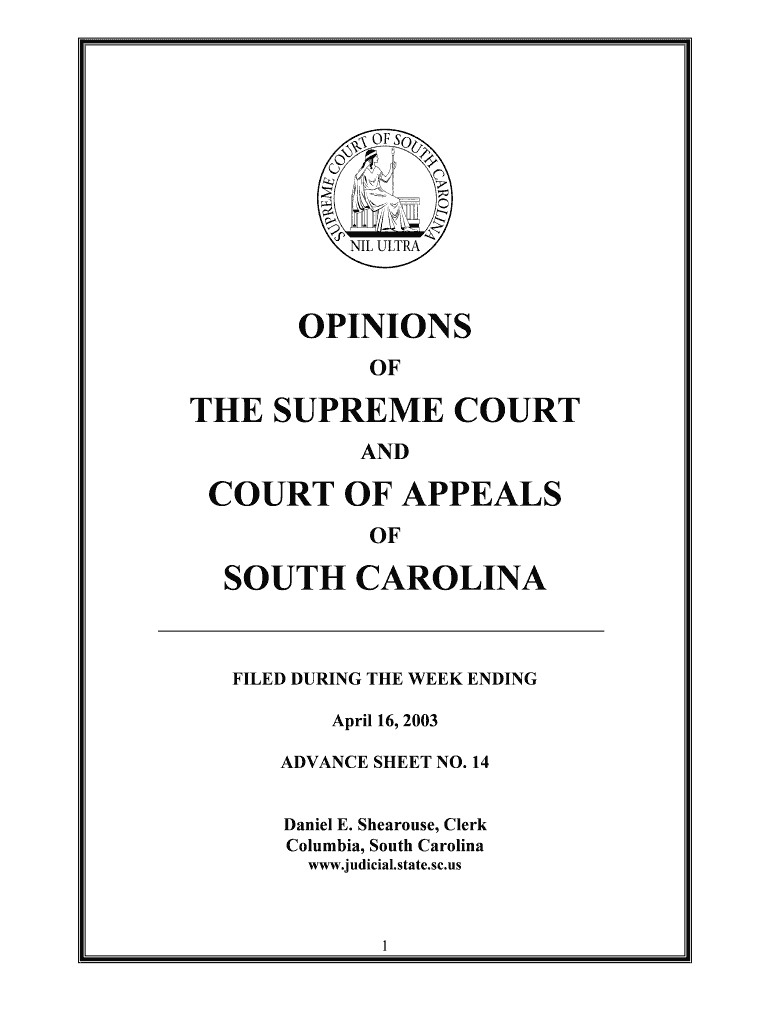
The "Opinions - South Carolina Judicial Department - judicial state sc" form encompasses a collection of legal opinions rendered by the Supreme Court and Court of Appeals of South Carolina. These opinions provide authoritative interpretations on a range of legal issues pertinent to cases within the jurisdiction of South Carolina. The document serves as a primary reference for legal professionals when analyzing case law and understanding how specific legal principles have been applied or interpreted in the state. It includes detailed summaries that highlight the context, legal arguments, and decisions of various noteworthy cases.
How to Use the Form
Legal practitioners and judicial analysts typically use these opinions as a resource for comparative legal studies, case preparation, and understanding precedent. To effectively utilize the document:
- Identify relevant case summaries that align with the legal issue at hand.
- Review the legal principles applied in these cases to assess their applicability to the current situation.
- Integrate findings into legal strategies or arguments in a court of law.
By consulting these opinions, users can gain insights into how South Carolina courts may approach similar cases, thereby enhancing their legal strategies.
How to Obtain the Form
The South Carolina Judicial Department publishes these opinions online, accessible to the public through their official website. Users can:
- Visit the South Carolina Judicial Department's online portal.
- Navigate to the section dedicated to court opinions.
- Search for specific cases or browse through the weekly updates for the latest opinions.
For individuals or organizations requiring physical copies, requests can be submitted to the court's administrative office.
Steps to Complete a Review
To conduct a thorough review of the "Opinions - South Carolina Judicial Department - judicial state sc":
- Start by gathering all relevant cases included in the document.
- Read each opinion, focusing on the court's reasoning and the legal principles applied.
- Document key takeaways and how they relate to your legal context.
- Compare and contrast these opinions with similar cases in other jurisdictions to identify broader legal trends.
- Compile a summary report that highlights critical insights and their potential impact on your legal work.
Key Elements of the Document
The form comprises several key elements essential for understanding and analyzing judicial opinions:
- Case Summaries: Brief overviews of each case outlining the factual background and legal questions.
- Legal Principles: Detailed explanation of the legal rules and doctrines applied in reaching a decision.
- Court's Reasoning: Insights into how the court interpreted laws and facts to arrive at a conclusion.
- Outcomes: The final decision of the court, providing clarity on the legal position taken.
These components collectively provide a comprehensive understanding of each case and its implications.
Who Typically Uses the Form
The primary users of the "Opinions - South Carolina Judicial Department - judicial state sc" are legal professionals, including:
- Attorneys: For case preparation and development of legal strategies.
- Judges: As a resource for ruling on similar or related cases.
- Law Students: For academic purposes and gaining insights into judicial decision-making processes.
- Scholars and Researchers: To explore legal interpretations and trends in South Carolina jurisprudence.
These groups rely on the document to draw informed legal conclusions and build compelling arguments.


Legal Use of the Opinions
The judicial opinions serve as a critical legal tool in South Carolina by:
- Establishing binding precedent for all lower courts within the state.
- Providing authoritative references for legal professionals seeking judicial consistency.
- Guiding legislative bodies on potential areas for statutory reform based on judicial feedback.
When citing these opinions, practitioners must ensure their relevance and accuracy to maintain credibility and uphold the integrity of legal proceedings.
State-Specific Rules
In South Carolina, judicial opinions are governed by specific procedural rules that determine their publication and use:
- Publication Timelines: Opinions are typically published on a weekly basis, with some issued immediately after decisions in high-profile cases.
- Citation Standards: Professionals must adhere to citation norms that respect the hierarchy and structure of court opinions.
- Jurisdictional Limitations: Opinions are persuasive only within the state unless similar cases arise in other jurisdictions where these can be consulted for reference.
Understanding these state-specific nuances ensures appropriate application and reliance on the judicial opinions within legal contexts.