






Definition and Meaning of Chapter 101- Publication of Code - Cuyahoga County
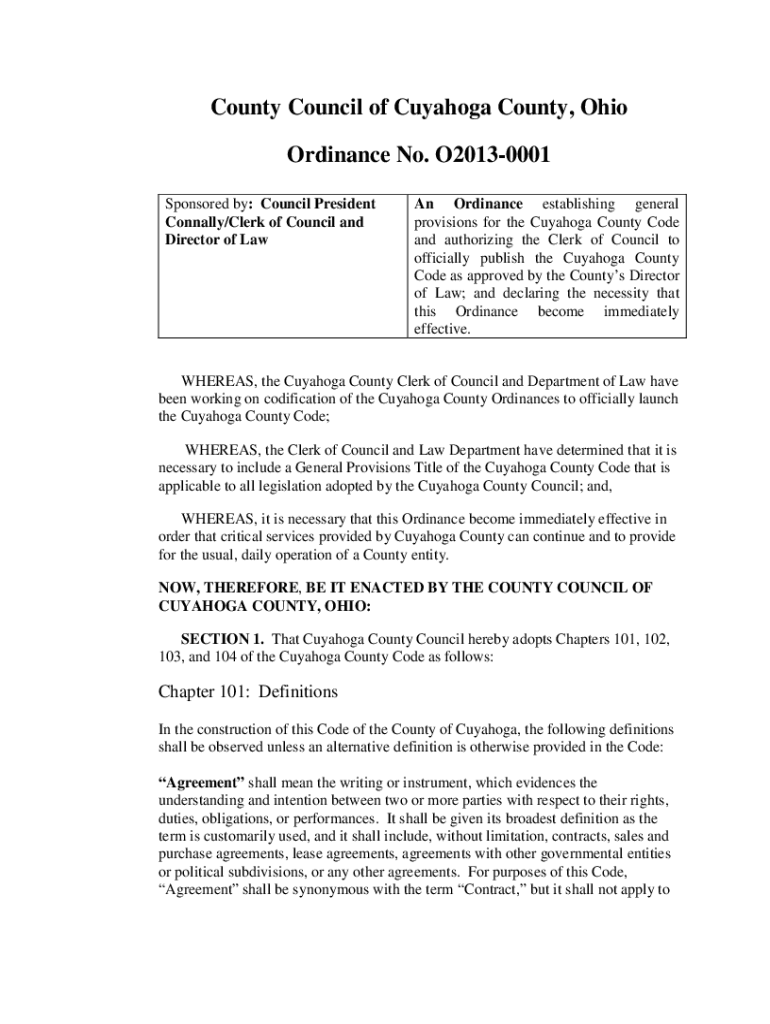
The "Chapter 101- Publication of Code - Cuyahoga County" is an ordinance established by the County Council of Cuyahoga County. This legislation is designed to provide a structured and official framework for the management of the Cuyahoga County Code. It primarily emphasizes the role of the Clerk of Council in the official publication and continual updating of the Code. Key components include guidelines for interpreting the Code, definitions of terms, and references to home rule powers, making it an essential document for maintaining legal clarity and procedural continuity within the county.
How to Use the Chapter 101- Publication of Code - Cuyahoga County
Understanding and applying the guidelines found in Chapter 101 is crucial for maintaining compliance with county regulations. Here’s a step-by-step guide on how to effectively utilize this ordinance:
-
Accessing the Document: Obtain a copy of the Chapter 101 ordinance from the Cuyahoga County Council's official website or request it directly from the Clerk of Council's office.
-
Review Definitions and Terms: Familiarize yourself with the specific definitions and terminologies outlined in the document. These definitions will provide clarity on the scope and application of various sections of the Code.
-
Explore Home Rule Powers: Study the parts addressing home rule powers to understand the extent of autonomy granted to Cuyahoga County under the Ohio Constitution, which impacts local governance and legislative processes.
-
Apply Interpretation Guidelines: Use the interpretation guidelines to resolve any ambiguities or uncertainties in other parts of the county Code, ensuring decisions are consistent with the overarching legal framework.
Important Terms Related to Chapter 101- Publication of Code - Cuyahoga County
Understanding the terms used in Chapter 101 is crucial for interpreting the ordinance correctly:
-
Clerk of Council: The official responsible for the publication and updating of the Cuyahoga County Code, ensuring it remains current and accessible.
-
Home Rule Powers: These refer to the authority Cuyahoga County possesses to govern itself independently within the bounds of state and federal law.
-
Severability: This term highlights the ability to separate specific sections of the Code so that if one part is invalidated, the rest can still stand.
-
Publication and Update: The processes by which the Code is officially documented and revisions are disseminated to keep the Code applicable and up-to-date.
Key Elements of the Chapter 101- Publication of Code - Cuyahoga County
Chapter 101 encompasses several critical elements that ensure its effectiveness and relevance:
-
Official Authorization: Grants explicit authority to the Clerk of Council to manage the publication and ongoing updates of the Code.
-
Immediate Effectiveness: Stipulates the need for the ordinance to take immediate effect, which helps in maintaining uninterrupted legal and administrative operations within the county.
-
Definitions and Scope: Includes precise definitions, ensuring clarity in its application and interpretation across various departments and stakeholders within the county.
Legal Use of the Chapter 101- Publication of Code - Cuyahoga County
The legal application of Chapter 101 involves:
-
Enforcing Compliance: Ensuring that all practices and operations within the county align with the guidelines and definitions set forth in the Code.
-
Guiding Legal Interpretations: Assisting in legal proceedings where ambiguities in language or regulatory scope might arise.
-
Supporting Legislative Processes: Used by legislators and county officials to draft new laws and amendments in accordance with the established framework.
Examples of Using the Chapter 101- Publication of Code - Cuyahoga County
-
Legal Proceedings: Attorneys might reference Chapter 101 during court cases to support arguments related to local governance disputes.
-
Policy Formulation: County officials could use the ordinance as a basis for drafting new policies that align with Cuyahoga County's self-governance abilities.
Who Typically Uses the Chapter 101- Publication of Code - Cuyahoga County
Several groups are primary users of this ordinance:
-
County Officials and Legislators: Utilize it for creating and amending local laws and policies.
-
Legal Practitioners: Reference it in legal cases to ascertain the applicability of county regulations.
-
Public Administrators: Employ it to ensure their departmental procedures conform to the outlined statutory mandates.


Steps to Complete the Chapter 101- Publication of Code - Cuyahoga County
While Chapter 101 is not a fillable form, understanding its completion involves:
-
Document Acquisition: Retrieve the latest version of the Code from the Cuyahoga County website or Clerk of Council.
-
Thorough Review: Analyze each section for its applicability to your specific legal or administrative requirements.
-
Implementation of Guidelines: Apply the defined terms and guidelines in real-world scenarios, ensuring public policies adhere to the Code's directives.