01. Edit your form online
Type text, add images, blackout confidential details, add comments, highlights and more.

Type text, add images, blackout confidential details, add comments, highlights and more.

Draw your signature, type it, upload its image, or use your mobile device as a signature pad.

Send it via email, link, or fax. You can also download it, export it or print it out.
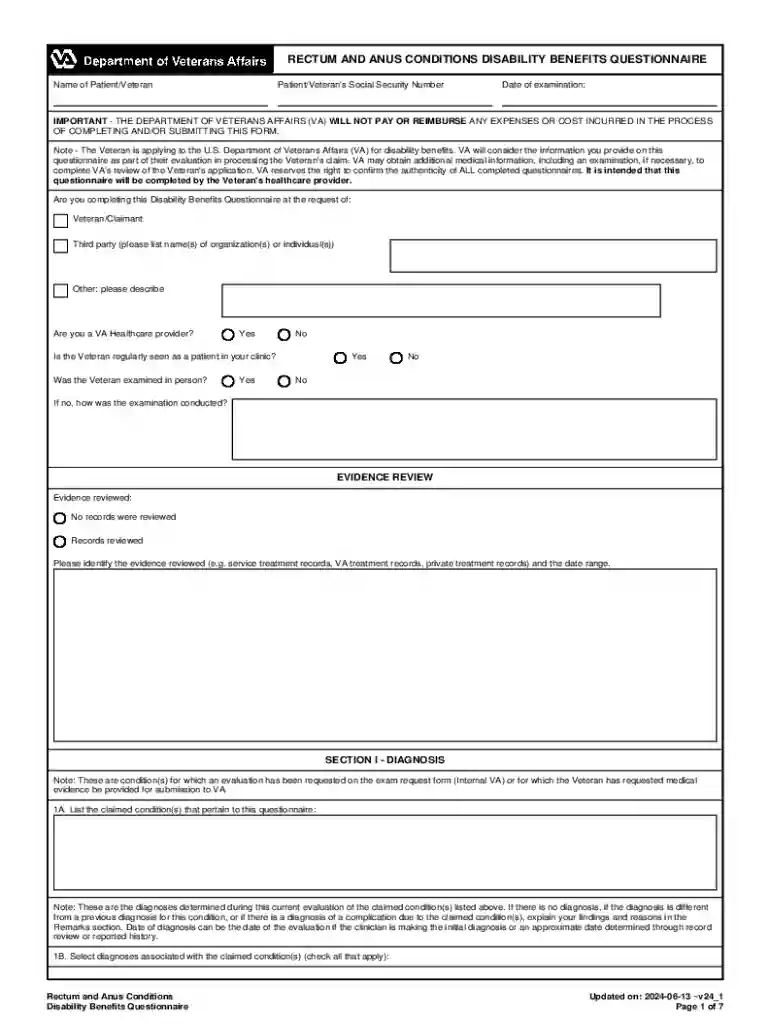
The Rectum and Anus Conditions Disability Benefits Questionnaire, commonly referred to as the Disability Benefits Questionnaire (DBQ), is specifically designed for Veterans applying for disability benefits from the U.S. Department of Veterans Affairs (VA). This document is crucial for assessing the extent of a Veteran's rectal or anal condition and determining how it affects their daily lives. The DBQ allows healthcare providers to report on a range of issues such as hemorrhoids, fistulas, strictures, and other related conditions.
Obtain the Form: Veterans or their representatives must first acquire the DBQ. It can be downloaded from the VA website or requested from a VA office.
Schedule a Medical Examination: Arrange an appointment with a qualified healthcare provider familiar with VA disability assessments.
Complete the Medical Information: During the examination, the healthcare provider will fill out the form based on the Veteran’s medical history, symptoms, and physical examination results.
Review and Sign: Once completed, both the medical provider and the Veteran should review the form for accuracy. The provider will sign the form to attest to the information provided.
Patient Information: Begin by filling out the Veteran’s personal information, including name, social security number, and contact details.
Medical History: Detail the Veteran’s medical history related to rectal and anal conditions, including diagnoses, treatments, and surgical history.
Physical Examination Findings: Record the results of the physical examination, noting any abnormalities or conditions such as hemorrhoids or fissures.
Functional Impact Assessment: Evaluate how these conditions impact the Veteran's ability to work and perform daily activities.
Final Assessment and Signatures: Conclude by completing the impression section and confirming that all information is correct with signatures from both the healthcare provider and the Veteran.



Understanding the comprehensive components and the completion process of the Rectum and Anus Conditions Disability Benefits Questionnaire ensures that Veterans can accurately report their conditions, facilitating timely and accurate benefit determinations.
We've got more versions of the RECTUM AND ANUS CONDITIONS DISABILITY BENEFITS QUESTIONNAIRE Rectum and Anus Conditions Disability B form. Select the right RECTUM AND ANUS CONDITIONS DISABILITY BENEFITS QUESTIONNAIRE Rectum and Anus Conditions Disability B version from the list and start editing it straight away!
At DocHub, your data security is our priority. We follow HIPAA, SOC2, GDPR, and other standards, so you can work on your documents with confidence.