






Definition & Meaning
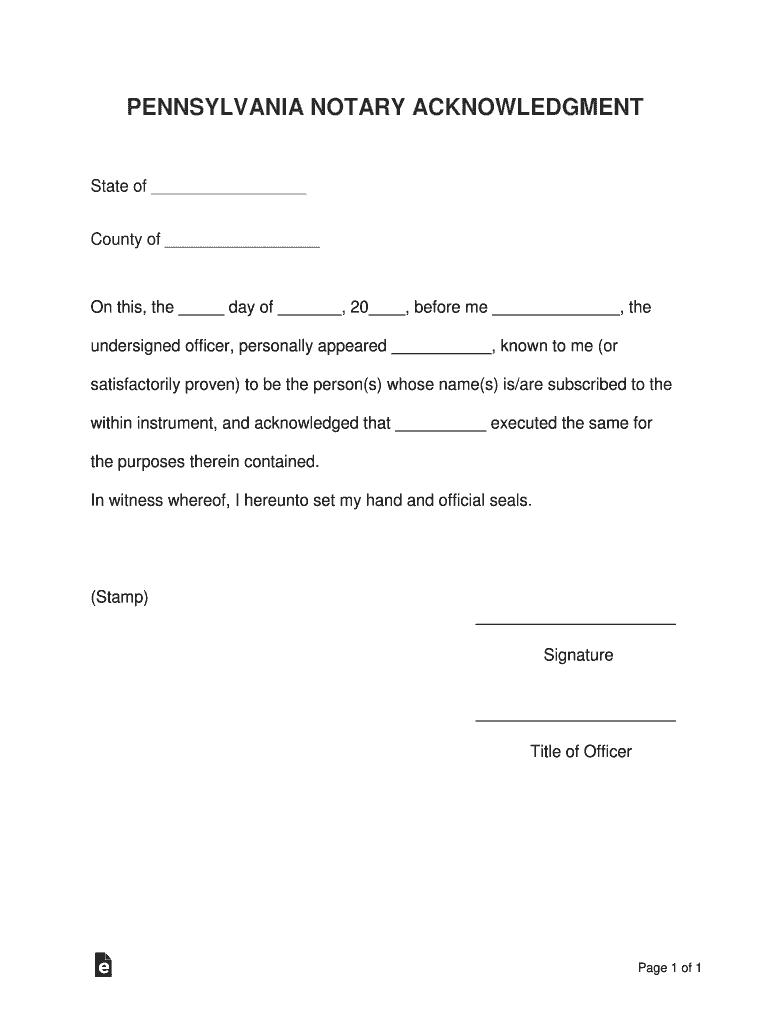
The Pennsylvania Notary Acknowledgement Form is a legal document used by notaries public in Pennsylvania to confirm and certify that an individual has knowingly and willingly signed a document. This form serves as a detached certificate of acknowledgment, which the notary attaches to the signed document to verify the identity of the signer and their intent to accept the contents of the document. Notably, the form does not validate the content of the document itself but strictly ensures the authenticity of the signature and the signatory's volition.
Key Elements of the Pennsylvania Notary Acknowledgement Form
The form must contain certain essential components to be considered valid. These elements include:
- Notary Public Details: The name and commission details of the notary public.
- Signer's Information: The full name of the person whose signature is being notarized.
- Date of Acknowledgment: The date on which the signer appeared before the notary.
- Statement of Acknowledgment: A declaration by the notary that the signer appeared in person, was identified by the notary, and acknowledged signing the document willingly.
- Notary Signature and Seal: A notary public must sign the form and affix their official seal to complete the process.
Steps to Complete the Pennsylvania Notary Acknowledgement Form
Completing the Pennsylvania Notary Acknowledgment Form involves a series of steps to ensure accuracy and legality:
- Verification of Identity: The notary must confirm the identity of the signer through valid identification methods such as government-issued IDs.
- Assessment of Willingness: Confirm that the signer is freely signing the document without any coercion.
- Completion of Acknowledgment: Fill out the Pennsylvania Notary Acknowledgment Form with the required details as mentioned above.
- Affixation of Seal: The notary public must apply their seal and signature on the form.
- Recordkeeping: The notary should log the acknowledgment in their official journal, noting the date, type of document, and the signer's details for future reference if needed.
Legal Use of the Pennsylvania Notary Acknowledgement Form
This form is primarily utilized to bolster the legal enforceability of documents by providing proof that the signatures are genuine and executed voluntarily. Common documents requiring acknowledgment include:
- Real Estate Deeds: Ensuring that property transfers are conducted with full transparency.
- Power of Attorney Documents: Verifying the authority granted to act on behalf of another.
- Trusts and Wills: Establishing authenticity in estate planning documents.
State-Specific Rules for the Pennsylvania Notary Acknowledgement Form
Pennsylvania has specific rules governing the use of notary acknowledgment forms, dictated by the state's notarial laws:
- Personal Appearance Requirement: The signer must be physically present before the notary at the time of acknowledgment.
- ID Requirements: Acceptable identification must be presented to the notary for identity confirmation, which includes driver’s licenses, passports, or other government-issued IDs.
- Sealing Guidelines: The notary seal must be affixed to either the form itself or the attached document, as the seal attests to the notarial act's validity.
How to Obtain the Pennsylvania Notary Acknowledgment Form
Procuring a Pennsylvania Notary Acknowledgment form can be straightforward:
- Online Resources: Many legal document providers, such as DocHub, offer downloadable templates.
- Office Supply Stores: Forms may also be available in print at stores specializing in professional supplies.
- Notary Associations: Joining local notary associations often provides access to standard forms and additional resources.
Who Typically Uses the Pennsylvania Notary Acknowledgement Form
The use of this form is prevalent among various parties who need to validate signed documents:
- Real Estate Agents and Firms: For property-related transactions and transfers.
- Lawyers and Legal Professionals: When dealing with legal documents requiring notarization.
- Financial Institutions: Banks and other financial entities when notarizing documents like loan agreements or financial contracts.


Important Terms Related to Pennsylvania Notary Acknowledgement Form
Understanding specific terminology is crucial for proper use of the form:
- Acknowledger: The individual whose signature is being verified.
- Affiant: A person who makes an official statement or affidavit.
- Commission: The official authorization given to an individual to perform notarial acts.
Examples of Using the Pennsylvania Notary Acknowledgement Form
Practical instances where the form is applied include:
- Home Purchase Closings: Ensuring all transaction documents are duly signed and acknowledged.
- Business Contracts: Confirming the signer’s authority and intent when entering into binding agreements.
- POA Documents: Verifying that individuals understood the implications of granting powers of attorney.