01. Edit your form online
Type text, add images, blackout confidential details, add comments, highlights and more.

Type text, add images, blackout confidential details, add comments, highlights and more.

Draw your signature, type it, upload its image, or use your mobile device as a signature pad.

Send it via email, link, or fax. You can also download it, export it or print it out.
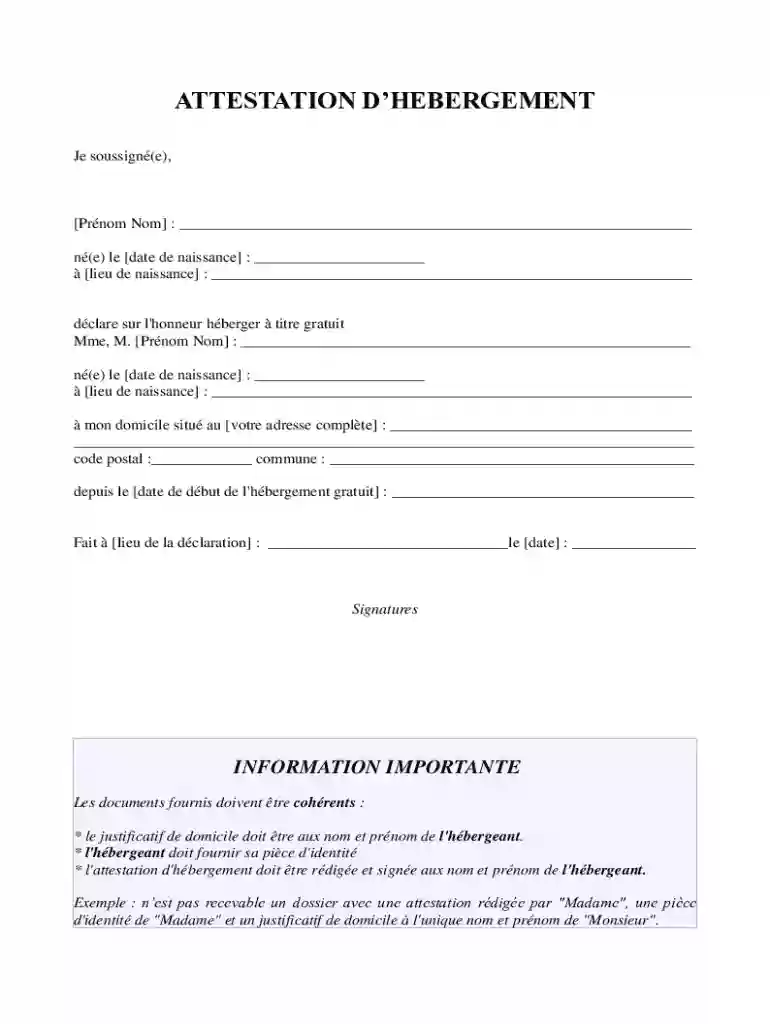
An "Attestation d'Hébergement" is a formal declaration used to confirm that an individual is providing accommodation at their residence to another person without any financial exchange. It typically includes personal information about both the host and the guest, such as names, addresses, and sometimes their relationship. This document is crucial in scenarios where proof of residence is required by authorities.
This form is predominantly used by individuals hosting non-paying guests, such as family members or friends staying temporarily. Typical users include:


The attestation must include specific details to be considered valid:
Using the "Attestation d'Hébergement" involves a few critical steps:
When filling out the form, follow these intricate steps:
When completing the "Attestation d'Hébergement," gather documents like:
Understanding the legal framework surrounding this document is vital. It serves as an affidavit or a sworn statement, ensuring the host is legally allowing the guest to stay at said residence. Misuse or falsification can lead to legal repercussions, emphasizing the importance of accurate and truthful declarations.
Creating and managing this form can be streamlined using software like Microsoft Word, Google Docs, or PDF editors. These applications provide easy-to-use templates and editing features that ensure a professional standard is met. Additionally, platforms like DocHub facilitate remote collaboration and digital signature collection, useful for distributing signed copies efficiently.
At DocHub, your data security is our priority. We follow HIPAA, SOC2, GDPR, and other standards, so you can work on your documents with confidence.