Definition & Meaning
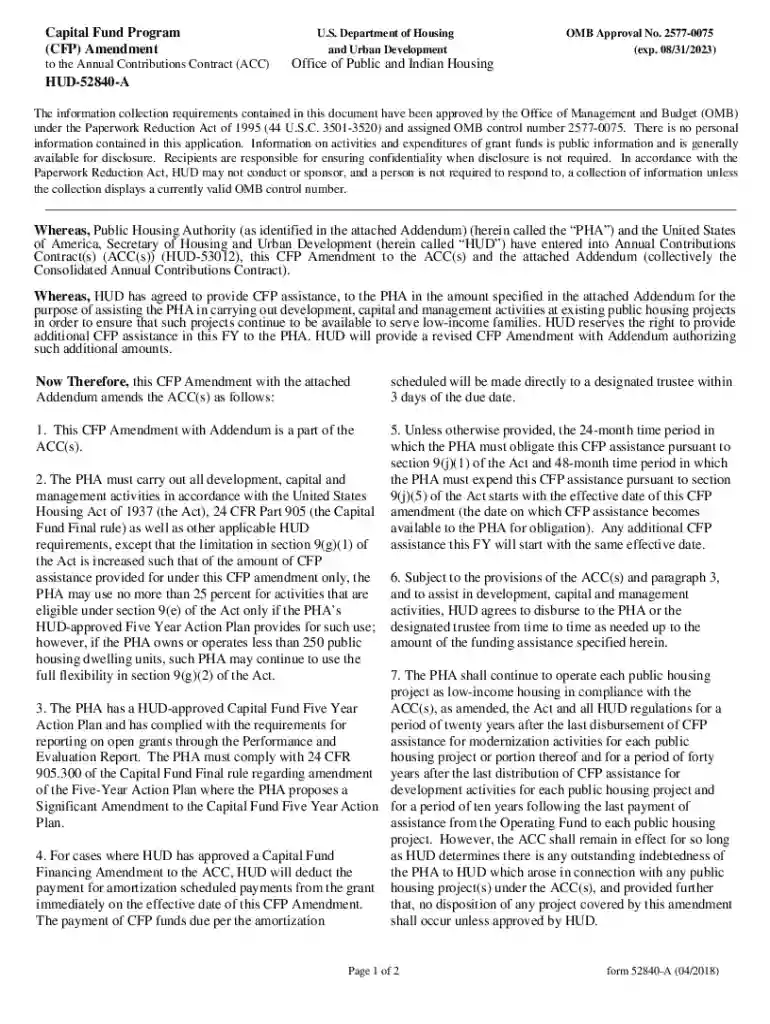
The Capital Fund Program (CFP) Amendment refers to the adjustments made to the Annual Contributions Contract (ACC) between the Public Housing Authority (PHA) and the U.S. Department of Housing and Urban Development (HUD). This amendment delineates the obligations, assistance provisions, and compliance requirements for public housing projects aimed at serving low-income families. It specifies how funds are to be allocated for development, capital, and management activities, ensuring that all projects meet HUD standards and timelines.
Key Components of the CFP Amendment
- Provisions of Assistance: The amendment outlines how CFP assistance can be used to support specific housing project needs.
- Obligations and Expenditures: Defines the timelines and conditions for fund obligation and expenditure compliance.
- Regulatory Compliance: Ensures all activities adhere to established HUD guidelines, safeguarding public accountability and transparency.
How to Use the CFP Amendment
Using the CFP Amendment effectively involves understanding the specific adjustments and their applications within the PHA’s existing framework. It is crucial to familiarize oneself with the amendment's requirements to ensure proper implementation and compliance.
Steps to Adoption
- Review Documentation: Examine the full text of the CFP Amendment and related ACC documents to understand changes.
- Consult Stakeholders: Engage with relevant PHA officials and legal advisors to discuss the implications of the amendment.
- Update Practices: Adapt organizational practices to align with the new guidelines and ensure all staff are informed.
Key Elements of the CFP Amendment
The CFP Amendment includes several critical elements that guide its integration and execution. Understanding these components is essential for successful implementation.
Essential Provisions
- Funding Allocation: Outlines the distribution of funds across various projects to ensure optimal resource use.
- Project Timelines: Establishes deadlines for project phases to ensure timely completion and compliance.
- Security and Oversight: Details measures to ensure funds are used appropriately and projects meet safety standards.
Steps to Complete the CFP Amendment
Completing the CFP Amendment process requires careful attention to detail and adherence to outlined protocols. Here’s a step-by-step guide:
- Gather Necessary Documents: Collect all required documentation, including existing ACC agreements and relevant project information.
- Complete Amendment Forms: Fill out the amendment forms accurately, ensuring all fields are completed.
- Submit for Approval: Forward the completed amendment to HUD for review and approval, awaiting any feedback or required adjustments.
Important Terms Related to CFP Amendment
Several terms are specific to the CFP Amendment and understanding them is crucial for proper application and compliance.
Key Terms
- Annual Contributions Contract (ACC): The ongoing agreement between PHAs and HUD dictating how funds are allocated and managed.
- Public Housing Authority (PHA): The organization responsible for managing public housing projects and ensuring compliance with HUD guidelines.
- HUD Regulations: Federally mandated standards that govern public housing practices and ensure equitable housing for low-income families.
Who Typically Uses the CFP Amendment
The primary users of the CFP Amendment are Public Housing Authorities (PHAs), who oversee public housing projects. Other stakeholders may include HUD officials, financial analysts, and legal advisors working in the housing sector.

User Responsibilities
- PHAs: Implement amendment changes and ensure all projects align with updated regulations.
- HUD Officials: Provide oversight and approval for amendment compliance and project funding.
- Legal Advisors: Assist PHAs in interpreting the legal implications of amendment terms and ensure adherence.
Legal Use of the CFP Amendment
The legal use of the CFP Amendment is governed by HUD regulations and federal housing standards. Ensuring legal compliance is a fundamental aspect of managing public housing funds effectively.
Legal Considerations
- Compliance: PHAs must demonstrate adherence to the terms specified in the CFP Amendment to continue receiving funding.
- Penalties for Non-Compliance: Failure to comply with amendment terms may result in financial penalties or loss of funding.
- Audit and Review: Regular audits ensure that funds are used as intended and projects meet legal standards.
Examples of Using the CFP Amendment
To illustrate the practical application of the CFP Amendment, consider the following scenarios:
Scenario Examples
- New Development Projects: A PHA uses the amendment to allocate additional funds for an expansion project, ensuring it meets updated safety standards.
- Renovation Initiatives: Amendments allow for reallocating resources to refurbish existing facilities, improving living conditions for residents.
- Compliance Adjustments: PHAs adjust management practices in response to new regulatory changes specified in the amendment.