






Definition & Meaning of Form LS-1
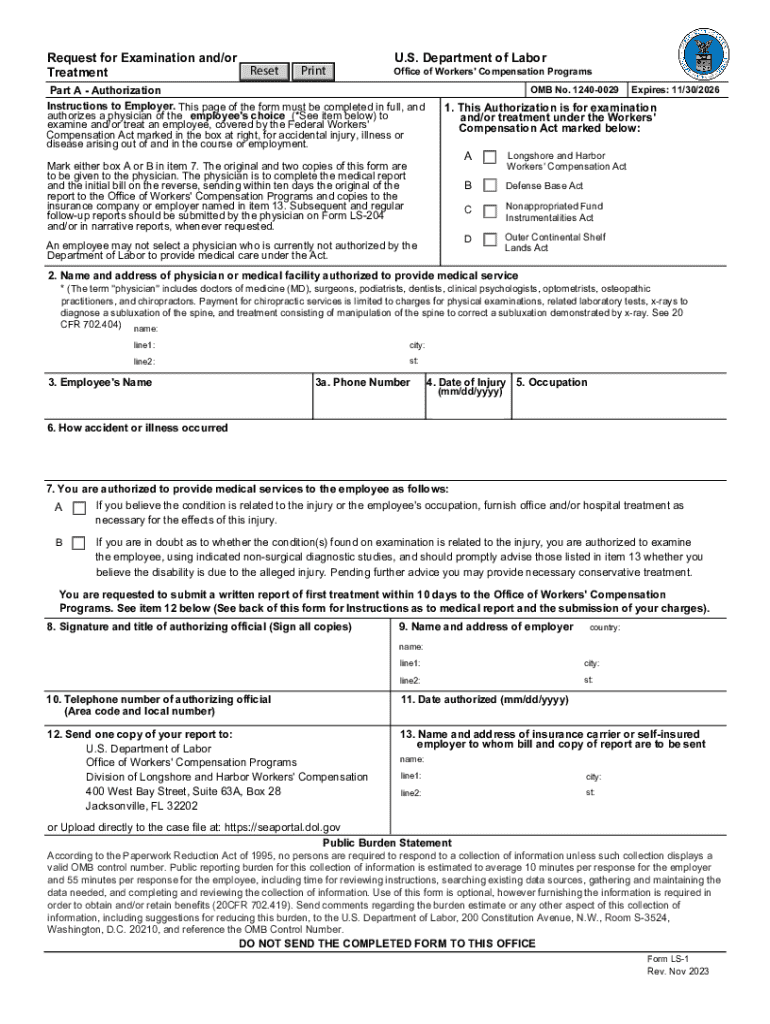
Form LS-1, known as the Request for Examination and/or Treatment, is a document utilized by the U.S. Department of Labor's Office of Workers' Compensation Programs. This form is specifically designed for cases involving work-related injuries or illnesses under the Federal Workers' Compensation Act. It authorizes a physician to examine and treat an employee. The form collects crucial information concerning the employee's injury and necessary treatment, serving as a bridge between employers, employees, and healthcare providers to ensure appropriate medical care and documentation of work-related incidents.
How to Use the Form LS-1
Using Form LS-1 involves several key steps to ensure it is correctly completed and utilized. Employers initially fill out their sections providing details about the employee and the incident related to the injury or illness. Once the employer completes their portion, the form is handed over to the employee, who must present it to the attending physician. The physician then completes their designated sections, documenting the examination and recommended treatment plan. The form must be submitted promptly to maintain compliance with workers' compensation regulations. Each party involved must ensure accuracy and completeness to facilitate a seamless workflow and compensation process.
Steps to Complete the Form LS-1
-
Employer Completes Initial Sections: The employer fills out the sections requiring their details and provides a description of the work-related incident.
-
Employee Submits to Physician: After receiving the partially completed form, the employee presents Form LS-1 to their selected or assigned healthcare provider.
-
Physician Examination and Treatment Plan: The physician examines the employee, records their findings, and outlines the necessary treatment directly on the form. They also include any recommendations for ongoing care or limitations on the employee's work capabilities.
-
Form Submission: The completed form, now containing input from all relevant parties, must be submitted as per the instructions provided, typically to the relevant workers' compensation office or the employee’s HR department.
Important Considerations During Completion
- Accuracy in Reporting: It is vital that all details, particularly those concerning the injury or illness and the treatment provided, are accurately recorded.
- Timeliness: Prompt completion and submission of Form LS-1 are critical to ensure compliance with workers' compensation claims process timelines.
- Verification: The information provided should be verified for completeness before submission to avoid potential delays in processing claims.
Legal Use and Compliance of Form LS-1
The form is used primarily within the framework of the Federal Workers' Compensation Act. It legally facilitates the treatment and examination of federal employees who are injured in the line of duty. Healthcare providers are expected to comply with the instructions on billing and reporting detailed within the form. Employers must ensure the form is completed accurately to maintain compliance with federal regulations. Failure to comply with the regulations associated with Form LS-1 can result in delays or denial of worker's compensation benefits.
Key Elements of Form LS-1
- Employer Information: Employer's name, address, phone number, and authorized representative's title.
- Injury Details: Date, time, and circumstances of the incident leading to the injury or illness.
- Employee Information: Employee's details, position, and department.
- Physician's Findings: The physician records exam results, treatment plans, and any recommendations for work restrictions.
- Signatures: Required from the employer, employee, and physician to validate the form.
State-Specific Rules for Using Form LS-1
While Form LS-1 is a federal document, each state may have variations in how workers' compensation claims are processed and managed. Some states might have additional forms or specific filing processes that need to be adhered to in conjunction with the federal guidelines. It is essential for employers and employees to be aware of their state's specific workers' compensation requirements and ensure all corresponding regulations and rules are followed alongside the federal use of Form LS-1. Consulting with a legal expert or a workers' compensation specialist can provide clarity on state differences.
Penalties for Non-Compliance
Failure to properly complete and submit Form LS-1 can lead to several consequences, including delays in receiving benefits, denial of claims, or potential legal action in cases of fraudulent documentation. Employers who fail to adhere to workers' compensation protocols may face fines, penalties, or greater scrutiny on future claims. Ensuring full compliance with all instructions and timelines is critical to avoiding these adverse outcomes.
Digital vs. Paper Version
Form LS-1 can be accessed and used in both digital and paper formats. Employing the digital version can provide advantages such as easier access for multiple parties, quicker submission, and reduced paperwork. However, the choice between digital and paper may depend on an individual's preference or specific organizational requirements. Ensuring that whichever format is used, the form must be properly filled out and securely handled to protect the privacy and personal information of employees and maintain compliance with regulatory standards.