






Definition & Meaning
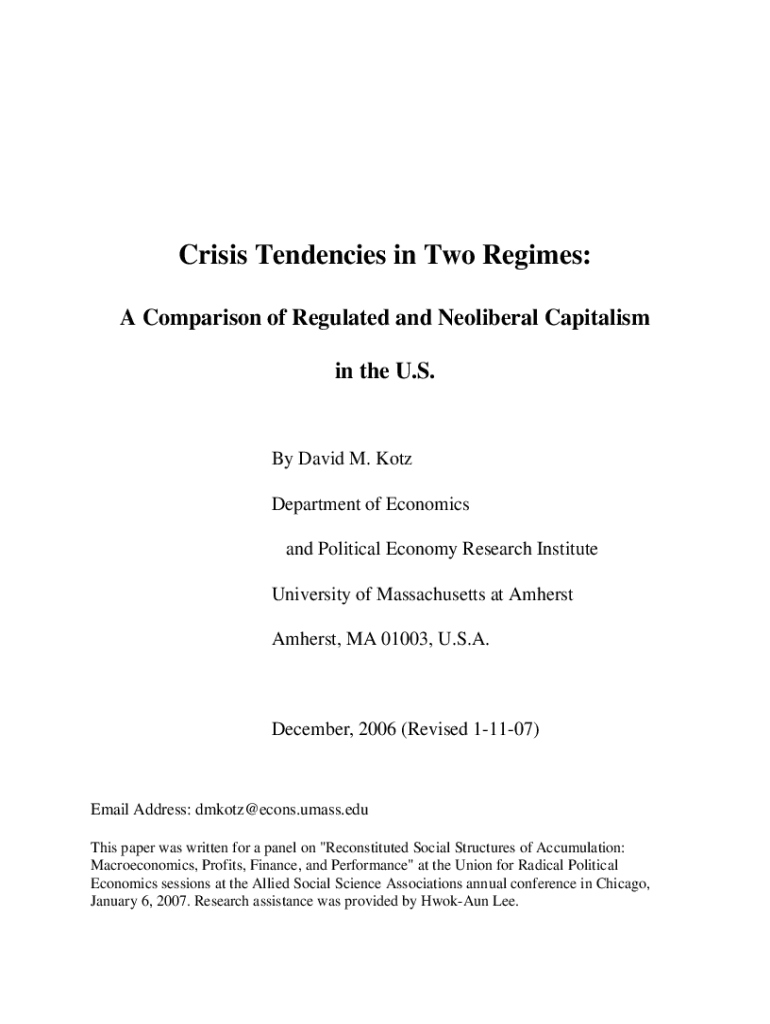
The title "Crisis in 2 Regimes V1 R6 SS w figures w endnotes 06 12 doc" suggests an in-depth analysis of crisis tendencies within two distinct economic frameworks—regulated capitalism and neoliberal capitalism, as observed in the United States. The term "V1 R6 SS" indicates it could be a version or iteration of this analysis. The inclusion of “w figures” and “w endnotes” suggests that this document is supplemented with illustrative figures and detailed endnotes for further reference and clarification.
How to Use the Document
When dealing with "Crisis in 2 Regimes V1 R6 SS w figures w endnotes 06 12 doc," it is important to approach the document methodically:
- Download or Access Online: Ensure you have access to the document via your preferred document management system.
- Read Sequentially: Start with the introduction to understand the underlying themes before delving into specific sections featuring empirical data and theoretical analysis.
- Utilize Figures and Endnotes: Refer to the figures for visual reinforcement of complex data points, and consult endnotes for supplementary information or clarification on specific topics.
- Highlight Key Sections: Use annotation tools to highlight and comment on key passages that are relevant to your research or interests.
Steps to Complete the Document
Completing a study of the "Crisis in 2 Regimes V1 R6 SS w figures w endnotes 06 12 doc" involves:
- Preparation: Gather related materials and understand the basic concepts of economic regimes.
- Active Reading: Use annotation for notes and mark critical analyses of economic transitions directly on the document.
- Synthesis: Combine information from figures and text to synthesize your understanding of crisis mechanisms across economic regimes.
- Conclusive Notes: Draft your interpretations and comments based on the detailed endnotes provided in the document.
Key Elements of the Document
- Economic Analysis: Exploration of regulated and neoliberal capitalism crises.
- Empirical Data: Document is likely filled with empirical data supporting the analysis.
- Visual Support: Figures to illustrate economic trends and effects.
- Detailed References: Endnotes offering comprehensive backgrounds and citations.
Important Terms Related to the Document
- Regulated Capitalism: An economic framework prevalent in the U.S. from 1948 to 1973 with strong state intervention.
- Neoliberal Capitalism: A post-1979 economic framework with minimal state intervention and free-market dominance.
- Bargaining Power: The leverage held by labor or capital in economic negotiations.
- Reserve Army Effect: Economic theory linked to unemployment levels impacting wage growth.
Examples of Using the Document
- Academic Research: Leverage this document for thesis work on economic transition periods in the U.S. economy.
- Policy Analysis: Utilize figures and empirical data to support policy analysis concerning proposed economic regulations.
- Economic Theory Development: Use the document as a reference for comparing historical economic theories to modern interpretations.
Legal Use of the Document
Ensure that usage adheres to copyright regulations. When citing the document in academic or professional work, provide proper attribution to maintain intellectual property rights and acknowledge sourcing.
Digital vs. Paper Version
Utilizing the document in a digital format allows for enhanced interaction through collaborative tools and ease of access to linked figures and endnotes. Conversely, a paper version may facilitate focused analysis away from digital distractions.
Versions or Alternatives
Keep an eye out for previous or subsequent versions of the analysis document, which may provide updated data or refined analyses. Comparing different versions could offer insights into evolving theories or responses to peer review.
Who Typically Uses the Document
- Economists and Scholars: For the development of theories or supporting economic history research.
- Policy Makers and Analysts: In examining past economic policies’ impact on crises.
- Academic Institutions: Used as a teaching tool to illustrate economic transition studies.