
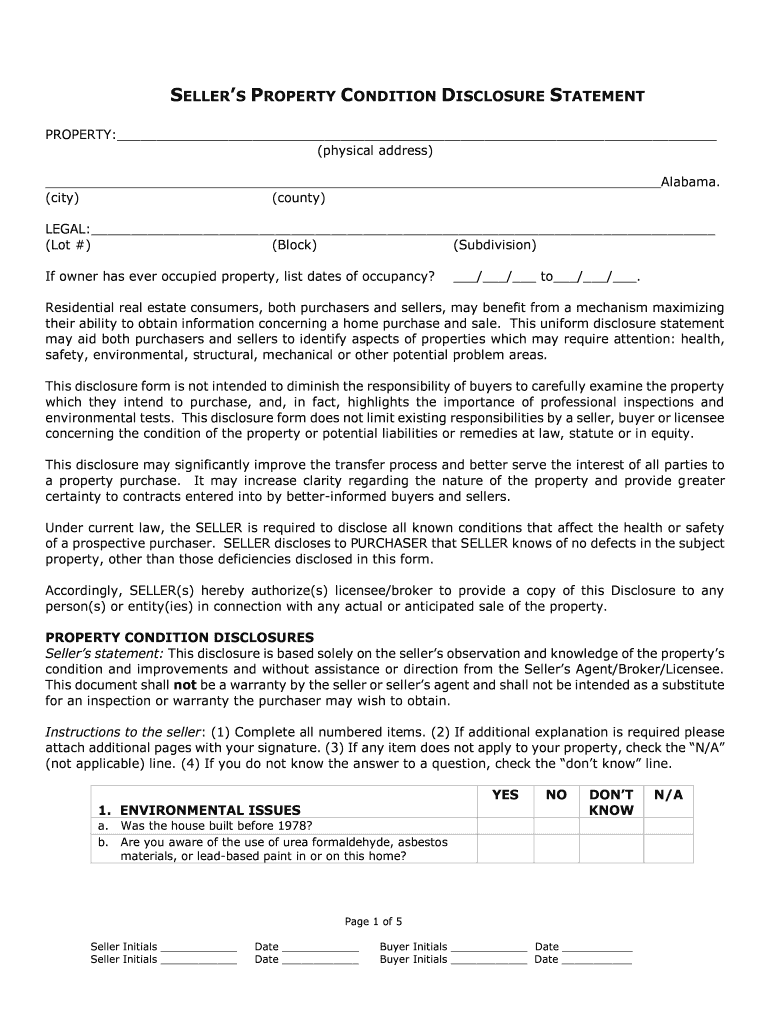







Definition and Meaning of the Alabama Seller's Property Disclosure Statement
The Alabama Seller's Property Disclosure Statement is an essential document in real estate transactions within the state of Alabama. Its primary purpose is to provide a detailed account of the seller's knowledge regarding the property's condition. This includes any known defects and issues related to health, safety, environmental, structural, and mechanical aspects. By presenting this disclosure, both buyers and sellers can engage in informed negotiations, thus facilitating a transparent and efficient transaction process. The statement emphasizes the buyer's need for professional inspections to verify the property's condition.
Key Elements of the Alabama Seller's Property Disclosure Statement
This document covers several critical areas concerning the property's condition. Each section requires the seller to disclose information accurately:
- Structural integrity: Details about the foundation, roof, and walls. Sellers must mention any prior repairs or ongoing issues.
- Environmental factors: Any hazardous materials or environmental concerns, such as asbestos or flooding history.
- Mechanical systems: Information on the heating, cooling, plumbing, and electrical systems, including ages and any known issues.
- Safety concerns: Disclosures about smoke detectors, security systems, and any unsafe conditions on the property.
- Recent repairs or renovations: Any updates or changes made to the property and whether they complied with local building codes.
Steps to Complete the Alabama Seller's Property Disclosure Statement
Completing this form involves a systematic approach to ensure all necessary information is provided:
- Gather all relevant property documents: Collect records such as maintenance logs, repair invoices, and any previous inspection reports.
- Conduct a thorough property inspection: Even though sellers disclose known issues, a comprehensive inspection can uncover additional matters that might need addressing.
- Complete each section of the form: Ensure honest and full disclosure in each category to avoid potential legal issues.
- Review the completed statement: Check for completeness and accuracy before filing it for potential buyers to review.
- Consult a real estate professional: To ensure compliance with Alabama's disclosure laws and gain assistance in interpreting complex sections.
Legal Use and Compliance
In Alabama, while sellers are encouraged to use the disclosure statement, the state does not mandate it by law. However, failing to provide a disclosure can lead to allegations of misrepresentation or fraud if undisclosed problems are later discovered. This statement acts as a legal safeguard for sellers, protecting them against future claims, provided they have made all disclosures in good faith and with full honesty.
Disclosure Requirements Specific to Alabama
Although the Alabama Seller's Property Disclosure Statement is a comprehensive document, certain state-specific rules govern its use. Sellers are expected to:
- Disclose only what they know about the property truthfully.
- Not guess about potential issues; if uncertain, they must indicate that they do not know the answer.
- Provide updates if any new information becomes known before the transaction is finalized.
Who Typically Uses the Alabama Seller's Property Disclosure Statement
This document is primarily used by:
- Home sellers: Who wish to present an honest account of the property condition to prospective buyers.
- Real estate agents: To guide sellers and ensure compliance with local laws and standards.
- Buyers: To assess whether they wish to move forward with the acquisition of a property after being informed of its condition.
- Legal professionals: To counsel clients on potential risks and ensure both parties are protected under the current real estate laws.


Obtaining the Alabama Seller's Property Disclosure Statement
The disclosure statement is accessible through a variety of channels:
- Real estate offices: Most agencies provide forms as part of their service offerings.
- Online real estate platforms: Websites related to real estate often have downloadable versions of the form.
- Legal service providers: Attorneys specializing in real estate can supply the correct document format and ensure its comprehensive completion.
Examples and Case Studies
Consider the case of a recent property transaction in Montgomery, where the seller disclosed a minor roof leak that had been repaired. Due to their transparency, negotiations continued smoothly, highlighting the importance of honesty in disclosures. Conversely, in Huntsville, a seller omitted issues regarding the HVAC system, leading to post-sale disputes and legal challenges. These cases illustrate how adherence to the disclosure requirements can either facilitate or hinder the real estate process.
Important Terms Related to Alabama Seller's Property Disclosure
Understanding the terminologies associated with this document is crucial:
- "Material defect": Any issue with the property that might influence the buyer's decision or the property's value.
- "As-is condition": Selling without warranties or repairs; however, this doesn't exempt sellers from disclosing known defects.
- "Latent defects": Hidden problems not immediately obvious but required to be disclosed if known by the seller.
State-Specific Differences in Disclosure Regulations
Alabama's approach to property disclosure slightly varies from nearby states:
- Some states may require mandatory disclosure reports for all residential properties.
- Alabama's voluntary disclosure might limit legal obligations, but sellers may still face repercussions for non-disclosure or misrepresentation based on the principles of “Caveat Emptor” or buyer beware.
Understanding these nuances helps sellers navigate potential pitfalls in real estate transactions in Alabama.




