






Definition & Meaning
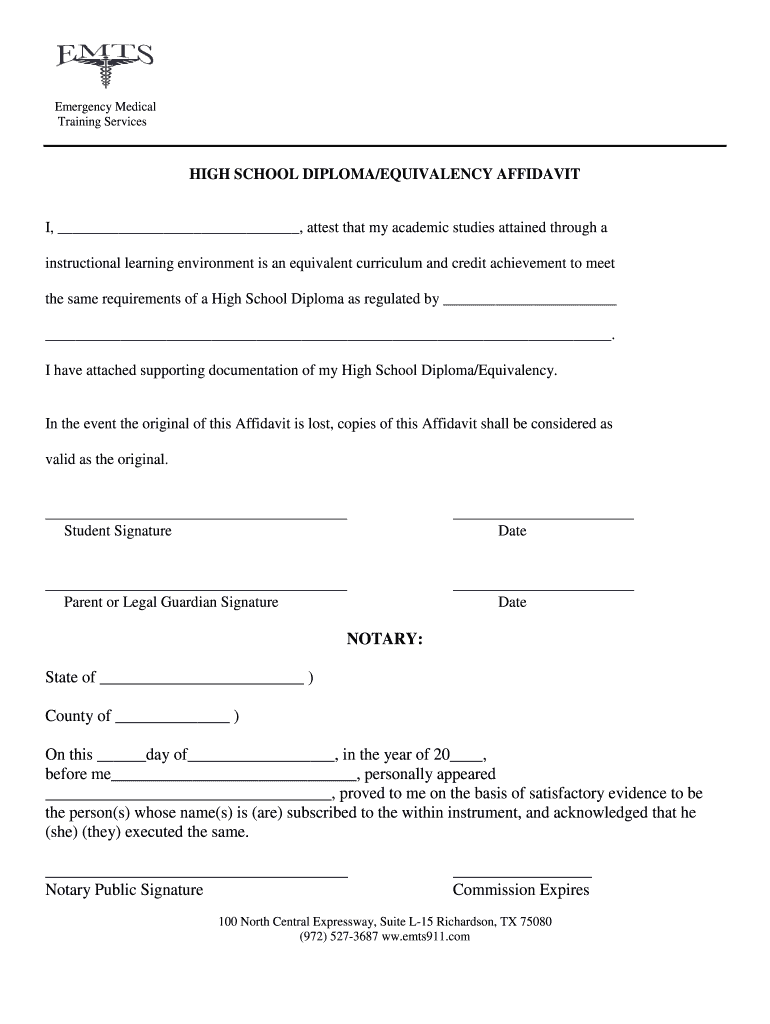
The High School Diploma-Equivalency Affidavit is a legal document used by individuals who need to confirm their academic qualifications as equivalent to a high school diploma. This form is crucial for those who have not completed traditional high school education but have pursued other forms of study or training that meet the required standards for high school completion. It serves as a formal declaration affirming that the signatory's educational experiences suffice for equivalency, often needed for employment or further education applications.
How to Use the High School Diploma-Equivalency Affidavit
Using the High School Diploma-Equivalency Affidavit involves completing the document with personal and educational information. It's typically used when applying for jobs or educational programs that require a high school diploma or its equivalent. The affidavit must be filled out accurately, with sections completed by the student and, if applicable, a parent or guardian. It may also require notary acknowledgment to ensure its legality.
Steps to Complete the High School Diploma-Equivalency Affidavit
- Gather Required Information: Collect all necessary details regarding your educational background, including the institution names, courses taken, and any certifications obtained.
- Fill Out Personal Information: Enter your full name, date of birth, and contact information on the affidavit form.
- Detail Educational Equivalency: Provide a comprehensive list of your educational qualifications that equate to a high school diploma, including any non-traditional courses.
- Signatures: Both the student and a parent or guardian (if applicable) must sign the document.
- Notary Acknowledgment: Have the affidavit notarized to authenticate the information presented.
- Attach Supporting Documentation: Include copies of certificates or transcripts that support your equivalency claim.
- Submit: Send the completed and notarized affidavit to the relevant authority or institution.
Key Elements of the High School Diploma-Equivalency Affidavit
- Personal Information: Includes the full name, contact details, and identification information of the applicant.
- Educational Background: Detailed description of the academic and training experiences that qualify as a high school equivalent.
- Signatures: Spaces for the student and a guardian, if required, to affirm the truthfulness of the affidavit's contents.
- Notary Section: A designated area for a notary public to confirm the document's authenticity.
- Attachments Requirement: Directions to include any relevant documents that support the equivalency assertion.
Required Documents
- Proof of Educational Achievements: Copies of certificates, diplomas, or transcripts that demonstrate completed courses or training.
- Identification: Government-issued ID to verify the identity of the signatory.
- Notary Public Information: This may include the notary's stamp and credentials, acknowledging the signing.
Legal Use of the High School Diploma-Equivalency Affidavit
This affidavit is utilized to verify educational qualifications for legal purposes, such as employment applications or admission to further education programs. It affirms that the individual's academic training meets or exceeds the standards of a high school diploma, thus making them eligible for opportunities requiring such credentials.
State-Specific Rules for the High School Diploma-Equivalency Affidavit
Different states may have distinct requirements regarding what constitutes equivalency and the process for affidavit approval. It's crucial to check your state’s specific guidelines, including possible additional documentation or varying formats of the affidavit, to ensure compliance with local regulations.
Examples of Using the High School Diploma-Equivalency Affidavit
- Employment Applications: An individual applies for a job requiring high school education. They provide the affidavit to demonstrate their equivalent educational attainment.
- College Admissions: A prospective student submits the affidavit when applying to a college that accepts non-traditional educational backgrounds.
- Vocational Training: When enrolling in certain training programs, participants might need to prove their educational level with this affidavit.
Important Terms Related to the High School Diploma-Equivalency Affidavit
- Notary Public: A state-appointed individual authorized to attest to the authenticity of documents.
- Equivalency: Recognition that specific educational achievements are comparable to a traditional high school diploma.
- Affidavit: A written statement confirmed by oath or affirmation for use as evidence in a legal context.