






Definition & Meaning
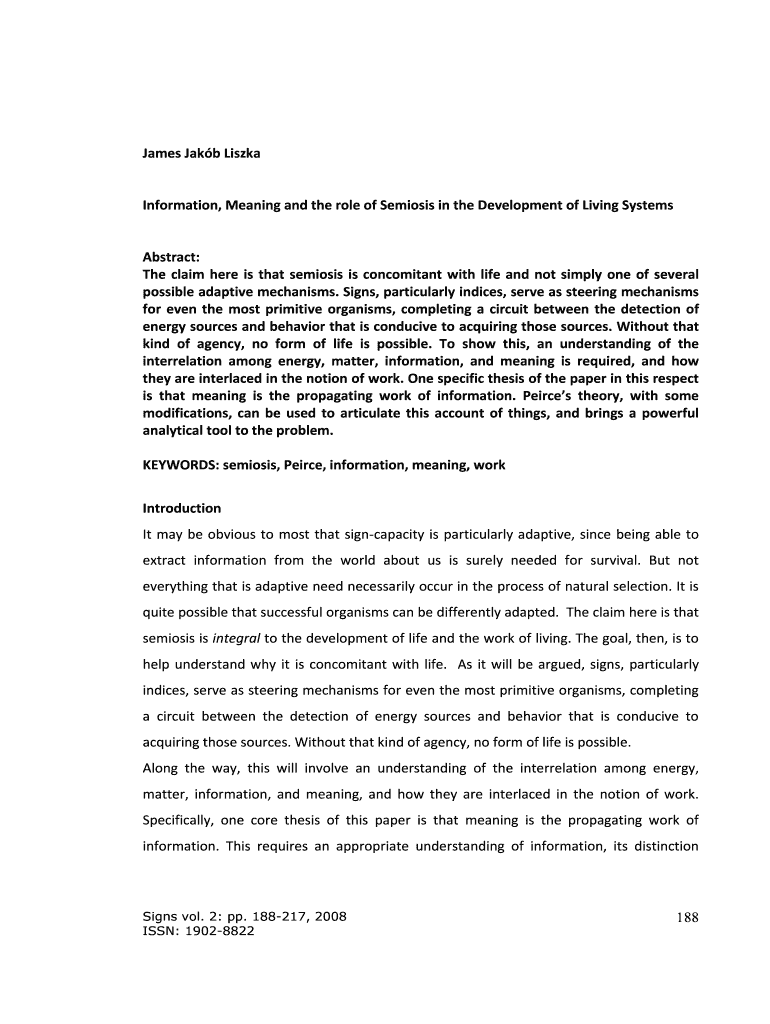
The form "188 James Jak b Liszka Information, Meaning and the role of - uaa alaska" addresses the intricate connection between semiosis and the life processes of organisms. Semiosis, as outlined by Jakób Liszka, involves the transmission of signs, such as indices, which organisms use to locate energy and adapt behaviors. The form delves into how information translates into meaning within living systems, a concept grounded in semiotic theory modified for non-semantic information processing.
Key Elements of the Form
The primary components of this form include:
- Semiosis Mechanisms: Involves the use of signs to convey information necessary for organism survival.
- Energy Source Detection: Explains how organisms utilize semiosis to identify energy sources.
- Behavioral Adaptation: Examines how semiosis assists in behavioral modification to optimize survival chances.
- Sign Types: Discusses various signs like indices that function within living systems.
Steps to Complete the Form
- Gather Information: Compile data on semiosis' role within specific living systems.
- Analyze the Theory: Review Liszka's interpretation of Peirce's semiotic theory and its application.
- Formulate Responses: Synthesize explanations on how semiosis underpins organism behavior.
- Complete Sections: Address each segment about indices and their functions in survival and adaptation.
- Review and Finalize: Ensure all parts are filled with detailed, relevant examples before submission.
Who Typically Uses the Form
This form primarily serves:
- Biologists: Those researching the role of information in living processes.
- Semioticians: Scholars examining the intersection of signs and meaning within life systems.
- Ecologists: Professionals exploring adaptive behaviors related to environmental interaction.


Legal Use of the Form
While the form does not have direct legal implications, it aids understanding semiosis within the legal framework of research involving living organisms. It ensures compliance with ethical practices in conducting studies related to behavioral adaptations.
Examples of Using the Form
- Case Study in Ecology: Used to document findings on animal behavior in response to environmental changes.
- Research Paper Data: Providing a structured format for compiling evidence on semiosis in behavioral ecology.
- Academic Theses: Supporting arguments in academic works focused on semiotics and biological adaptation.
State-Specific Rules for the Form
The focus of this form is more universal than state-specific, but researchers should align their findings with state-mandated ethical guidelines in biological research when applying these concepts to practical studies. Additional state-specific licensing may be required for fieldwork potentially impacting local ecosystems.
Form Submission Methods
Submissions of this form are typically handled within academic or research settings:
- Online: Via scholarly platforms or university portals dedicated to research submissions.
- In-Person: At conferences or seminars where findings are shared with peers.
- Mail: Used for applications involving research grants or academic publication submissions.
Required Documents
To complete this form, users should prepare the following:
- Research Data: Evidence supporting semiosis theory within the biological study.
- Theoretical Analysis: An in-depth review of relevant semiotic literature.
- Case Examples: Documented instances where semiosis application can be observed within studied organisms.
Digital vs. Paper Version
The preference for digital over paper format aligns with modern documentation practices in academic realms. This enables easier sharing, storage, and electronic annotation, which is particularly useful in collaborative research environments.