






Definition and Meaning
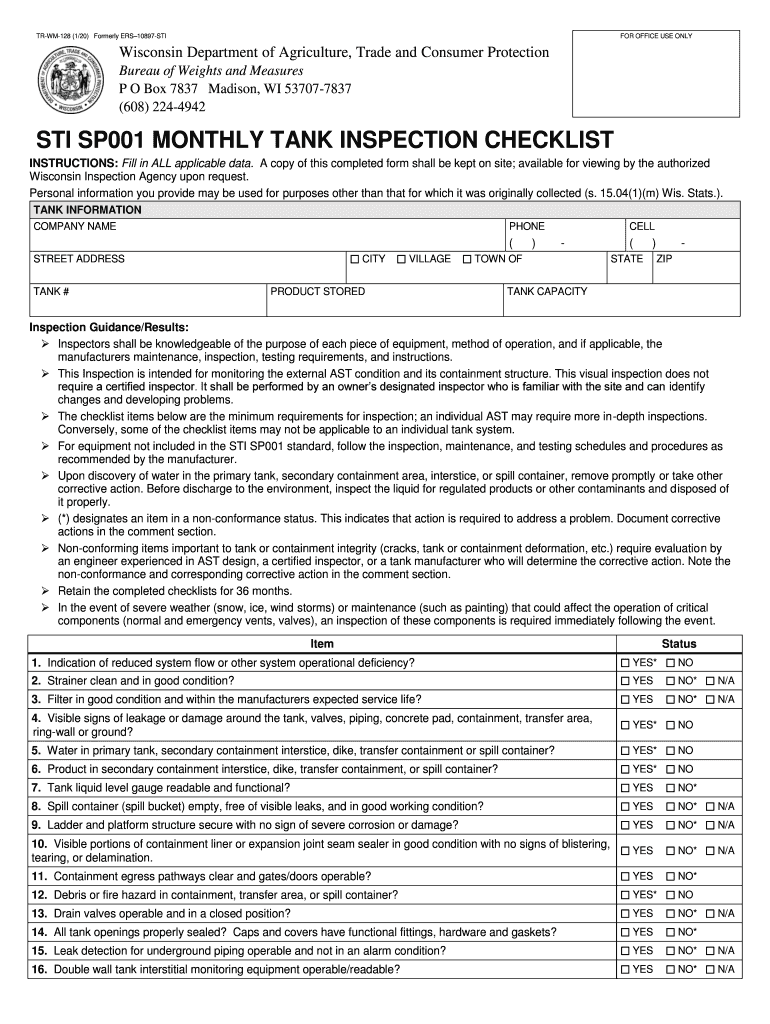
The document "TR-WM-128 (1 20) Formerly ERS10897-STI" refers to a form associated with the Wisconsin Department of Agriculture, Trade and Consumer Protection. It is a structured document used for the monthly inspection of aboveground storage tanks (ASTs) to ensure compliance with safety and operational standards. The purpose of the form is to verify that ASTs are maintained in proper condition, reducing the risk of leaks, spills, or environmental damage. Its reference to a prior code, ERS10897-STI, indicates it may have undergone revisions or updates to meet new regulatory requirements.
How to Use the TR-WM-128 (1 20)
To effectively utilize the TR-WM-128 (1 20), inspectors must follow a detailed process:
- Inspection Preparation: Gather necessary tools and information related to the tank site.
- Tank Condition Assessment: Examine the physical state of the tank, checking for any visible damage or corrosion.
- Containment Structures: Verify the integrity of secondary containment measures, ensuring they can prevent leaks.
- Operational Integrity: Test all operational components, including valves and gauges, for functionality.
- Documentation: Record findings meticulously, noting any non-compliance or issues requiring corrective action.
Each stage demands careful attention to detail and adherence to safety protocols.
How to Obtain the TR-WM-128 (1 20)
To acquire the TR-WM-128 (1 20):
- Online Access: Visit the official Wisconsin Department of Agriculture, Trade and Consumer Protection website, where downloadable PDFs may be available.
- Direct Request: Contact the department via phone or email to request a physical copy if digital versions are not preferred.
- Local Offices: Obtain copies from local regulatory offices where hard copies may be distributed.
- Industry Networking: Engage with industry groups or associations that might provide access to essential regulatory documents.
Each method ensures regulated parties can access the necessary forms to maintain compliance.
Steps to Complete the TR-WM-128 (1 20)
Filling out the TR-WM-128 (1 20) involves several critical steps:
- Review Instructions: Begin by reading all instructions to understand the data required.
- Complete Identification Section: Enter identifying information, including tank location and operator details.
- Inspection Details: Fill in each inspection criterion, marking compliance or noting issues.
- Action Plan: For any deficiencies noted, document steps taken or planned for corrective actions.
- Signature: Conclude by signing the document, certifying the accuracy of the information.
This process requires accuracy and thoroughness to ensure compliance.
Importance of the TR-WM-128 (1 20)
Using the TR-WM-128 (1 20) is crucial for several reasons:
- Regulatory Compliance: Ensures adherence to state regulations governing ASTs.
- Risk Mitigation: Identifies potential hazards, preventing environmental damage and potential legal implications.
- Operational Efficiency: Helps maintain peak operational status and minimizes downtime.
- Historical Record: Provides a documented record of inspections for future reference or audits.
The form is pivotal in protecting public safety and maintaining regulatory compliance.
Key Elements of the TR-WM-128 (1 20)
The TR-WM-128 (1 20) contains several essential elements:
- Tank Identification Details: Includes specific information on the tank's location and operator.
- Inspection Items: Lists criteria such as physical condition checks, containment verification, and operational tests.
- Corrective Actions: Fields to detail necessary remedial measures for non-compliance.
- Inspector Signature: Space for the inspector’s signature certifying the validity of the inspection.
These elements ensure a comprehensive evaluation of the tank's safety and operational status.
Required Documents
When completing the TR-WM-128 (1 20), several supporting documents might be necessary:
- Previous Inspection Reports: Allow comparison and tracking of tank condition over time.
- Maintenance Records: Provide evidence of regular upkeep and any repairs performed.
- Compliance Certificates: Confirm alignment with environmental regulations.
Having these documents on hand ensures a thorough and defensible inspection process.
Penalties for Non-Compliance
Failure to adhere to the requirements of the TR-WM-128 (1 20) can result in:
- Fines and Penalties: Financial consequences for violating state regulations.
- Operational Shutdowns: Cease of operations until compliance is restored, impacting business productivity.
- Legal Action: Possible lawsuits or state actions if negligence results in environmental harm.
Understanding these penalties underscores the importance of strict compliance.
Form Variants and Alternatives
The TR-WM-128 (1 20) may have predecessors or related forms, like ERS10897-STI, which reflect older standards or procedures. Alternatives could include forms used in different states for similar purposes but customized according to local regulatory environments. Understanding which version applies is essential for correct application and compliance.