






Definition & Meaning
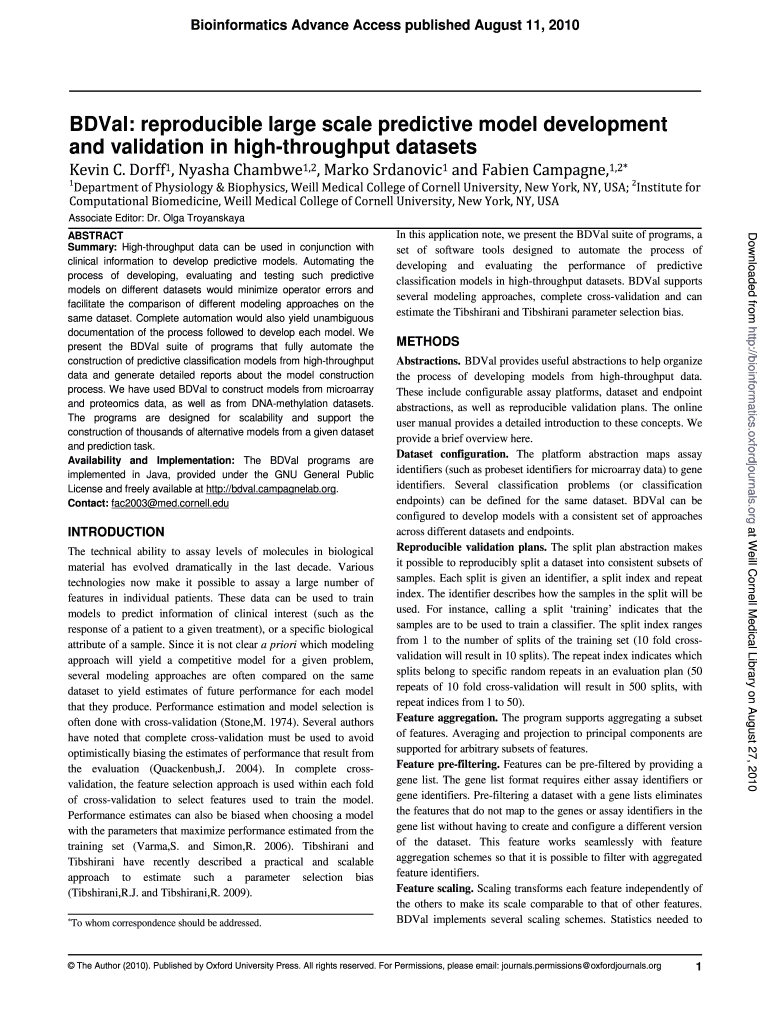
The "BDVal - Physiology Biophysics and Systems Biology Graduate" refers to a specialized suite of tools specifically designed to assist graduates in the field of Physiology, Biophysics, and Systems Biology with the development and evaluation of predictive classification models. The BDVal tools aim to streamline the large-scale analysis of high-throughput datasets, emphasizing the significance of reproducibility and thorough documentation. By addressing parameter selection bias and performance estimation via complete cross-validation, BDVal ensures rigorous model validation. This suite is equipped to handle various modeling approaches, feature selection methods, and supports parallel processing, thereby proving scalable for extensive research projects. Implemented in Java, these tools are freely accessible for users.
Who Typically Uses the BDVal - Physiology Biophysics and Systems Biology Graduate
BDVal is predominantly utilized by students, researchers, and professionals involved in fields such as physiology, biophysics, and systems biology. These users often seek efficient tools to aid in the processing and analysis of extensive biological data. Graduate students in relevant disciplines may rely on BDVal for their thesis work, benefiting from its comprehensive capabilities in automating and validating predictive model development. Moreover, scientific institutions and research facilities that handle high-throughput datasets find BDVal valuable for accelerating their research processes and achieving reproducible outcomes.


Steps to Complete the BDVal - Physiology Biophysics and Systems Biology Graduate
-
Download and Installation: Begin by downloading the BDVal tools from the official repository. Follow the provided instructions to install the software on your system.
-
Input Data Preparation: Prepare your high-throughput datasets for analysis. Ensure that data is formatted according to the instructions provided by BDVal, typically in compatible formats like CSV or TXT.
-
Model Configuration: Set up your predictive model parameters, selecting appropriate feature selection methods and modeling approaches that suit your research aims.
-
Execution and Cross-Validation: Run the models using BDVal, employing the complete cross-validation feature to assess performance and mitigate parameter bias.
-
Analysis of Results: Analyze the results to identify patterns or insights and refer to the detailed documentation for interpreting performance metrics.
-
Documentation and Reporting: Compile the findings into a structured report, making sure to include detailed documentation for reproducibility and future reference.
Why Should You Use BDVal - Physiology Biophysics and Systems Biology Graduate
The BDVal suite is an invaluable asset for researchers and students aiming to develop precise and reproducible predictive models. Its emphasis on thorough documentation and cross-validation ensures that users can mitigate biases and accurately assess model performance. BDVal's capability to handle vast datasets efficiently makes it ideal for high-throughput biological research. Additionally, its open-source nature and Java implementation offer flexibility and accessibility, empowering users to adapt the tools to their specific research needs.
Key Elements of the BDVal - Physiology Biophysics and Systems Biology Graduate
-
Reproducibility Focus: Ensures detailed documentation and methodological transparency for reproducible research outcomes.
-
Comprehensive Model Testing: Supports parameter selection bias mitigation through extensive cross-validation procedures.
-
Flexibility in Modeling: Offers a diverse range of modeling approaches and feature selection techniques.
-
Scalability for Large Datasets: Facilitates parallel processing, accommodating extensive and complex biological datasets.
-
Accessibility and Implementation: Freely available software implemented in Java, suitable for a broad user base.
Software Compatibility
BDVal's implementation in Java ensures broad compatibility across different systems, whether users prefer Windows, macOS, or Linux operating systems. This universal adaptability allows seamless integration into various computational environments used by academics and researchers. Users commonly incorporate BDVal into their workflows alongside other data analysis tools like R and Python, ensuring comprehensive data processing and analysis.
Digital vs. Paper Version
BDVal's functionality is entirely digital, reflecting modern trends in data analysis and model evaluation. Unlike traditional paper methods, which are obsolete in this context, BDVal leverages digital technology for data input, processing, and reporting. This digital focus enables efficient data handling, quick iteration cycles, and instantaneous sharing of results within the research community.
Examples of Using the BDVal - Physiology Biophysics and Systems Biology Graduate
Researchers in systems biology might use BDVal to evaluate gene expression datasets, aiming to develop models that predict disease states or patient outcomes. For example, a study focused on cancer genomics could utilize BDVal to identify crucial gene signatures that differentiate between healthy and cancerous tissue.
Graduate students working on thesis projects might employ BDVal to understand metabolic network behaviors by simulating various biochemical interactions and validating their results against experimental data.
In another scenario, research institutions conducting drug efficacy studies could use BDVal to classify responses to different treatment regimes, ultimately aiding in the development of personalized medicine strategies.
Important Terms Related to BDVal - Physiology Biophysics and Systems Biology Graduate
-
High-Throughput Datasets: Large-scale data typically generated by techniques like microarrays, next-generation sequencing, and mass spectrometry, crucial for biological research.
-
Predictive Classification Models: Algorithms used to predict the category of data points within datasets, based on various feature inputs.
-
Parameter Selection Bias: A bias that occurs when parameters in a model are chosen based on the data being analyzed without proper validation, potentially leading to overfitting.
-
Cross-Validation: A technique used to evaluate the predictive performance of a model by partitioning data into training and testing sets multiple times to ensure stability in model evaluation.
-
Feature Selection Methods: Techniques that select relevant features for use in model building, crucial for improving model accuracy and interpretation.
By embracing these key aspects and understanding their practical applications, researchers can fully exploit BDVal's capabilities to advance projects in physiology, biophysics, and systems biology.