






Definition & Meaning
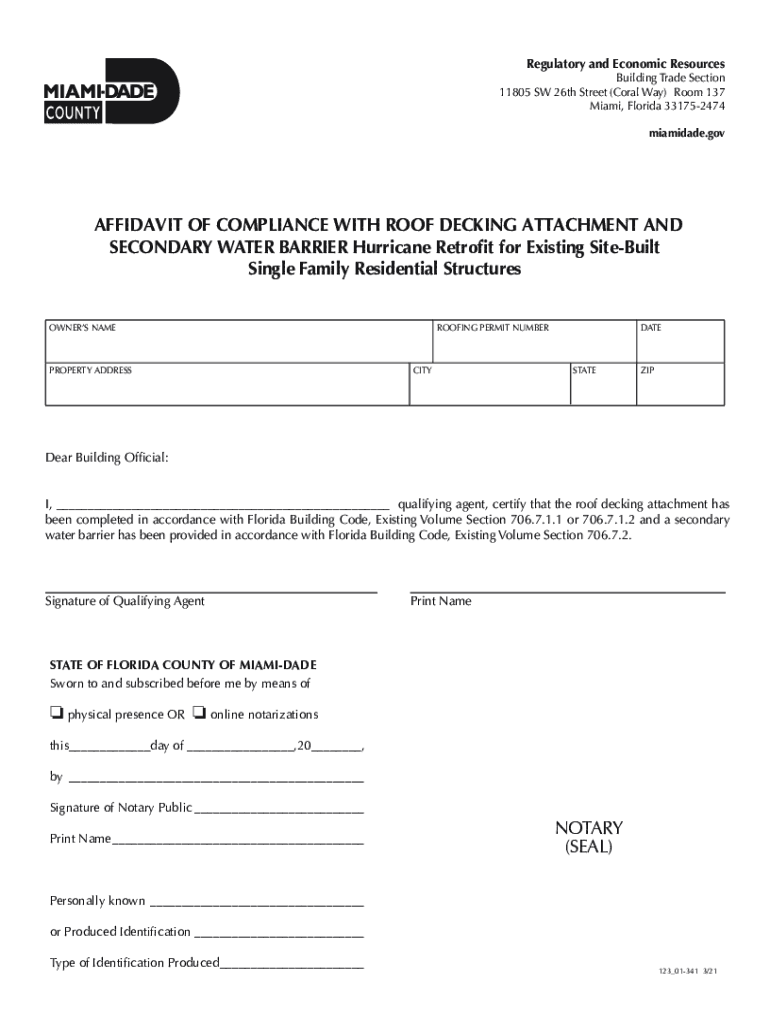
The "Affidavit of Compliance with Roof - Miami-Dade County" is a crucial legal document for homeowners in Miami-Dade County. It certifies that a property owner has complied with local building codes regarding roof decking attachment and secondary water barrier requirements. This affidavit is a necessary step in the hurricane retrofitting process for existing single-family residential structures, ensuring they meet safety standards to withstand severe weather conditions. It serves as an official statement confirming that the roofing work aligns with specific sections of the Florida Building Code, which is designed to protect the residents and their properties from hurricane damage.
Steps to Complete the Affidavit
-
Gather Required Information:
- Collect detailed information about the property, including owner details and roofing permit number.
- Ensure all necessary data is accurate and corresponds with official records to avoid delays in processing.
-
Fill Out the Form:
- Complete sections related to the roofing project, including contractor details and specific work performed.
- Specify compliance aspects related to roof decking and water barrier requirements.
-
Notarization:
- Have the completed affidavit notarized to validate the authenticity of the details provided.
- A notary public can be found at local banks, libraries, or private offices offering notary services.
-
Submission:
- Submit the notarized affidavit to the relevant county building department or appropriate authority.
- Ensure that submission meets any deadlines to avoid potential fines or project delays.
Key Elements of the Affidavit
- Roof Decking Attachment: Certification that the roof decking is securely attached as per code requirements.
- Secondary Water Barrier: Information confirming installation of a water barrier to prevent leaks during severe weather.
- Owner Information: Comprehensive details of the property owner, including contact information and property address.
- Permit Number: Reference to the roofing permit number that pertains to the completed work.
- Compliance Sections: Citation of specific Florida Building Code sections that the affidavit adheres to.
Legal Use and Importance
The affidavit acts as a legal safeguard for homeowners, ensuring that roofing projects meet the stringent safety standards set by the local government. It protects homeowners from liabilities arising from non-compliance with the building code. Moreover, it is an authoritative declaration that can be used in legal contexts to demonstrate due diligence in maintaining the structural integrity of their residence in line with local regulations.
Why Homeowners Should Use This Affidavit
Utilizing this affidavit is essential for homeowners seeking to retrofit their homes for better resilience against hurricanes. By providing a legally binding document that confirms compliance with safety standards, homeowners can enjoy peace of mind knowing their property is safeguarded. This document may also lead to favorable conditions with insurance companies who require proof of compliance to offer coverage or discounts.
Important Terms to Understand
- Hurricane Retrofitting: Process of strengthening buildings to withstand the impact of hurricane winds and related pressure.
- Notarization: Official process of certifying documents by a licensed notary, ensuring legality and authenticity.
- Building Code Compliance: Conforming to legislatively established safety standards for construction and renovation.
Obtaining the Affidavit Form
The affidavit form can typically be obtained from the Miami-Dade County Building Department or through its official website. It's advisable to consult directly with the department for the latest version and additional documents that might be needed to support the compliance process. This ensures adherence to any updates or new requirements imposed by local authorities.
Examples of Use Cases
- Hurricane Preparedness: Certifying that a home is prepared for hurricane season with defined safety measures in place.
- Property Sale or Transfer: Using the affidavit to show compliance during the sale or transfer of property as part of due diligence.
- Insurance Claims: Presenting the affidavit to insurance companies to substantiate claims or receive policy discounts.
Each of these sections provides depth and clarity on the different aspects of the "Affidavit of Compliance with Roof - Miami-Dade County," ensuring that homeowners fully understand its purpose, steps for completion, and legal implications.