Ontario-Ministry-of-Health-and-Long-Term- 2026

Get Form
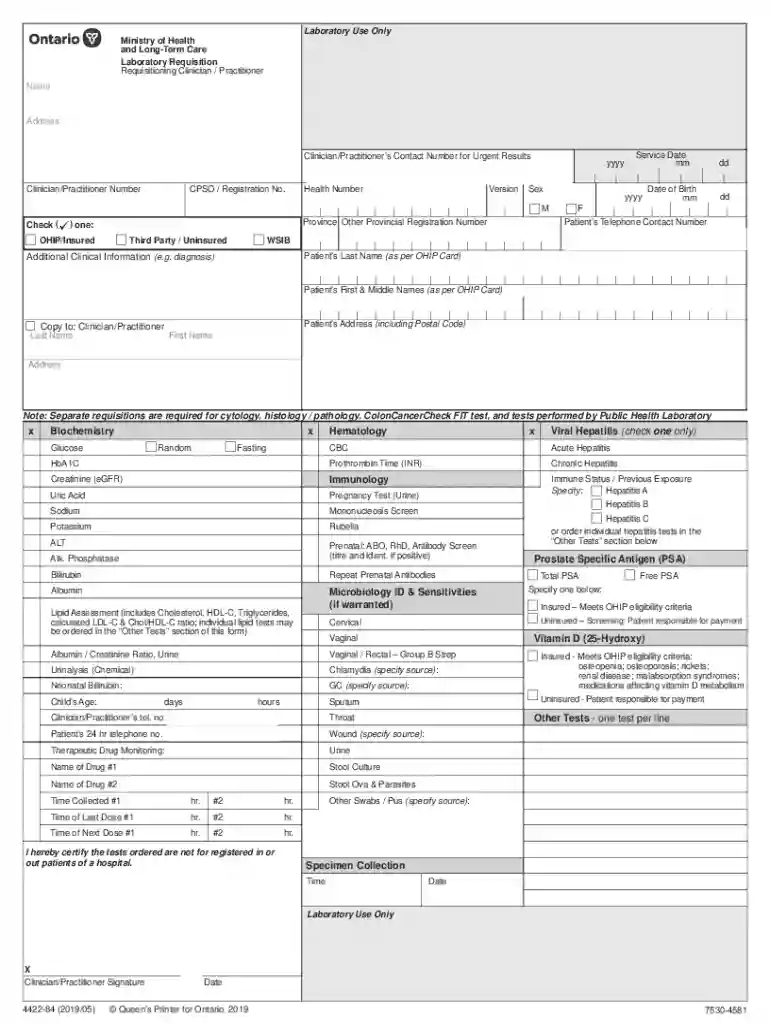
Ontario-Ministry-of-Health-and-Long-Term- Preview on Page 1

Here's how it works

01. Edit your form online
Type text, add images, blackout confidential details, add comments, highlights and more.

02. Sign it in a few clicks
Draw your signature, type it, upload its image, or use your mobile device as a signature pad.

03. Share your form with others
Send it via email, link, or fax. You can also download it, export it or print it out.

Definition and Purpose of the Ontario Ministry of Health and Long-Term Care Form

The Ontario Ministry of Health and Long-Term Care form is a laboratory requisition tool designed for healthcare professionals who need to request medical tests for their patients. This form is crucial in guiding clinicians and laboratory personnel through the test ordering process, ensuring clarity and precision in medical testing. It provides sections tailored for both patient and clinician information, as well as options for selecting various medical tests such as biochemistry, hematology, immunology, and microbiology.

Objectives of the Form

  • Facilitates Accurate Test Requests: Provides a structured format for clinicians to request specific tests, reducing errors.
  • Streamlines Data Collection: Ensures all necessary information is collected efficiently.
  • Supports Medical Decision-Making: Integral in providing data for diagnosing and monitoring patient health.

How to Obtain the Ontario Ministry of Health and Long-Term Care Form

Securing the Ontario Ministry of Health and Long-Term Care form is straightforward, primarily accessible through multiple channels tailored to healthcare providers.

Access Points

  • Healthcare Institutions: Hospitals and clinics usually have these forms readily available for clinicians.
  • Official Ministry Websites: Digital copies can be downloaded from the Ministry’s official site.
  • Direct Request: Healthcare providers might request these forms directly from the Ministry’s administrative offices.

Steps to Complete the Ontario Ministry of Health and Long-Term Care Form

Filling out the Ontario Ministry of Health and Long-Term Care form requires careful attention to detail to ensure all critical information is captured accurately.

Completion Process

  1. Enter Patient Information: Fill in patient details including name, date of birth, and health card number.
  2. Clinician Details: Provide your name, contact information, and professional ID number.
  3. Test Selection: Use the form’s designated sections to select the specific tests required, ensuring clarity in your requests.
  4. Clinical Information: Include any relevant clinical notes or instructions that guide the testing process.
  5. Certification: Confirm that the requisition is not for a registered hospital patient as required.

Key Elements of the Form

The form is divided into various sections, each essential for the seamless processing of test orders.

Principal Components

  • Patient Identification: Ensures that test results are matched with the correct individual.
  • Clinician Certification: Verifies the request is legitimate and aligns with policy requirements.
  • Test Lists: Divided by medical discipline, helping with quick selection.
  • Additional Instructions: Outlines any specific requirements or conditions necessary for the test.

Who Typically Uses the Ontario Ministry of Health and Long-Term Care Form

The primary users of this form are healthcare practitioners who need to order laboratory tests for their patients.


decoration image ratings of Dochub

User Groups

  • General Practitioners and Specialists: Utilize the form to request a variety of routine and specialized tests.
  • Healthcare Facility Staff: May assist in ensuring forms are completed and submitted correctly.
  • Medical Clerks: Involved in processing and managing test requisitions within healthcare settings.

Important Terms Related to the Form

Understanding the terminology used within the form is crucial to ensure proper completion.

Commonly Used Terms

  • Requisition: Official request for laboratory tests.
  • Biochemistry: Tests related to chemical processes within the body.
  • Hematology: Involves the study of blood and its disorders.
  • Immunology: Deals with immune system-related tests.
  • Microbiology: Focuses on microorganisms that can affect human health.

Legal Use of the Ontario Ministry of Health and Long-Term Care Form

Legal compliance is a cornerstone in using the Ontario Ministry of Health and Long-Term Care form correctly.

Legal Considerations

  • Patient Confidentiality: Protects patient information in compliance with privacy laws.
  • Regulatory Compliance: Aligns with health regulations to ensure ethical use.
  • Approval and Inspection: May be subject to review by health authorities to confirm legitimate use.

Examples of Using the Ontario Ministry of Health and Long-Term Care Form

Practical examples highlight how the form facilitates the healthcare process.

Real-World Scenarios

  • Pre-surgical Testing: Clinicians order required tests pre-surgery to ensure patient readiness.
  • Chronic Condition Monitoring: Used for ongoing monitoring of conditions such as diabetes through regular test requests.
  • Public Health Surveillance: Aids in testing and data collection for public health investigations.

By understanding the multifaceted aspects of the Ontario Ministry of Health and Long-Term Care form, healthcare providers can ensure efficient and effective test requisition and processing, ultimately aiding in better patient care and resource management.

be ready to get more

Complete this form in 5 minutes or less

Get form

Got questions?

We have answers to the most popular questions from our customers. If you can't find an answer to your question, please contact us.
Contact us
If you are moving to another province or territory, you must: let your provincial or territorial health insurance plan know that you are moving. register with the health insurance plan of your new province or territory.
You can be outside of Canada for 212 days in a 12-month period and still be covered by your OHIP. If you will be away for more than 212 days, you can apply for continuous OHIP eligibility. This means that you want to keep your OHIP benefits, even though you will be out of the country for more than 212 days.
Long-term care homes can provide a residential alternative for patients with high care needs, who meet the following criteria: 18 years of age or older; have a valid Ontario Health Card; have health care needs that cannot be met with any combination of caregiving in the home or community; and.
Ministers MPPPolicy Area Jones, Hon. Trevor Minister of Agriculture, Food and Agribusiness Kerzner, Hon. Michael S. Solicitor General Khanjin, Hon. Andrea Minister of Red Tape Reduction Kusendova-Bashta, Hon. Natalia Minister of Long-Term Care38 more rows
Long-term care is part of the provinces health care system and publicly funded on a cost-shared basis with those residing here. The government does not pay the full cost of long-term care and expects you to pay a portion of your room and board to the long-term care community.

Security and compliance

At DocHub, your data security is our priority. We follow HIPAA, SOC2, GDPR, and other standards, so you can work on your documents with confidence.

Learn more
ccpa2
pci-dss
gdpr-compliance
hipaa
soc-compliance
be ready to get more

Complete this form in 5 minutes or less

Get form