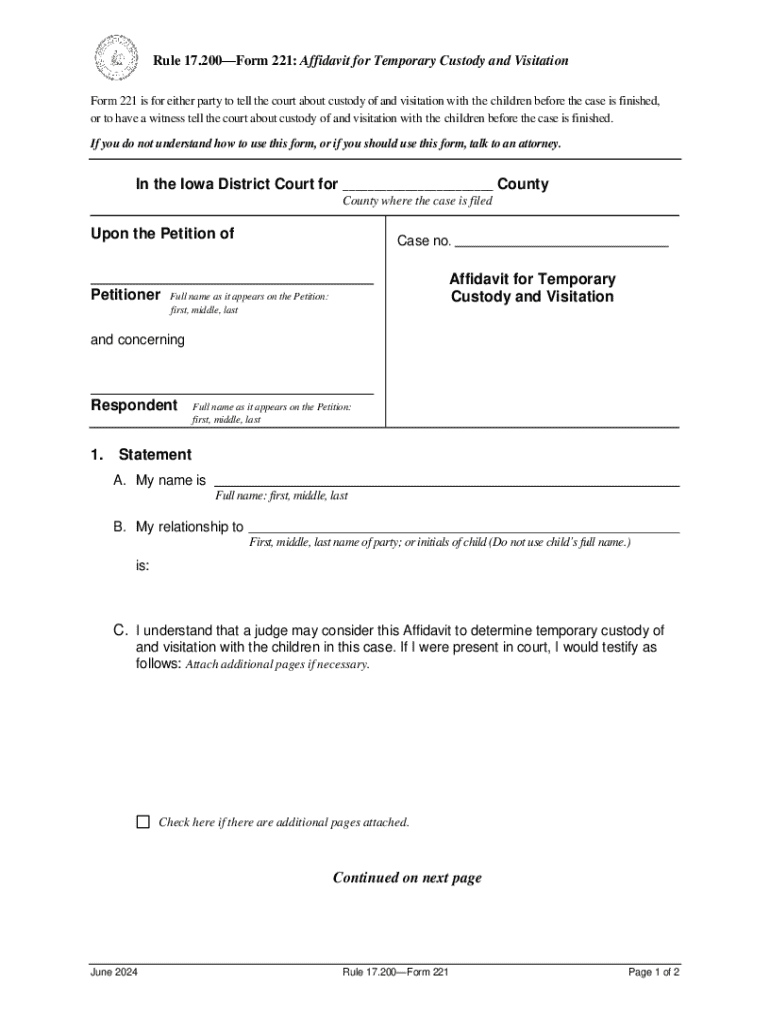







Definition & Purpose of the "In the Iowa District Court for County Upon the Petition of Affidavit for"
The "In the Iowa District Court for County Upon the Petition of Affidavit for" is a legal document used within the judicial system of Iowa. This affidavit allows individuals to formally request temporary custody and visitation rights during an ongoing court case. It is structured to collect essential information from the petitioner regarding their relationship with the child involved, ensuring the court has all the necessary details before making interim decisions.
Key Elements of the Affidavit
- Personal Details: Includes the full name, address, and contact information of both the petitioner and the respondent.
- Relationship Statement: Describes the petitioner's connection to the child and their custodial history.
- Oath and Confirmation: Requires the petitioner to swear under oath that the information provided is truthful and accurate.
How to Use the Affidavit
The document is used primarily to formalize requests related to custody and visitation during court proceedings. Petitioners must complete the affidavit fully, ensuring that each section is filled out with accurate information. After completion, it should be submitted to the Iowa District Court for review.
Step-by-Step Process
- Download the Form: Obtain the form from the Iowa District Court's official website or a legal aid service.
- Fill in Personal Information: Complete the sections requiring details about yourself and other involved parties.
- Detail Relationship: Clearly outline your relationship to the child and the justification for your custodial request.
- Sign and Notarize: Once completed, sign the affidavit in the presence of a notary public to authenticate your declaration.
- Submit to Court: File the affidavit with the court clerk, ensuring all required accompanying documents are included.
How to Obtain the Form
Acquiring the "In the Iowa District Court for County Upon the Petition of Affidavit for" can be done through several methods:
- Online Access: Visit the Iowa District Court's website to download the form directly.
- Court Clerk’s Office: Obtain a physical copy by visiting the local county courthouse.
- Legal Assistance Services: Some nonprofit organizations offer assistance in procuring legal forms.
Who Typically Uses This Form
The form is primarily employed by individuals involved in legal proceedings concerning child custody and visitation in the state of Iowa. This includes:
- Parents: Seeking to establish or modify temporary custody arrangements.
- Guardians: Acting on behalf of minors in custody-related matters.
- Legal Representatives: Attorneys filing on behalf of their clients.
Legal Use and Requirements
The affidavit serves as a formal legal request and must comply with Iowa state laws governing child custody. It requires the petitioner to:
- Provide Verifiable Information: Only factual and verifiable information should be presented.
- Adhere to State Laws: Ensure all procedural steps align with state guidelines specific to custody proceedings.
Important Legal Terms
- Petitioner: The individual initiating the request for custody.
- Respondent: The other party involved in the custody case.
- Notary Public: An official who verifies the authenticity of signatures.
State-Specific Rules for the Affidavit
Iowa's legal framework dictates specific requirements and procedures:
- Timely Submission: Affidavits should be filed at the earliest opportunity to avoid delays in the court process.
- Court-Specific Formats: Each county may have variations in the filing process; consult local court procedures where necessary.
Examples of Usage
Real-world scenarios where this affidavit might be applied include:
- Divorce Proceedings: When parents are divorcing, one might file this affidavit to secure temporary custody until permanent arrangements are decided.
- Emergency Situations: A guardian may need to seek immediate custody to protect a child's welfare.
Submission Methods
The form can be submitted to the court through various methods, depending on the preference and convenience of the petitioner:
- In-Person: Directly at the courthouse.
- Mail: Sent with proper postage and tracking to ensure delivery.
Ensuring the proper filing of this affidavit prepares the petitioner to effectively participate in legal proceedings concerning the welfare of children in their custody or care.