







Definition and Meaning
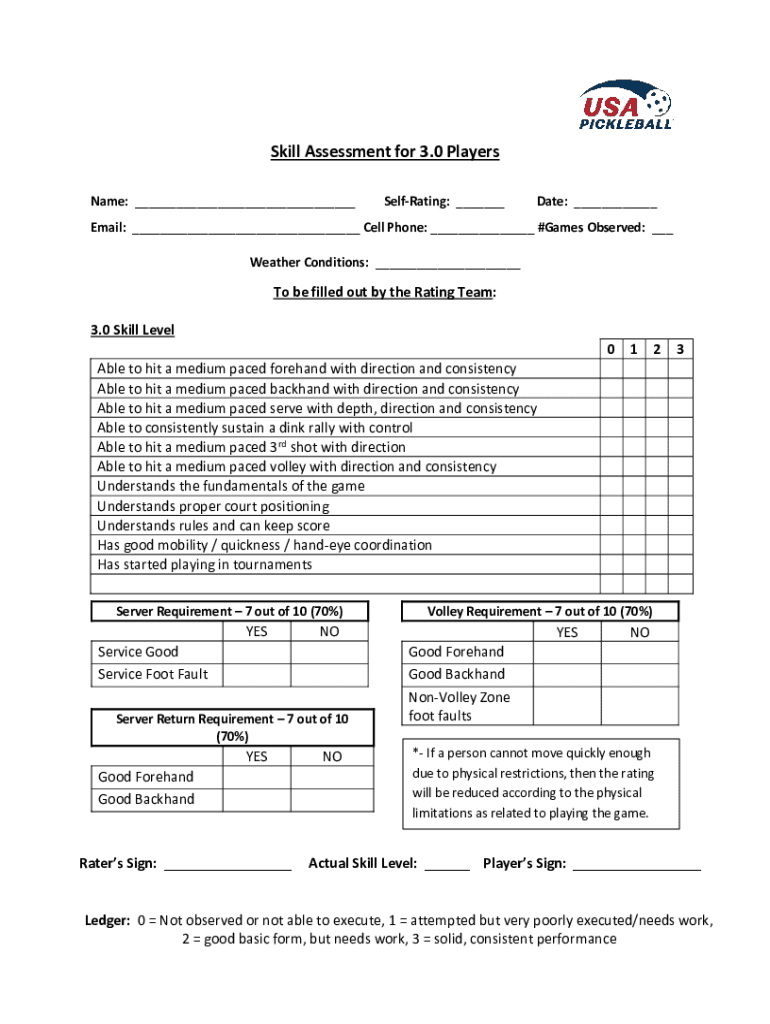
The "Skill Assessment For 30 Players - US Legal Forms" is a structured document used for evaluating the skill levels of players at a 3.0 ability level in sports such as pickleball. This evaluation form provides a comprehensive assessment for players, focusing on key competencies like forehand and backhand consistency, serve quality, court positioning, and understanding of game rules. It is designed to help coaches and assessment teams rate players effectively, allowing for a standardized evaluation process that can be used across various educational and competitive environments.
Key Aspects of the Assessment
- Forehand and Backhand Consistency: This examines the player's ability to consistently hit shots with accuracy using both the forehand and backhand strokes.
- Serve Quality: Evaluates the precision, power, and effectiveness of a player's serve, including the ability to serve under different circumstances.
- Dinking Ability: Assesses the player's competence in executing dink shots, which are soft shots intended to land near the net.
- Court Positioning: Judges how well the player positions themselves on the court in both offensive and defensive situations.
- Game Rule Understanding: Tests the player's knowledge of standard game rules and their ability to apply this understanding during play.
Steps to Complete the Skill Assessment Form
Completing the "Skill Assessment For 30 Players - US Legal Forms" involves a series of systematic steps aimed at capturing a player's skill profile accurately.
- Gather Personal Information: Start by documenting the player's basic personal details such as name, age, sport, and contact information.
- Self-Rating Section: Encourage players to assess and rate their skills in different areas of play, providing a self-evaluation perspective.
- Observation by Rating Team: The rating team should observe the players in action, taking notes on performance in various skill categories outlined in the form.
- Performance Evaluation: Use the form to rate each player’s skill level in specific categories, focusing on areas like consistency, serve quality, and overall game comprehension.
- Adjustments for Physical Limitations: Consider any physical limitations that may affect a player’s performance and make appropriate notations to provide a complete picture of their ability.
Important Terms Related to Skill Assessment Forms
Understanding the terminology associated with the "Skill Assessment For 30 Players" form ensures proper utilization and interpretation of the assessment data.
- Self-Rating: An evaluation section completed by players to reflect upon their own skill levels and areas for improvement.
- Rating Team: A group of evaluators or coaches responsible for independently assessing each player's skills.
- Volleyball Serve: An essential skill assessed in sports like volleyball, examining the ability to serve accurately and powerfully.
- Dink Shot: A strategic shot in pickleball used to neutralize the opponent’s offense by dropping the ball near the net.
- Consistency Rating: A measure of how consistently a player performs under specific in-game scenarios.
Legal Use of the Skill Assessment Form
The "Skill Assessment For 30 Players - US Legal Forms" is used legally within the context of sports organizations, educational institutions, and training camps. Its primary purpose is to standardize evaluations across diverse player groups, ensuring that each player receives a fair and impartial assessment of their abilities.
Compliance and Legal Standards
- ESIGN Act Compliance: The form can be completed electronically and signed in compliance with the ESIGN Act, ensuring that electronic signatures are legally binding.
- Data Protection Regulations: All personal data collected via the form must be managed in adherence to data protection laws, safeguarding players' privacy and information.
Key Elements of the Skill Assessment Form
The form encompasses several critical elements designed to capture comprehensive details about a player's abilities and areas for growth.
Essential Components
- Self-Assessment Section: A portion of the form where players provide their perspective on their skill level and training goals.
- Observer Notes: Space for rating team members to jot down insights and observations during live assessments of performance.
- Skill Ratings: A detailed matrix allowing evaluators to score players on specific skill sets, promoting a nuanced view of capability.
Who Typically Uses the Skill Assessment Form
This form is widely utilized by various entities within the sporting and educational sectors.
- Coaches and Trainers: Use the form to establish a baseline of player abilities and tailor training programs effectively.
- Educational Institutions: Schools and universities use it to gauge the competence of students participating in sports activities.
- Sports Organizations: Leagues and clubs rely on the form to assess players and make informed decisions about team composition and strategy.


Examples of Using the Skill Assessment Form
Practical applications of this form help illustrate its usefulness in real-world scenarios.
- Team Tryouts: During team selections, coaches use the form to objectively rank individuals based on their skills, ensuring a fair selection process.
- Seasonal Evaluations: Clubs implement the form as part of their evaluation process at season's end to guide player development plans for the following year.
- Player Development Workshops: The form becomes a key tool in workshops aimed at improving specific skills like serving and court positioning, offering a benchmark for progress.
Digital vs. Paper Version of the Form
The skill assessment form is available in both digital and paper formats, each offering unique advantages.
Digital Version Advantages
- Efficiency: Streamlines data entry and analysis through automated calculations and storage.
- Accessibility: Can be completed and submitted remotely, allowing for greater flexibility.
- Integration: Easily integrates with existing digital platforms for record-keeping and analytics.
Paper Version Benefits
- Tangible Records: Provides a physical document for users preferring traditional record-keeping methods.
- Simplicity: Requires no technological infrastructure, making it accessible anywhere.
Application Process and Approval Time
The application and approval process for utilizing this form in an organization often involve specific steps and timelines.
- Form Submission: Interested parties submit a request to the organizational body governing the assessments.
- Review and Approval: The request undergoes a review process to ensure compliance with organizational criteria.
- Implementation: Once approved, the form is distributed to relevant parties, ready for use in assessments.
- Evaluation Timeline: The entire process from application to use can span several weeks, depending on the organization's internal procedures.
Overall, the "Skill Assessment For 30 Players - US Legal Forms" serves as a robust tool for analyzing and improving player performance across multiple sports disciplines.




