
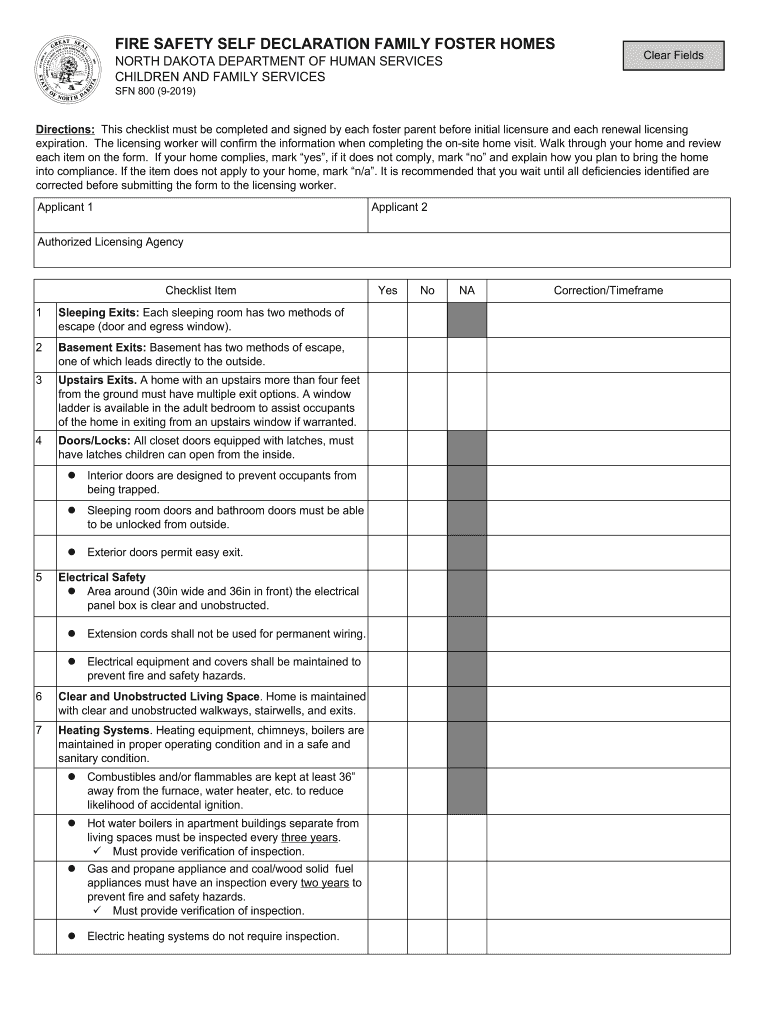







Definition and Meaning
The Fire Safety Self Declaration for Family Foster Homes is a critical document required for family foster homes to ensure compliance with fire safety standards set by governing authorities, specifically the Department of Human Services in North Dakota. It acts as a checklist that foster parents must complete to confirm that their home meets necessary fire safety requirements. By signing this declaration, foster parents assert that they have met the listed safety measures before initial licensure and during renewal periods.
Key Elements of the Fire Safety Self Declaration
This declaration encompasses several key safety elements vital to maintaining a secure environment in foster homes:
-
Exits: Verification of clear and unobstructed exits is mandatory. Each room must have a functional escape route in case of emergencies.
-
Smoke Alarms: Homes must be equipped with operational smoke alarms installed on every level and near sleeping areas. Regular testing to ensure functionality is advised.
-
Carbon Monoxide Alarms: If applicable, these alarms must be installed and functional in homes with fuel-burning appliances.
-
Fire Extinguishers: Properly placed and accessible fire extinguishers should be inspected regularly. Foster parents must demonstrate knowledge of their use.
-
Evacuation Plans: A well-documented evacuation plan is essential. Foster parents should ensure all household members are familiar with the plan.
Steps to Complete the Fire Safety Self Declaration
-
Review the Checklist: Thoroughly go through each requirement on the checklist to understand what needs to be verified.
-
Inspect the Home: Conduct a detailed inspection of your home, checking each item on the checklist, such as exits and alarm systems.
-
Test Safety Equipment: Ensure all alarms and fire extinguishers are working properly. Replace or repair any faulty equipment immediately.
-
Document and Sign: Once everything is in order, document your compliance by signing the declaration.
-
Submit the Declaration: Provide the completed form to the designated licensing worker during their on-site visit.
Why Use the Fire Safety Self Declaration
Utilizing this self-declaration form ensures that a family foster home complies with fire safety standards. It preemptively identifies potential hazards and rectifies them before they result in harm. This form not only protects the foster families but also the children under their care by providing a safe living environment.
Legal Use of the Fire Safety Self Declaration
The self-declaration form holds legal significance as it forms part of the documentation required for obtaining and renewing a family foster home license. Foster parents are legally bound to comply with the outlined safety standards and provide truthful information in their self-declaration, which is subject to verification by licensing agents.
Obtaining the Fire Safety Self Declaration
Foster parents can obtain this form from the North Dakota Department of Human Services. It may be available for download from the department’s official website or provided during initial licensing meetings.
Examples of Using the Fire Safety Self Declaration
-
Scenario A: A family looking to renew their foster home license uses the self-declaration form to ensure their smoke alarms are up to date and fully functional, following a recent kitchen renovation.
-
Scenario B: A couple, newly licensed as foster parents, utilizes the form to create a robust emergency evacuation plan with their children, practicing monthly drills to familiarize everyone with the escape procedure.
State-Specific Rules for Fire Safety Self Declaration
While the focus here is on North Dakota, foster homes in different states may be subject to varied regulations concerning fire safety. It's crucial for foster parents to understand the specific requirements applicable in their state and maintain compliance through regular updates on standards provided by their state’s human services department.




