







Definition and Meaning
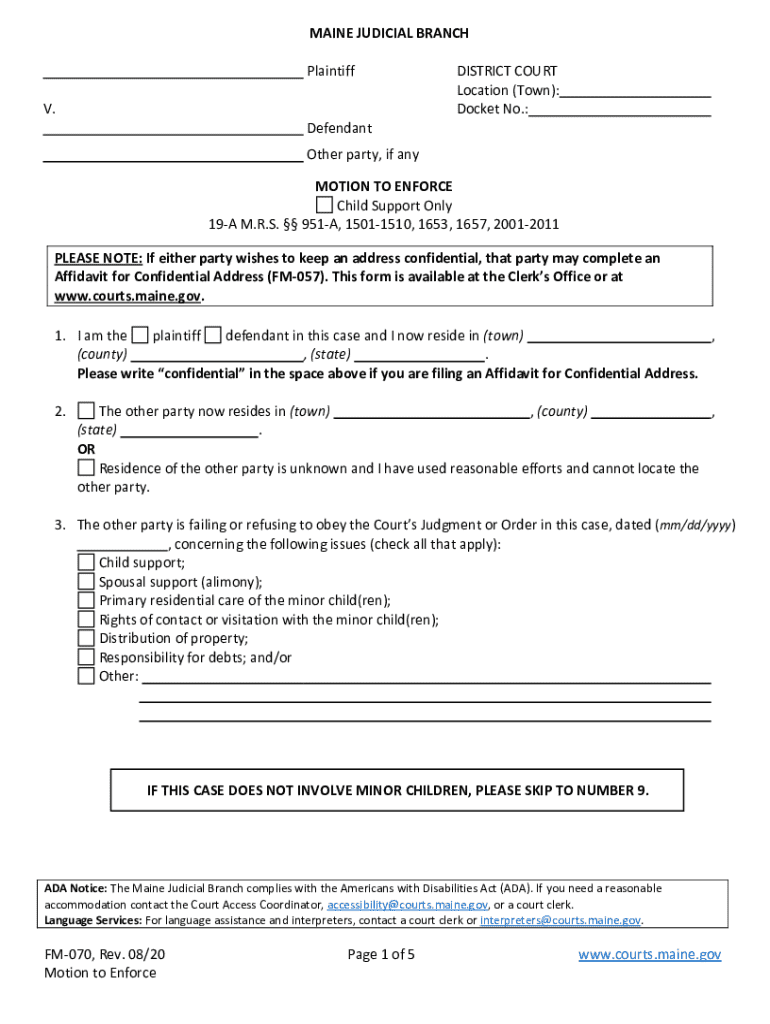
The Maine Judicial Branch FM-070, Rev 08 20 Page 1 of, is a legal form under the jurisdiction of the Maine Judicial Branch. It is used primarily in cases involving enforcement of a court's prior judgment or order. This often relates to child support, spousal support, custody, visitation rights, and property distribution. The form captures important details about compliance with court decisions and requests further legal action. Understanding the purpose of this document is crucial for individuals involved in family law disputes or enforcement proceedings.
Key Elements of the Form
The form contains several critical components that the plaintiff or defendant must fill out accurately. Key elements include:
- Personal Information: Details regarding the parties involved, which may include names, addresses, and contact information.
- Non-Compliance Details: Information about which specific orders or judgments have not been followed by the opposite party.
- Requested Relief: A section where the filer specifies the type of enforcement they seek from the court to address the non-compliance.
Each section of the form serves an essential purpose, ensuring that the court has all the necessary details to make a informed decision on the enforcement request.
Steps to Complete the Form
Completing the Maine Judicial Branch FM-070 requires attention to detail and accuracy. Here’s a step-by-step guide:
- Gather Necessary Information: Collect all relevant personal information and any documentation related to the original judgment or order.
- Fill Out Personal Details: Enter the necessary information about yourself and the other party involved accurately.
- Detail Non-Compliance: Clearly outline which specific orders have been violated and provide any evidence supporting your claim.
- Specify the Relief Sought: Clearly describe what enforcement action you are requesting from the court.
- Review and Sign: Double-check that all information is complete and correct before signing the form. If required, get the form notarized.
- File the Form: Submit the completed form to the appropriate court office as directed by court instructions.
How to Obtain the Form
Obtaining the Maine Judicial Branch FM-070 form can be done through several methods. Here’s how:
- Visit the Judicial Branch Website: The form may be downloadable from the Maine Judicial Branch’s official website.
- Contact the Court Clerk: Get a copy by visiting the local court where the case is filed or calling the court clerk’s office.
- Legal Assistance: Attorneys often have access to these forms and can provide guidance on completion.
Regardless of the method, it is essential to ensure that you are using the latest version of the form.
Who Typically Uses the Form
This form is generally utilized by individuals involved in family law, either as plaintiffs or defendants, seeking to enforce court orders related to family matters. Common users include:
- Plaintiffs: Individuals who have previously received a favorable judgment and are seeking enforcement.
- Defendants: Respondents who are required to comply with the court-ordered actions.
- Legal Representatives: Attorneys acting on behalf of clients to facilitate the legal process.
Understanding who uses the form helps identify the appropriate context for its application.


Important Terms Related to the Form
Familiarity with certain legal terminologies is vital when dealing with the FM-070 form:
- Judgment: The official decision handed down by a court regarding the legal matters in question.
- Enforcement: The act of compelling compliance with a court order.
- Plaintiff: The party that initiates the request to enforce the court’s decision.
- Defendant: The party against whom enforcement is sought.
These terms help in comprehending the roles and procedures involved in completing and submitting the form.
Legal Use of the Form
The form serves as an official request to the court for intervention in cases of non-compliance with established orders. Legal use ensures:
- Adherence to Court Decisions: Enables the enforcement of existing judgments, maintaining the integrity of court rulings.
- Substantiated Claims: Requires detailed documentation and rationalization for court intervention.
- Protection of Rights: Provides a legal avenue for protecting the interests and rights of the injured party.
Adhering to the specified use of this form is crucial for compliance with legal standards.
State-Specific Rules
While the FM-070 form is used within Maine, specific state rules govern its use:
- Local Court Procedures: Requirements may differ by county regarding how and where the form is submitted.
- Statutory Compliance: Adherence to Maine’s family law statutes is required when completing the form.
- Court-Specific Instructions: Specific courts may have additional documentation or procedural requirements.
Awareness of these state-specific rules ensures compliance and facilitates a smoother legal process.




