01. Edit your form online
Type text, add images, blackout confidential details, add comments, highlights and more.

Type text, add images, blackout confidential details, add comments, highlights and more.

Draw your signature, type it, upload its image, or use your mobile device as a signature pad.

Send it via email, link, or fax. You can also download it, export it or print it out.
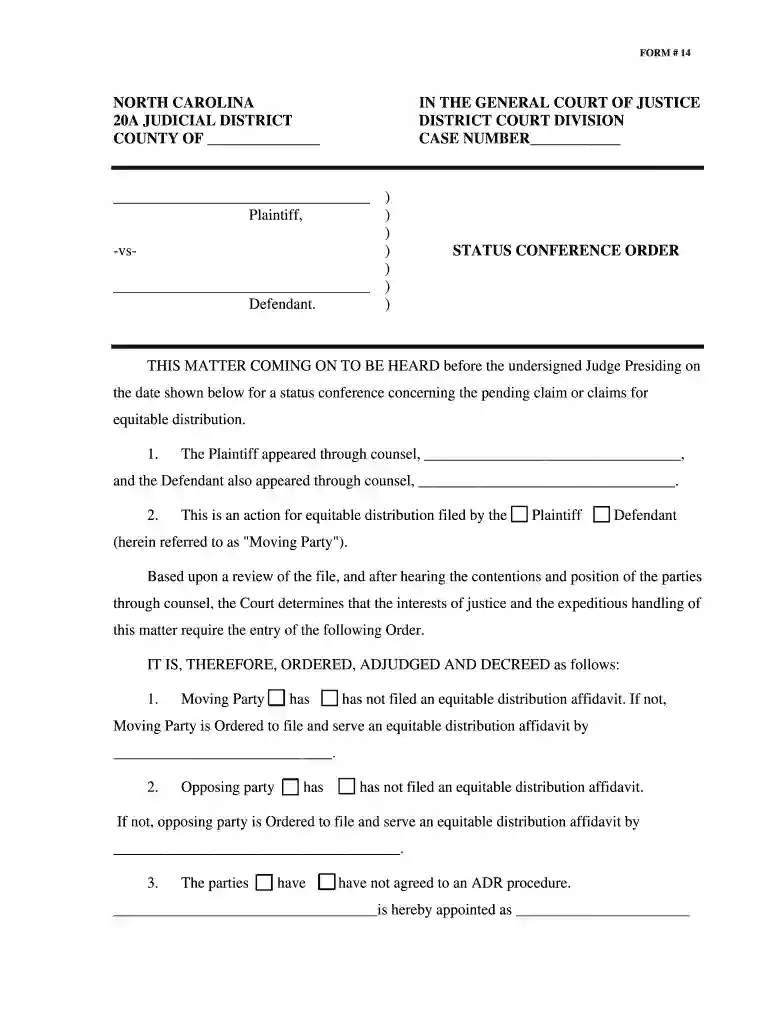
The "fillable Status Conference Order - The North Carolina Court System" is a legal form used in the North Carolina District Court specifically for cases involving equitable distribution. This document facilitates the management of court-related activities by outlining the schedule, appearances, and required submissions for both parties involved, typically the plaintiff and defendant. The order focuses on organizing the pretrial processes and streamlining dispute resolution through the use of structured affidavits and proposed orders.
Using the "fillable Status Conference Order - The North Carolina Court System" involves several steps to ensure that the document is completed correctly and adheres to legal standards. It is designed to be user-friendly, providing an interactive platform to enter necessary details directly.
Access the Form: Obtain the form through the North Carolina Court System's website or use platforms like DocHub for editing.
Enter Case Details: Fill in the case number, names of the parties involved, and their respective legal counsels.
Schedule and Deadlines: Input the scheduled dates for submission of equitable distribution affidavits and deadlines for any proposed pretrial orders.
Alternative Dispute Resolution: Indicate if ADR procedures such as mediation are to be used, and provide relevant dates if applicable.
Signature and Submission: Ensure that all necessary fields are filled and sign the document digitally if required. Submit the form as directed, whether it's through mail, online, or in person.
Obtaining the form is straightforward and can be done through various channels to suit your needs. The aim is to provide flexibility in accessing this crucial legal document.
Completing the form requires careful attention to detail, ensuring compliance with the legal framework set by the North Carolina courts.
Initial Information: Start by filling out basic identifying information, including case and party details.
Set Appearances: Specify the attorneys and parties who will make court appearances along with their roles.
Adhere to Filing Requirements: Follow the form's guidance on submitting necessary equitable distribution affidavits and documents by specified deadlines.
Confirm ADR Procedures: Determine and confirm any ADR steps, ensuring all parties agree to the mentioned procedures.
Finalize and Review: Double-check all entries for accuracy and completeness before submitting the form to prevent any delays or issues in court proceedings.
Understanding the fundamental components of the document is crucial for effective use and fulfillment of court requirements.
Case Information: Includes critical judicial details such as case number, court dates, and presiding judge.
Parties Involved: Details of the plaintiff and defendant, including their legal representatives.
Filing Instructions: Lists all documents required as part of the equitable distribution process, along with pertinent deadlines.
ADR Options: Dispute resolution methods, if engaged, to foster settlement outside traditional court settings.
The form serves a vital role in legal proceedings by streamlining pretrial activities related to equitable distribution within family law.
Documentation: Acts as a formal record of all proceedings and submissions related to the case.
Compliance: Ensures all parties adhere to court mandates and schedules.
Dispute Resolution: Facilitates the use of ADR, when applicable, to potentially resolve issues outside of court, expediting the legal process.
The document finds its application primarily in divorce cases specifically focused on equitable distribution, showing its utility in real-world scenarios.
Divorce Settlements: When couples amicably agree on property division, the form aids in outlining and formalizing these agreements.
Court-Mandated Orders: In contentious cases, it helps solidify the court's decisions, scheduling trial dates and submission requirements more effectively.
Platforms such as DocHub provide enhanced functionality for editing and completing the "fillable Status Conference Order," ensuring cross-platform convenience.
PDF Editing: Seamlessly edit PDF forms alongside document replicas such as DOC and XLS.
Cloud Integration: Allows for importing and exporting to major cloud services like Google Drive, eliminating local limitations.
We've got more versions of the (fillable) Status Conference Order - The North Carolina Court System form. Select the right (fillable) Status Conference Order - The North Carolina Court System version from the list and start editing it straight away!
At DocHub, your data security is our priority. We follow HIPAA, SOC2, GDPR, and other standards, so you can work on your documents with confidence.