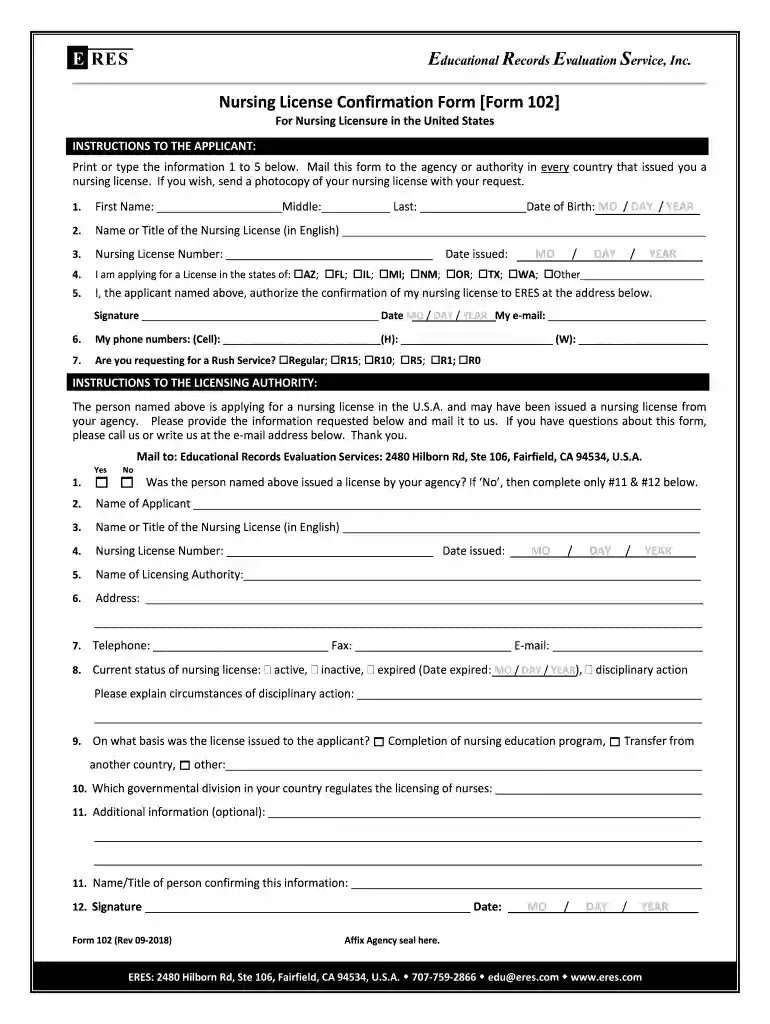
Eres form 102 2026

Get Form
eres form 102 Preview on Page 1

Here's how it works

01. Edit your eres form 102 online
Type text, add images, blackout confidential details, add comments, highlights and more.

02. Sign it in a few clicks
Draw your signature, type it, upload its image, or use your mobile device as a signature pad.

03. Share your form with others
Send eres evaluation via email, link, or fax. You can also download it, export it or print it out.

Definition and Purpose of the ERES Form 102

The ERES Form 102 is a vital document used for the verification of nursing licenses in the United States through the Educational Records Evaluation Service (ERES). Its primary purpose is to assist nursing candidates in confirming their qualifications to the relevant state nursing boards. By completing this form, applicants ensure that their educational history and licensure details are formally recognized and evaluated for compliance with state-specific criteria.

Key Components of the ERES Form 102

  • Personal Information: This section typically includes the applicant's full name, contact information, and any previous names used.
  • Nursing License Details: Applicants must provide information about their nursing license, including the issuing state, license number, and expiration date.
  • Licensing Authority Requests: The form includes a section for the applicants to request confirmation from various licensing authorities, which is crucial for the evaluation process.

The ERES Form 102 plays a significant role in ensuring that candidates meet necessary requirements before applying for the nursing licensure examination in their respective states.

Completing the ERES Form 102

Filling out the ERES Form 102 requires careful attention to detail to ensure all information is accurate and complete. Here is a step-by-step guide to assist applicants in completing the form properly.

  1. Gather Personal Documentation: Before starting the form, collect all relevant documents, including your nursing license, transcripts, and identification.
  2. Fill in Personal Details: Start by entering your current name and contact information. If you have changed your name, include previous names in the section provided.
  3. Input Nursing License Information: Accurately reflect the details of your nursing license, specifying the state of issuance and license number. It is essential to double-check this information for accuracy.
  4. Complete Licensing Authority Requests: Identify the authorities from which confirmation is needed. This section may require additional documentation or signatures from those authorities.
  5. Review and Submit: After completing the form, review all entries for spelling and accuracy. Submit the form electronically or via mail, depending on the requirements outlined by ERES.

Ensuring that each of these steps is rigorously followed will contribute to a seamless evaluation process.

Required Documents for ERES Form 102 Submission

Submitting the ERES Form 102 entails providing supporting documents to validate the information provided within the form. The following documents are commonly required:

  • Nursing License Copy: A clear photocopy of the nursing license is necessary for verification purposes.
  • Official Transcripts: Transcripts from nursing programs should be sent directly from the educational institution to ERES.
  • Identification Proof: A copy of a government-issued ID, such as a driver’s license or passport, may be required to confirm identity.

Additional documents may be included based on the state in which licensure application is being sought, so applicants should consult their specific licensing board for additional requirements.

Evaluation Process of the ERES Form 102

Once submitted, the ERES Form 102 undergoes a thorough evaluation process designed to ensure compliance with state nursing standards. Understanding this process can help applicants know what to expect.

  • Document Verification: ERES begins by verifying the authenticity of the submitted documents. This may involve contacting educational institutions or licensing boards.
  • Assessment of Educational Background: The evaluation then proceeds to assess the applicant's educational qualifications against the requirements of the state nursing board.
  • Final Approval and Recommendations: Following the assessment, a report is generated detailing whether the applicant meets the necessary criteria for licensure. This report is sent to the relevant state authority, and applicants are notified accordingly.

This structured evaluation process ensures that only qualified candidates are endorsed for licensure.

Legal Implications of the ERES Form 102

The ERES Form 102 is governed by legal standards defined by nursing boards and educational evaluation services across the United States. Understanding these legal implications helps ensure compliance and can safeguard applicants against potential issues.

  • Confidentiality and Data Protection: All information provided on the ERES Form 102 is treated with high confidentiality to protect sensitive personal data.
  • Compliance with State Regulations: The form must comply with state-specific regulations related to nursing licensure. It is crucial that applicants check the rules relevant to the state where they seek licensure.
  • Consequences of Misrepresentation: Providing false information or failing to disclose necessary facts can lead to penalties, including the denial of licensure or future employment consequences.

Being aware of these legal considerations can help applicants navigate the process responsibly.

Important Contacts for ERES Form 102 Assistance

For applicants navigating the ERES Form 102, it is essential to have access to relevant contacts for assistance and clarification. The following resources can be helpful:

  • Educational Records Evaluation Service: Direct communication with ERES can clarify specific form-related queries or procedural issues.
  • State Nursing Boards: Each state has a nursing board that can provide guidance on specific requirements and the evaluation process relevant to ERES.
  • Professional Associations: Organizations such as the American Nurses Association can provide support and resources for valuable insights into the licensure process.

Utilizing these contacts can enhance the application experience and ensure that candidates receive comprehensive support throughout the evaluation process.

Common Issues with ERES Form 102 Submission

Understanding potential challenges during the submission of the ERES Form 102 can help applicants mitigate risks and ensure a smooth process. Common issues include:

  • Incomplete Applications: Missing information can lead to delays or denial of the form's acceptance. It is vital to double-check all fields and required documents.
  • Document Authentication Issues: Failure to submit required supporting documents or failure of educational institutions to send transcripts directly can complicate the evaluation process.
  • Misunderstanding State Requirements: Each state may impose specific requirements that differ from the general instructions provided with the ERES Form 102. Researching state-specific guidelines is essential for compliance.

By being aware of these potential issues, applicants can take proactive steps to avoid them and promote a successful evaluation outcome.

See more eres form 102 versions

We've got more versions of the eres form 102 form. Select the right eres form 102 version from the list and start editing it straight away!
Versions Form popularity Fillable & printable
2021 4.8 Satisfied (173 Votes)
2018 4.8 Satisfied (158 Votes)
2014 4 Satisfied (26 Votes)
be ready to get more

Complete this form in 5 minutes or less

Get form

Security and compliance

At DocHub, your data security is our priority. We follow HIPAA, SOC2, GDPR, and other standards, so you can work on your documents with confidence.

Learn more
ccpa2
pci-dss
gdpr-compliance
hipaa
soc-compliance
be ready to get more

Complete this form in 5 minutes or less

Get form