




01. Edit your form online
Type text, add images, blackout confidential details, add comments, highlights and more.

Type text, add images, blackout confidential details, add comments, highlights and more.

Draw your signature, type it, upload its image, or use your mobile device as a signature pad.

Send it via email, link, or fax. You can also download it, export it or print it out.
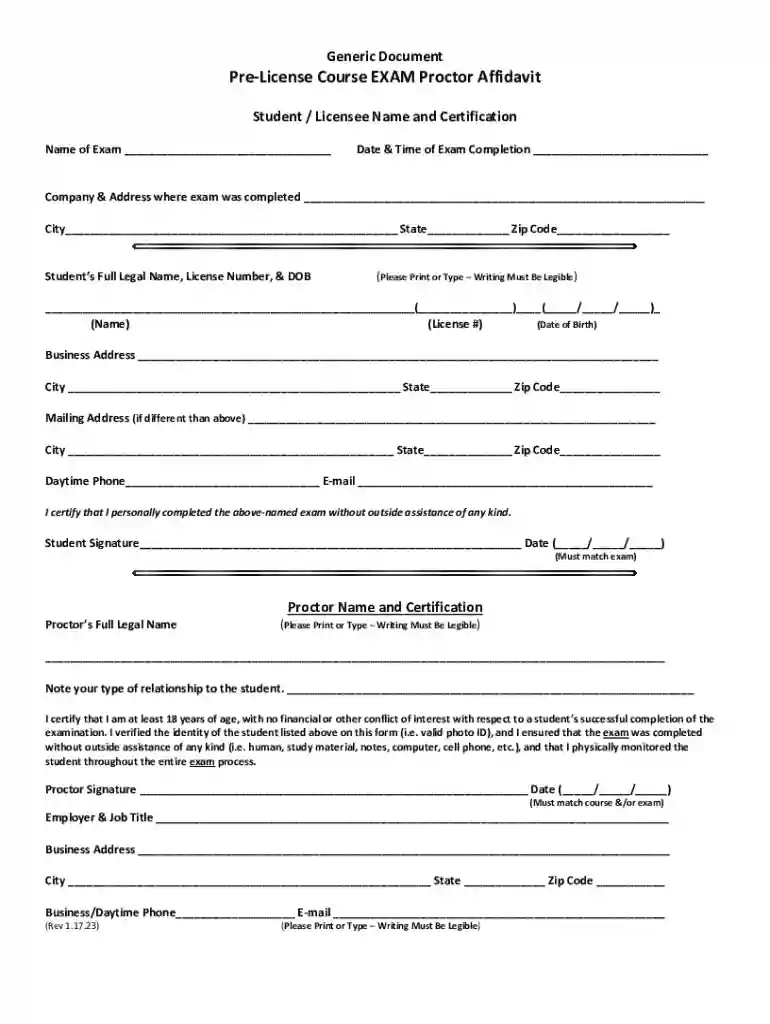
The CE Course and Exam Proctor Affidavit is a formal document used in educational settings, primarily within continuing education environments, to verify the authenticity of a student's completion of a course or exam. This affidavit serves as a safeguard against unauthorized assistance during the completion process. It includes sections for student details, proctor verification, and necessary signatures. This document ensures integrity in educational assessments, a crucial aspect when certification or licensure depends on the genuine effort and knowledge of the participant.
Gather Necessary Information: Start by collecting pertinent details such as student identification, course or exam information, and proctor details.
Complete Student Information: Fill in the student section accurately, including full name, contact information, and any relevant student identification numbers.
Proctor Verification: The proctor must complete their designated section, affirming that the exam or course was undertaken without unauthorized assistance. This section typically includes the proctor's contact information and credentials.
Secure Signatures: Both student and proctor must sign the document. The signatures certify that both parties agree to the document's stipulations and understand its legal implications.
Review and File: Double-check all information for completeness and accuracy before submitting or filing.
Submission and Record Keeping: Submit the completed form to the relevant educational authority and keep a copy for personal records, as these forms are typically retained for several years.
The CE Course and Exam Proctor Affidavit is utilized mainly in the context of ensuring exam integrity. Here's how to effectively apply it:
Educational Institutions: Institutions implement these affidavits as part of their examination protocols to certify that all assessments meet their academic standards.
Students: Participants are required to complete and submit the affidavit as a prerequisite for the validation of their exam or course completion.
Proctors: They affirm that they supervised the exam under the guidelines provided by the education provider, confirming no unfair means were employed.
Educational Providers: Universities, colleges, and online education platforms that offer continuing education courses use this affidavit to uphold academic integrity.
Students: Individuals enrolled in continuing education courses, particularly those that require official certification or licensure, typically use these affidavits.
Exam Proctors: Designated individuals responsible for overseeing the exam process must authenticate the conditions under which the exam was taken.


The CE Course and Exam Proctor Affidavit is composed of several critical components that ensure comprehensive and reliable verification:
Student Information Section: Includes personal details of the individual taking the exam or course.
Course/Exam Details: Specifies the nature of the course or exam, including date, time, and location.
Proctor Verification Section: Confirms that the exam conditions were controlled and complaint-free during the session.
Signature Blocks: Provides spaces for the essential signatures, attesting to the accuracy and truthfulness of the document's content.
Compliance with Educational Standards: Ensures adherence to institutional and legal standards required for accredited educational programs.
Protection Against Fraud: Acts as a legal checkpoint to deter and penalize fraudulent claims of course or exam completion.
Record Keeping: Functions as a formal, legal record that institutions can reference in disputes or audits related to academic honesty.
Different states may have varying regulations regarding the use of proctor affidavits in educational settings, which can include:
Verification Processes: States may have unique guidelines concerning how proctor verification should be conducted and documented.
Retention Periods: The period for which educational institutions must archive these documents may differ from state to state.
Legal Recognition: While universally important, the recognition of such documents' legal binding nature may vary depending on state laws.
Ensuring Fairness: Highlights the commitment of educational institutions to equitable standards, ensuring all students are evaluated under similar conditions.
Credibility and Trust: Builds trust among stakeholders, including employers and licensing bodies, by demonstrating adherence to exacting standards for evaluations.
Regulatory Compliance: Helps institutions remain compliant with education regulations, supporting accreditation and recognition of their programs.
Proctor: An authorized individual who supervises examinations to maintain academic integrity.
Affidavit: A written statement confirmed by oath or affirmation, used as evidence of completion under specific conditions.
Continuing Education: Courses or programs undertaken after the usual years of formal education, often required to maintain licenses or certifications.
Digital Version: Offers electronic completion and submission, often integrated with learning management systems for efficiency.
Paper Version: Traditional approach, may require physical collection and storage, ensuring accessibility for all participants in various settings.
Both formats provide viable options depending on institutional capabilities and student access to digital resources, underscoring the adaptability to diverse educational environments.
We've got more versions of the CE Course and or Exam Proctor Affidavit form. Select the right CE Course and or Exam Proctor Affidavit version from the list and start editing it straight away!
At DocHub, your data security is our priority. We follow HIPAA, SOC2, GDPR, and other standards, so you can work on your documents with confidence.

This form must be completed signed by the qualifying Proctor. This completed form MUST be attached to a completed student Affidavit form
The following is to be completed by the exam proctor for each course earning CE credit through The American College.


