01. Edit your 67 10 1 form online
Type text, add images, blackout confidential details, add comments, highlights and more.

Type text, add images, blackout confidential details, add comments, highlights and more.

Draw your signature, type it, upload its image, or use your mobile device as a signature pad.

Send 2019 dod 6710 1 plate officer evaluation report word via email, link, or fax. You can also download it, export it or print it out.
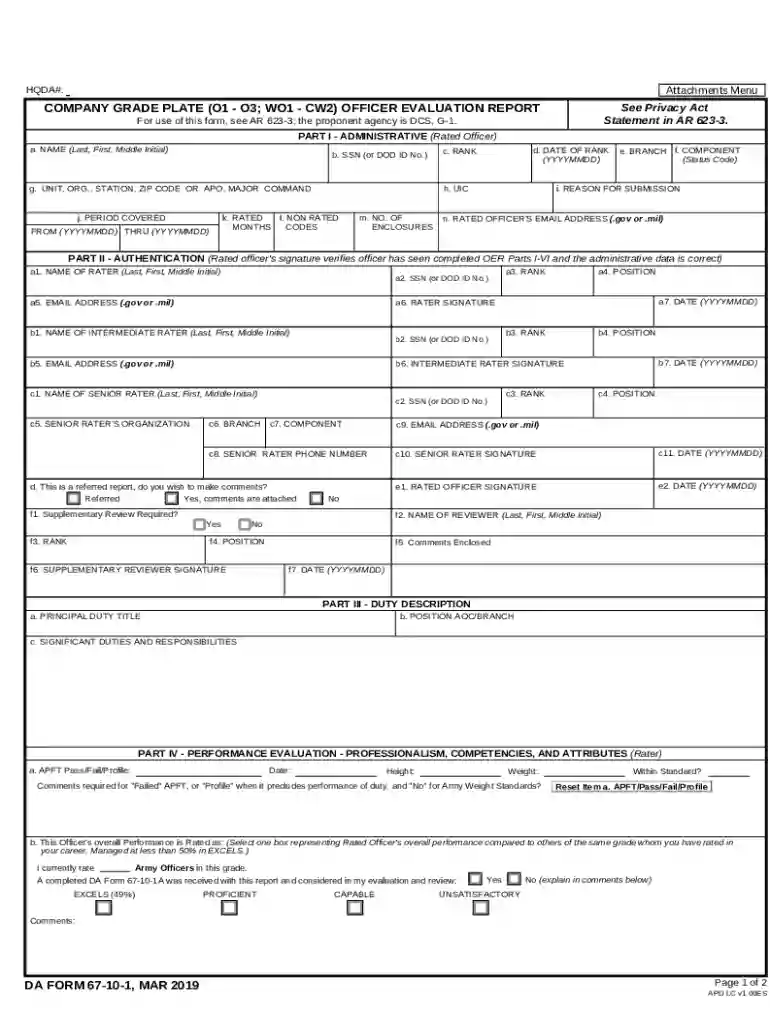
The DA Form 67-10-1, also referred to as the Company Grade Plate Officer Evaluation Report, is a critical document within the United States Army. This form serves to evaluate the performance and potential of officers in ranks O1 to O3, as well as warrant officers ranked WO1 to CW2. It aligns with the guidelines in AR 623-3. The form plays a pivotal role in the career progression of military personnel by providing a structured assessment format that includes sections for administrative details, performance evaluations, and potential assessments.
This evaluation report comprises several critical components:
To obtain the DA Form 67-10-1, personnel can access it through the Army Publishing Directorate website or through their unit's administrative office. This ensures that the latest version of the form is used, complying with all current regulations and guidelines.
Completing the DA Form 67-10-1 requires attention to detail and adherence to established guidelines:
The primary users of the DA Form 67-10-1 are:


The DA Form 67-10-1 is legally significant as it impacts decisions related to promotions, assignments, and retention within the Army. It is imperative for raters to be honest and precise in their evaluations to ensure fairness and integrity in the evaluation process.
Evaluators focus on several key areas when assessing performance and potential:
The completed DA Form 67-10-1 must be submitted according to established military protocols, often via the unit's administrative channels. It is critical to maintain copies for personal records and ensure they are accessible for future evaluations or appeals.
While the DA Form 67-10-1 is a federal document, it is subject to uniform military regulations rather than state-specific rules. However, officers based in different states should be aware of any local administrative procedures related to the submission of performance evaluations.
Each section of the DA Form 67-10-1 provides a comprehensive analysis of an officer’s current state and future potential, utilizing clear criteria to ensure fair and thorough evaluations across the Army. Understanding and navigating this form are crucial for career development within the military framework.
We've got more versions of the 67 10 1 form form. Select the right 67 10 1 form version from the list and start editing it straight away!
At DocHub, your data security is our priority. We follow HIPAA, SOC2, GDPR, and other standards, so you can work on your documents with confidence.