Temperature Log for Refrigerator Fahrenheit - sfdph 2026

Get Form
Temperature Log for Refrigerator Fahrenheit - sfdph Preview on Page 1

Here's how it works

01. Edit your form online
Type text, add images, blackout confidential details, add comments, highlights and more.

02. Sign it in a few clicks
Draw your signature, type it, upload its image, or use your mobile device as a signature pad.

03. Share your form with others
Send it via email, link, or fax. You can also download it, export it or print it out.

Definition and Purpose of the Temperature Log for Refrigerator Fahrenheit - sfdph

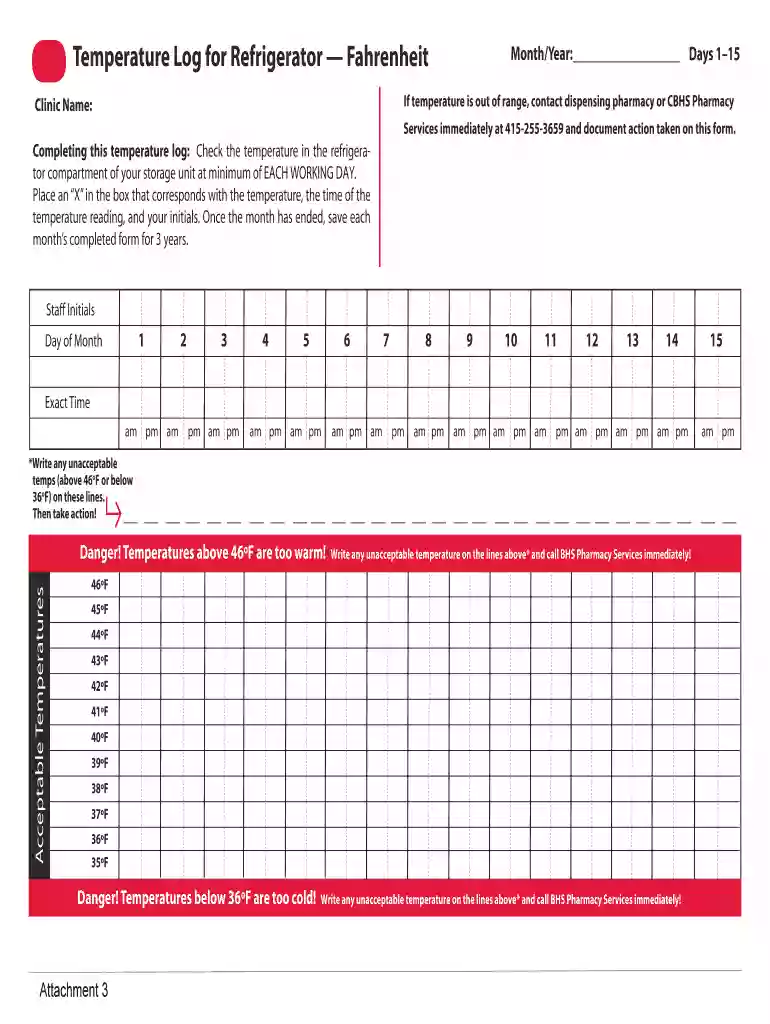
The Temperature Log for Refrigerator Fahrenheit - sfdph is a crucial document utilized in clinical settings to diligently monitor and document the temperatures of refrigerators. This log is primarily used to ensure that the temperature remains within a specified range to maintain the integrity and safety of stored medical and pharmaceutical products. This practice minimizes the risk of spoilage, contamination, or ineffective medications due to improper storage conditions. The form serves as an official record that can be retained for auditing purposes.

How to Use the Temperature Log for Refrigerator Fahrenheit - sfdph

Using the Temperature Log for Refrigerator Fahrenheit - sfdph involves a systematic approach to capture temperature data accurately. Typically, personnel are required to record the refrigerator's temperature daily, which ensures any fluctuations are promptly addressed. Each entry should include:

  • The date of the reading
  • The recorded temperature in Fahrenheit
  • Initials of the person documenting the entry

In cases where the temperature deviates from the acceptable range, staff must note the deviation and any corrective actions taken, such as adjusting the thermostat or contacting maintenance services.

Key Elements of the Temperature Log for Refrigerator Fahrenheit - sfdph

Understanding the structure and components of the Temperature Log for Refrigerator Fahrenheit - sfdph is vital:

  • Temperature Range: Defines the acceptable temperature range, such as 35°F to 46°F, ensuring stored items remain safe.
  • Action Plan: Outlines steps to be taken if the temperature is outside the acceptable range, including adjustments and notifications.
  • Monthly Monitoring: Emphasizes that logs must be updated daily for each month and securely stored for a minimum of three years for verification and compliance purposes.
  • Signature Field: Requires validation through initials or signatures from the responsible staff member to verify that the readings were conducted accurately and consistently.

Steps to Complete the Temperature Log for Refrigerator Fahrenheit - sfdph

To correctly fill out the Temperature Log, follow these detailed steps:

  1. Start of Day Reading: Take the initial temperature reading at the beginning of the workday.
  2. Document Temperature: Record the temperature in the designated column next to the corresponding date.
  3. Verify Conditions: Ensure the refrigerator maintains the specified temperature range and functions properly.
  4. Address Deviations: If the temperature deviates, document the issues and corrective actions undertaken.
  5. End of Day Review: Reassess to confirm that any irregularities have been corrected and record a final reading if necessary.
  6. Weekly Summarization: Summarize the week's entries to highlight any trends or recurring issues.

Why Use the Temperature Log for Refrigerator Fahrenheit - sfdph

The utility of the Temperature Log for Refrigerator Fahrenheit - sfdph lies in its ability to:

  • Maintain pharmaceutical efficacy by storing products under optimal conditions.
  • Ensure regulatory compliance by adhering to storage guidelines set by health authorities.
  • Facilitate quick responses to temperature fluctuations, thereby minimizing risk to inventory.
  • Aid in investigations or audits by providing documented proof of consistent and correct storage practices.

State-Specific Rules for Temperature Log Compliance

While the overarching principles of using the Temperature Log for Refrigerator Fahrenheit - sfdph are similar across the United States, certain specifics may vary depending on state regulations concerning health and safety codes. For example:

  • Some states might have more rigorous reporting requirements or additional fields.
  • Variations may exist in required temperature ranges based on local climate zones or product storage needs.

Healthcare facilities should consult with local health departments to ensure complete adherence to state-specific rules.

Examples of Using the Temperature Log for Refrigerator Fahrenheit - sfdph

Here are a few practical examples to illustrate the application:

  • Scenarios in Hospitals: Hospitals might use the log to monitor quarantined medications or vaccines, ensuring that drugs remain safe for patient administration.
  • Pharmacy Applications: Pharmacy operational compliance often involves using these logs to monitor and report on temperature stability, reducing the risk of stock wastage.
  • Research Laboratories: Labs handling temperature-sensitive reagents require precise monitoring to maintain their experiment's integrity.

Digital vs. Paper Version of Temperature Logs

Advancements in technology offer options for both digital and paper formats:

  • Digital Logs: Provide convenience and reduce the risk of data loss; features like automated reminders and alerts for temperature irregularities are common.
  • Paper Logs: Ensure simplicity and may be preferred in operations with limited digital access or resources. They serve as straightforward records during inspections.

Utilizing the correct version depends on facility resources, preference, and the need for advanced features incorporated in digital solutions.

be ready to get more

Complete this form in 5 minutes or less

Get form

Got questions?

We have answers to the most popular questions from our customers. If you can't find an answer to your question, please contact us.
Contact us
How To Fill In A Temperature Record Sheet Location or name of the appliance. Time - note down the exact time of the check. Temperature - check the temperatures of appliances by using either a probe or the internal temperature gauge on the appliance. Name/initials - indicate who carried out the temperature check.
Most experts recommend that the ideal temperature setting for a refrigerator is between 35-38F (1.6-3.3C). This temp ensures food safety by giving a 2-5 degree buffer in case the temperature gauge isnt wholly accurate.
What Temperature Should a Refrigerator Be? ing to the US Department of Energy, the recommended temperature range to ensure food safety and optimal freshness is between 35F (1.7C) and 38F (3.3C).
Your refrigerator should be set at or below 40F (4C) to keep food safe and prevent bacterial growth. Ideally, the temperature for the refrigerator is around 37F (3C). For the freezer, the temperature should be 0F (-18C) or lower.
0:03 0:40 And then to get out of this mode you hit the ice. Type button on the far. Left. You have now changedMoreAnd then to get out of this mode you hit the ice. Type button on the far. Left. You have now changed the refrigerator from Fahrenheit to Celsius remember to always refer to your use and care guide.

Security and compliance

At DocHub, your data security is our priority. We follow HIPAA, SOC2, GDPR, and other standards, so you can work on your documents with confidence.
Learn more
ccpa2
pci-dss
gdpr-compliance
hipaa
soc-compliance
be ready to get more

Complete this form in 5 minutes or less

Get form

People also ask

The ideal refrigerator temperature is about 37F (3C). However, a range of 3340F (04C) is generally accepted as safe for most purposes.
The ideal temperature settings for the freezer and refrigerator compartments are -19C and 3C (-2F and 38F).

Related links