




01. Edit your form online
Type text, add images, blackout confidential details, add comments, highlights and more.

Type text, add images, blackout confidential details, add comments, highlights and more.

Draw your signature, type it, upload its image, or use your mobile device as a signature pad.

Send it via email, link, or fax. You can also download it, export it or print it out.
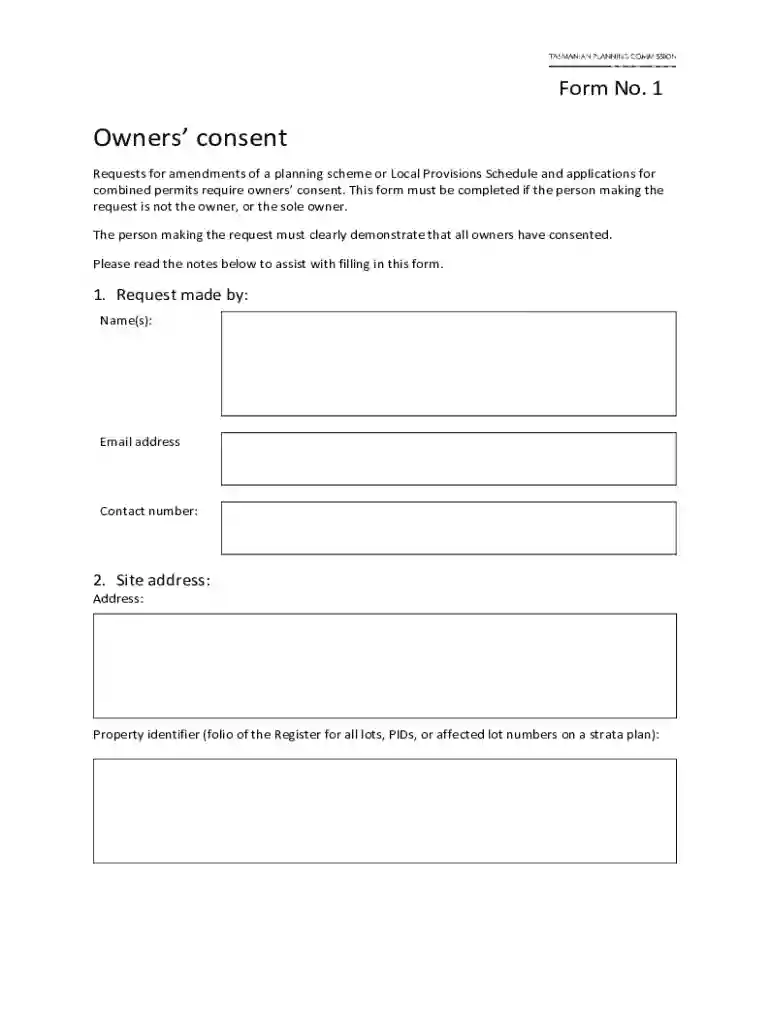
The "Form No 1 Owners Consent" is a crucial legal document used primarily in property-related transactions within the United States. It serves the purpose of obtaining consent from all registered landowners for amendments to planning schemes or applications for combined permits. The form ensures that changes to land use or ownership have the explicit approval of all parties with a vested interest in the property. This document is essential for maintaining transparency and legal compliance in property dealings.
Using the Form No 1 involves several key steps to ensure compliance and proper documentation:
Determine Necessity: Before proceeding, confirm whether the form is required for your specific transaction. This typically applies if you are seeking to alter planning schemes or obtain permits that affect land use.
Identify Signatories: List all registered landowners who need to provide consent. This may include individuals, corporate entities, or parties involved in joint ownership.
Complete the Form: Fill out the necessary sections, ensuring all fields are accurately completed. This includes providing personal details of owners and specifying the proposed changes or applications.
Obtain Signatures: Each listed owner must review and sign the document. Ensure signatures are witnessed where necessary, as per state-specific regulations.
Submit the Form: Once completed and signed, submit the form to the appropriate governmental or planning authority for processing.
Completing the Form No 1 Owners Consent accurately is essential to avoid delays or legal complications. Here's a detailed step-by-step guide:
Gather Necessary Information: Compile all relevant details about the property and the parties involved. This includes legal descriptions of the property, owner details, and specific changes.
Fill in the Owner’s Section: Start by entering the information of each owner. This includes their full name, address, and contact information.
Provide Details of the Amendment: Clearly outline the proposed changes to the planning scheme or permit application. Use additional pages if necessary for complex amendments.
Signature and Witness: Each owner must sign the form. Depending on the state, witnessing may be required to validate the signatures.
Review and Finalize: Double-check for any errors or omissions. Ensure all signatures are clear and correctly placed.
Submit: Deliver the form to the relevant authority, ensuring you adhere to submission guidelines.
Several critical elements must be included in the form to ensure it is valid:
This form is primarily used by:


The form is used legally to:
Each state may have unique requirements and procedures:
Real-world scenarios where this form is applicable:
These detailed insights into the "Form No 1 Owners Consent" form underscore its significance in property amendments and legal compliance, ensuring smooth and authorized transitions in property-related matters.
We've got more versions of the Form No 1 Owners Consent Form No 1 Owners Consent form. Select the right Form No 1 Owners Consent Form No 1 Owners Consent version from the list and start editing it straight away!
| Versions | Form popularity | Fillable & printable |
|---|---|---|
| 2021 | 4.2 Satisfied (29 Votes) |
At DocHub, your data security is our priority. We follow HIPAA, SOC2, GDPR, and other standards, so you can work on your documents with confidence.





I hereby DocHub that I am legal owner of the property at the Project Address listed above. I agree to the installation of the proposed equipment or materials;Read more
If there is more than one property owner, please make copies of this form for each property owner. This consent shall: Remain in effect


