Pastor Search Process Form 2026

Get Form
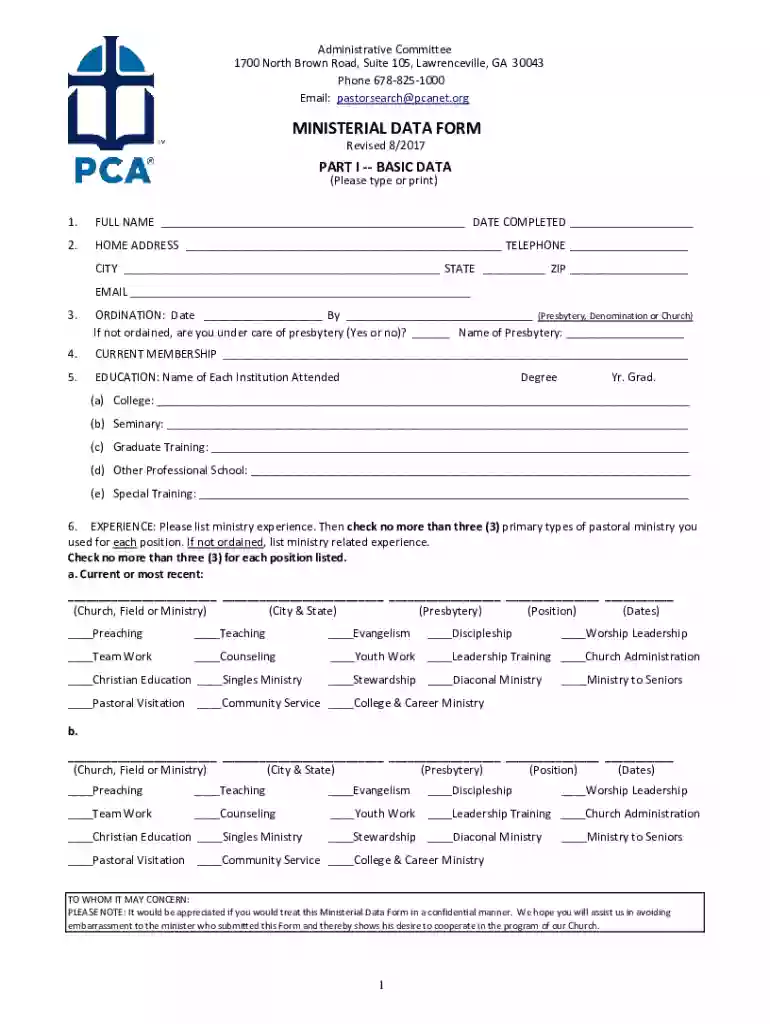
Pastor Search Process Form Preview on Page 1

Here's how it works

01. Edit your form online
Type text, add images, blackout confidential details, add comments, highlights and more.

02. Sign it in a few clicks
Draw your signature, type it, upload its image, or use your mobile device as a signature pad.

03. Share your form with others
Send it via email, link, or fax. You can also download it, export it or print it out.

Definition & Meaning

The Pastor Search Process Form is a structured document primarily used by church administrative committees to gather comprehensive information about pastoral candidates. This form is a crucial tool for churches searching for a pastoral leader, as it compiles significant data about a candidate's personal and professional background. Typically, it includes sections on personal details, educational background, ministry experience, and preferences for church type and community. Understanding this form is essential for church committees to make informed decisions during the pastoral recruitment process.

Key Elements of the Pastor Search Process Form

A well-designed Pastor Search Process Form contains several key elements that are critical for evaluating potential pastoral candidates. These elements generally include:

  • Personal Information: Collects basic details like name, contact information, and denominational affiliation.
  • Educational Background: Details about theological training and other relevant education.
  • Ministry Experience: Information on previous roles held, duration of service, and specific responsibilities.
  • Personal Beliefs and Practices: Insight into the candidate's religious views and pastoral practices.
  • Community Preferences: Questions about the candidate's preferred working environment and type of congregation.
  • References: Lists individuals who can vouch for the candidate's pastoral abilities and character.

These components help ensure that the committee can systematically evaluate candidates based on consistent and detailed information.

Steps to Complete the Pastor Search Process Form

Filling out the Pastor Search Process Form requires attention to detail to provide complete and accurate information. The steps typically include:

  1. Gather Necessary Documents: Collect all required documents, such as educational certificates, ordination records, and reference letters, before starting the form.
  2. Complete Personal Information Section: Enter basic personal details as requested.
  3. Fill Out the Education Section: Detail your educational qualifications, including the institutions attended and degrees obtained.
  4. Provide Ministry Experience: List previous pastoral roles, including duties and accomplishments in each position.
  5. Detail Personal Views and Practices: Answer questions regarding your spiritual beliefs and how you practice your ministry.
  6. Specify Community Preferences: Indicate preferred environments or community types for ministry work.
  7. Include References: Provide contact information for references who can attest to your pastoral competencies.

Each step should be completed thoroughly to ensure the form accurately reflects your qualifications.

How to Obtain the Pastor Search Process Form

Obtaining the Pastor Search Process Form can typically be done through several channels. Churches or candidates looking to acquire the form should:

  • Contact the Denominational Office: Most denominations provide their specific versions of this form, which can be requested from their administrative office.
  • Visit Church Websites: Some churches or church networks have downloadable forms on their official websites.
  • Directly from Committees: Church search committees may distribute the form directly to candidates during the recruitment process.

Ensure that you are using the most updated version tailored to your denomination’s specific requirements.

Who Typically Uses the Pastor Search Process Form

The Pastor Search Process Form is mainly utilized by church administrative committees tasked with pastoral recruitment. Other stakeholders who typically engage with this form include:

  • Pastoral Candidates: To provide necessary information for consideration.
  • Denominational Leaders: Oversee the evaluation process and ensure alignment with church teaching and values.
  • Senior Church Members: Sometimes involved in the selection process and may review candidate information.
  • Search Consultants: Professional agencies hired to assist with the recruitment process.

These users rely on the form to ensure a structured and thorough candidate evaluation.

decoration image ratings of Dochub

Important Terms Related to Pastor Search Process Form

Understanding certain terminology related to the Pastor Search Process Form can be beneficial:

  • Ordination: The process by which individuals are consecrated as clergy to perform religious rites.
  • Ecclesiastical Committee: A body within a church tasked with administrative responsibilities, including hiring.
  • Ministerial Data: Information pertaining to a ministry or minister usually inclusive of personal, educational, and experiential data.
  • Denomination: A recognized autonomous branch of the Christian Church.

These terms frequently appear in discussions regarding the form and its usage.

Examples of Using the Pastor Search Process Form

The Pastor Search Process Form is applied in various scenarios, such as:

  • Filling a Pastoral Vacancy: When a church needs to find a new pastor due to retirement or resignation.
  • Evaluation for Transfer: Used for pastors looking to transition to a new church within the same denomination.
  • Qualification Assessment: Aids in assessing the eligibility and fit of pastoral candidates based on their experience and theological alignment.

These examples illustrate the form's significant role in ensuring that congregations find leaders who align with their mission and values.

Legal Use of the Pastor Search Process Form

Ensuring compliance with legal considerations in the usage of the Pastor Search Process Form is key for both churches and candidates. Legal use involves:

  • Adhering to Privacy Regulations: Protecting candidate data in accordance with data protection laws.
  • Avoiding Discrimination: Ensuring all candidates are evaluated fairly without bias based on race, gender, or other protected characteristics.
  • Confidentiality: Maintaining the confidentiality of candidate information throughout the evaluation process.

These legal guidelines help maintain ethical standards and protect all parties involved during the pastoral search.

be ready to get more

Complete this form in 5 minutes or less

Get form

Got questions?

We have answers to the most popular questions from our customers. If you can't find an answer to your question, please contact us.
Contact us
The process has three distinct seasons: a time of internal preparation before the search, a time of seeking and selecting new pastoral leadership, and a time of affirming and welcoming the newly-called minister. candidates, the search and call process is a spiritual journey that trusts God to be an active participant.
A pastoral plan is more than goals and objectives; it provides direction and purpose. It promotes accountability and stewardship of resources. It strengthens the identity and mission of the Church in the world. It fosters a sense of vision and direction for the Church.
The average pastor search process takes 12-18 months, and it may take even longer in smaller churches. Therefore, acknowledge the strong possibility that the search could take a while. Be patient and trust in the Lords timing! Commit to confidentiality.
Find the right path It typically involves an assessment of ones theological knowledge, spiritual maturity, and character. The specific steps and requirements for ordination vary across denominations, but generally include an examination, interviews, and approval by a governing body or board of clergy members.
Step 1 Establish a Search Committee. Step 2 Develop a Church Profile. Step 3 Develop a Pastor Profile. Step 4 Find Pastoral Candidates. Step 5 Evaluating Prospective Candidates. Step 6 Choosing the Pastor.

Security and compliance

At DocHub, your data security is our priority. We follow HIPAA, SOC2, GDPR, and other standards, so you can work on your documents with confidence.

Learn more
ccpa2
pci-dss
gdpr-compliance
hipaa
soc-compliance
be ready to get more

Complete this form in 5 minutes or less

Get form

People also ask

If you have too few people, your committee may feel overwhelmed with the amount of work in the pastor search process and may burn out quickly. I recommend that search committees have somewhere between seven and eleven people. You should have an odd number of people to prevent stalemates when taking votes.

Related links