




01. Edit your basketball player evaluation form online
Type text, add images, blackout confidential details, add comments, highlights and more.

Type text, add images, blackout confidential details, add comments, highlights and more.

Draw your signature, type it, upload its image, or use your mobile device as a signature pad.

Send basketball evaluation form via email, link, or fax. You can also download it, export it or print it out.
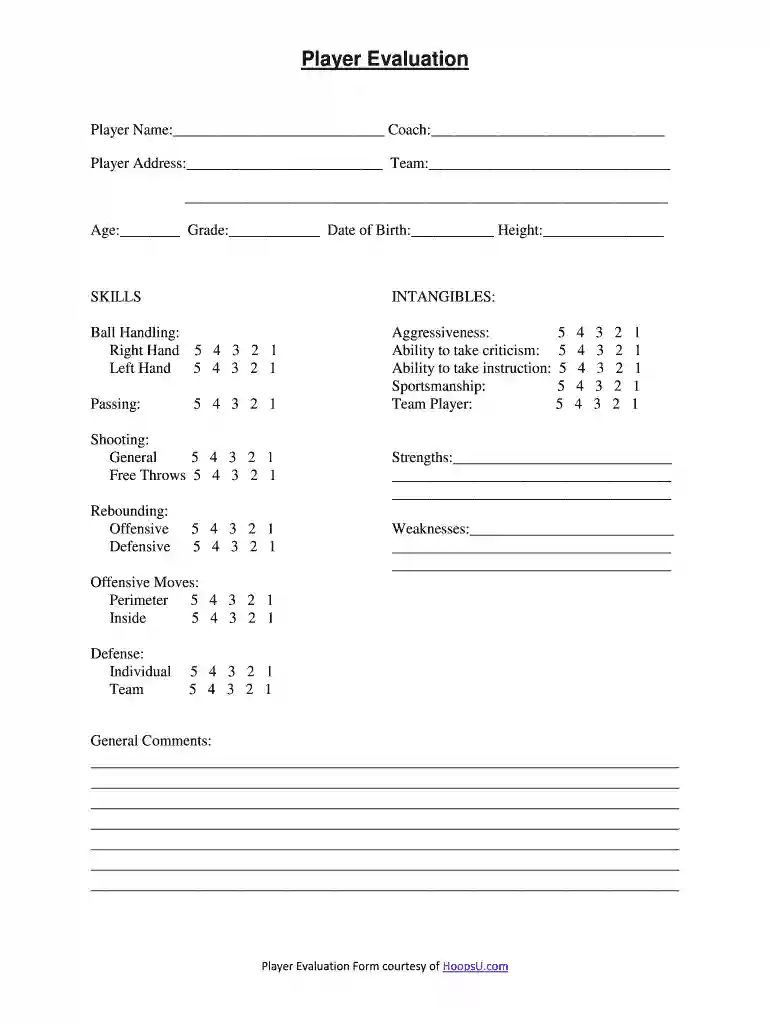
The basketball player evaluation form serves as a crucial tool for coaches and evaluators in assessing a player's skills, strengths, and areas for improvement. This structured form helps in gathering consistent and relevant data regarding a player's performance during practices and games. With various sections dedicated to different aspects of a player's abilities, these forms help streamline the evaluation process and provide valuable insights for future development.
The design of a basketball player evaluation form is essential for capturing comprehensive player data. Typical sections include:
Player Information: This section collects basic details such as the player's name, age, team, and position. These details help to personalize evaluations and ensure accurate tracking of player development over time.
Skill Ratings: The evaluation form typically includes specific skill categories such as ball handling, shooting accuracy, passing ability, rebounding skills, and defensive techniques. Each skill can be rated on a scale, which allows for a detailed understanding of the player's capabilities. This quantitative assessment helps coaches identify areas needing improvement.
Strengths and Weaknesses: This open-ended section allows evaluators to comment on specific strengths the player exhibits on the court, such as speed or agility, along with any weaknesses that may hinder performance, like inconsistent shooting or poor defensive positioning.
General Comments: This section provides space for evaluators to provide qualitative feedback, which can include observations about the player’s attitude, work ethic, and teamwork abilities. Such insights can be vital for understanding the player's overall contribution to the team.
Skill rating sections are particularly important as they provide measurable insights into a player's performance. The common practice of using a numerical scale — for example, from one to five — lets evaluators quantify skills objectively. This approach not only aids in identifying current player proficiency levels but also in tracking improvement over time.
The basketball player evaluation form can be utilized in team settings, encouraging collaboration among coaches and staff. By sharing these forms, multiple coaches can contribute their observations regarding a player's skills, resulting in a more rounded evaluation.
Digital evaluations have gained popularity due to their convenience and ease of use. Digital basketball player evaluation forms can be filled out on tablets or computers, allowing for instant sharing among coaches and players.
During tryouts, the basketball player evaluation form is invaluable. It helps coaches objectively compare skills and talents among different players, ensuring a fair selection process.
Post-evaluation feedback is crucial. The completed basketball player evaluation form should not only guide current training but also influence future strategies for player development.
In conclusion, the basketball player evaluation form is an essential tool that enhances the assessment process for coaches and fosters player development. By utilizing structured evaluations, coaches can effectively measure player skills, provide actionable feedback, and create pathways for improvement.
Yes, a typed name is recognized as a valid electronic signature when you create it on your paperwork using a compliant solution like DocHub. Simply import your basketball tryout evaluation form to our editor, click Sign in the top tool pane → Create your signature → Type your name in the proper tab, and choose how it will look on your document.
If you are searching for a state-specific basketball player evaluation sheet sample, you can find it in our DocHub Forms & Templates catalog. Use the search field, key in your form’s name, and search through the results for your state. You can also filter out irrelevant results while browsing our catalog by groups.
At DocHub, your data security is our priority. We follow HIPAA, SOC2, GDPR, and other standards, so you can work on your documents with confidence.


Sport: Date: Team: Division: . Thank you for participating in our 2025 River City Basketball Tournament! Your feedback helps us improve futureRead more
Competition Format: 1. Round 1 (approximately 35 minutes) Two Games: Six (6) players bowl straight individual 10 frame scoring. Between roundsRead more
The basketball evaluation form is a structured tool designed to assess the various skills and abilities of basketball players. Player information prior playingRead more


