




01. Edit your form online
Type text, add images, blackout confidential details, add comments, highlights and more.

Type text, add images, blackout confidential details, add comments, highlights and more.

Draw your signature, type it, upload its image, or use your mobile device as a signature pad.

Send it via email, link, or fax. You can also download it, export it or print it out.
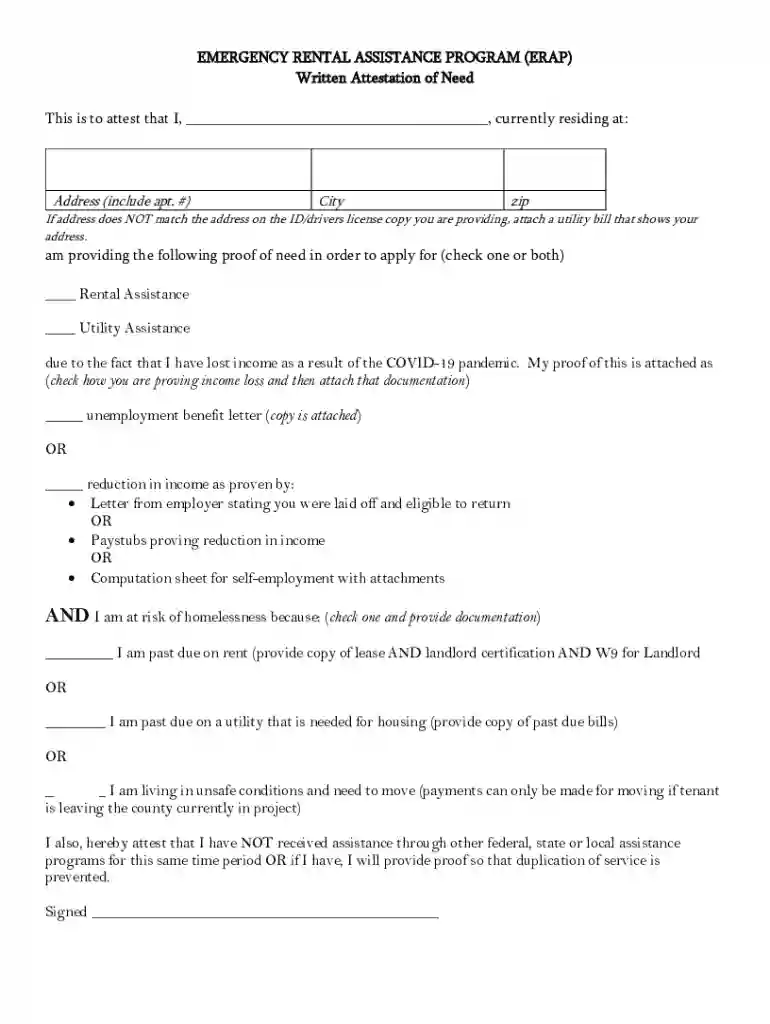
The Emergency Rental Assistance Program (ERAP) Written is a formal document employed to articulate the need for rental and utility assistance due to financial hardships, typically stemming from incidents like the COVID-19 pandemic. This document is pivotal in preventing homelessness by ensuring that applicants receive timely financial aid to cover rental and utility arrears. It serves as a written attestation of the applicant's situation, detailing their financial status and the specific support they require.
The primary function of the ERAP Written Form is to document and communicate the financial needs of an individual or household. Begin by reviewing the form thoroughly to understand the sections requiring attention. These typically include personal information, income details, and a declaration of necessity for assistance. Applicants should gather all relevant financial documentation to support their statements. Once completed, the form must be submitted according to the specific program guidelines, which may include online or physical submission methods.
Prospective applicants can access the ERAP Written Form through their local government websites, housing authorities, or community action agencies. It is often available as a downloadable PDF for easy access. Additionally, many organizations provide paper copies upon request, especially for individuals with limited internet access. It's crucial to verify that the form is the most current version to ensure compliance with updated regulations.
Gather Personal Information: Collect necessary details such as full legal names, addresses, and contact information for all household members.
Document Financial Status: Assemble recent income statements, tax returns, and other financial documents that reflect the household's current economic situation. Include any proof of income loss due to specific circumstances like the COVID-19 pandemic.
Attestation Section: Clearly explain the need for assistance, including the specific amounts required for rent or utility payments. This section requires careful attention to detail to ensure clarity and completeness.
Attach Supporting Documents: Attach all relevant documents as evidence of the assertions made in the form. This includes lease agreements, utility bills, and pay stubs.
Review and Submit: Double-check for accuracy and completeness before submitting the form through designated channels.
Eligibility for the ERAP is determined by specific criteria, including income level, rental arrears, and the impact of COVID-19 on financial circumstances. Generally, applicants must demonstrate a significant reduction in household income or increased expenses leading to financial hardship. Priority is often given to low-income families and individuals facing imminent risk of eviction or utility disconnections.


Applicants must furnish a comprehensive set of documents to support their application. Essential documents include:
Once submitted, the processing time for the ERAP application can vary based on the volume of requests and the efficiency of the local administering agency. Many programs strive for a turnaround time of two to four weeks. Communication from the administering body is generally prompt, updating applicants on the status or if additional information is needed.
While ERAP is federally funded, implementation and regulations can vary at the state level. Each state may impose distinct income thresholds, eligible expenses, and proof of residency requirements. Applicants should consult their state’s housing authority for precise rules and ensure compliance with all local stipulations. State variations can also include differences in the prioritization of application processing and supplemental assistance offerings.
We've got more versions of the EMERGENCY RENTAL ASSISTANCE PROGRAM (ERAP) Written form. Select the right EMERGENCY RENTAL ASSISTANCE PROGRAM (ERAP) Written version from the list and start editing it straight away!
| Versions | Form popularity | Fillable & printable |
|---|---|---|
| 2021 | 4.7 Satisfied (23 Votes) |
At DocHub, your data security is our priority. We follow HIPAA, SOC2, GDPR, and other standards, so you can work on your documents with confidence.


