
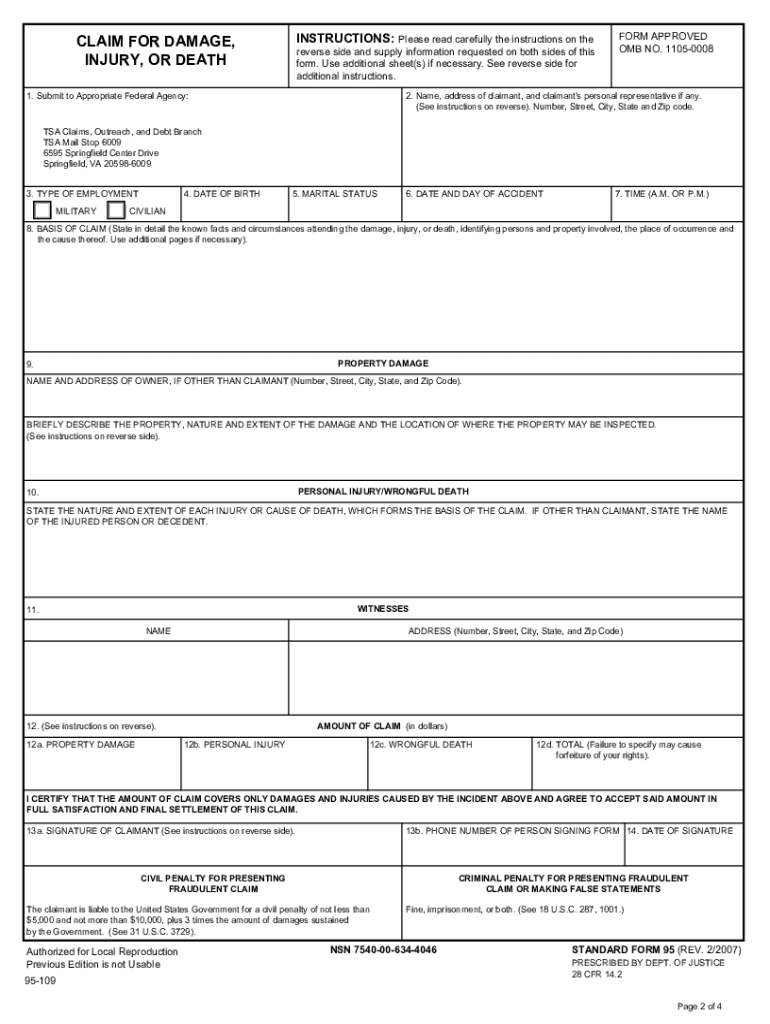







Definition and Meaning of the SF 95 Package
The SF 95 TSA Claims, Outreach, and Debt Branch Tort Claim Package is a comprehensive form used for submitting claims associated with property loss or damage due to TSA negligence. It serves as an official document for individuals or entities seeking compensation from the Transportation Security Administration. This package outlines necessary procedures and provides guidance on filing claims effectively.
Purpose and Applications
- Tort Claims: Primarily used for filing tort claims against the TSA when instances of property damage or loss occur due to employee negligence.
- Legal Documentation: Serves as an essential legal document enabling the claimant to seek redress for financial losses.
Relevance
Understanding the specifics of the SF 95 package is crucial for fulfilling the legal criteria required for compensation claims related to TSA activities.
How to Use the SF 95 Package
Utilizing the SF 95 package correctly enhances the chances of a successful claim. The following outlines the process for effective usage:
Step-by-Step Instructions
- Identify Incident: Begin by confirming that the loss or damage falls under TSA negligence through valid documentation.
- Complete Necessary Fields: Fill out each section of the SF 95 package accurately. Ensure that details such as the nature of the incident, loss estimates, and claimant information are thoroughly provided.
- Attach Supporting Documents: Secure all required documentation, such as receipts and evidence of damage, to support your claim.
- Review and Sign: Verify that all information is correct before signing the form to certify its accuracy.
Situational Examples
- Lost Luggage: If luggage is lost due to mishandling by TSA personnel, claimants can document the loss using the SF 95 package.
- Damaged Electronics: For electronics damaged during TSA inspection, use photos and purchase receipts to substantiate the claim.
Steps to Complete the SF 95 Package
Completing the form requires careful attention to detail. Below is a guided checklist:
Preparing Documentation
- Gather evidence: Photographs, receipts, repair estimates.
- Compile detailed incident description: Date, time, location, TSA involved personnel.
Form Completion
- Contact Information: Accurately fill out personal and communication details.
- Incident Details: Provide a clear account of the incident leading to the claim.
- Loss Valuation: Include an assessment of the loss incurred, supported by documentation.
Submitting Your Claim
Utilize available submission methods:
- Online Portal: Most efficient and provides immediate confirmation.
- Mail Submission: Send to the designated TSA office with necessary return receipt.
Importance of the SF 95 Package
The SF 95 package plays a pivotal role in allowing claimants to pursue compensation from the TSA for negligence-related incidents. It offers a formal avenue for restitution, emphasizing the importance of following the outlined process meticulously.
Key Benefits
- Legal Recourse: Provides an official path to seek compensation.
- Structured Approach: Standardizes the claim process for clarity and efficiency.
Real-World Implications
Victims of property damage can leverage this form to recoup losses, thus validating and formalizing their grievances within a legal framework.
Legal Use of the SF 95 Package
The SF 95 package is recognized under U.S. law as a valid claim process for negligence claims against the federal government, in this case, through TSA.
Legal Prerequisites
- Eligibility: Claimants must prove TSA employee negligence.
- Timeframe: Claims must be filed within two years from the date of the incident.
Considerations
Timely submission and comprehensive documentation are critical in meeting legal standards and improving claim viability.
Required Documents for the SF 95 Package
Proper documentation is essential to support a claim effectively:
Essential Documents
- Proof of Ownership: Original purchase receipts or affidavits.
- Damage Assessment Reports: From recognized authorities or service centers.
- Detailed Claim Narrative: Descriptive account of the incident and resulting losses.
Supplementary Evidence
Additional materials, such as witness statements or TSA communication records, may further substantiate the claim.
Filing Deadlines and Important Dates
Understanding deadlines ensures compliance and helps avoid claim denial:
Critical Timelines
- Claim Submission: Must be within two years of the incident.
- Response Expectation: TSA typically responds within a six-month period post-filing, though this can vary.
Importance of Adhering to Deadlines
Failing to meet submission deadlines can render a claim invalid, emphasizing the need for timely action.
Form Submission Methods
The SF 95 package allows multiple submission methods ensuring flexibility for the claimant:
Online and Electronic Submissions
- TSA Portal: Enables digital submission, providing confirmation and tracking capabilities.
- Email: Digital submission to require TSA addresses, though less preferred than direct portal usage.
Traditional Submission
- Postal Mail: Send to designated TSA address with tracking for verification.
Each submission method has distinct advantages that cater to different claimant preferences and capabilities.




