Smoking Questionnaire - ACE Lifestyle 2026

Get Form
smoking questionnaire quit cigarette Preview on Page 1

Here's how it works

01. Edit your smoking questionnaire quit cigarette online
Type text, add images, blackout confidential details, add comments, highlights and more.

02. Sign it in a few clicks
Draw your signature, type it, upload its image, or use your mobile device as a signature pad.

03. Share your form with others
Send smoking questionnaire manager cigarette via email, link, or fax. You can also download it, export it or print it out.

Definition & Meaning

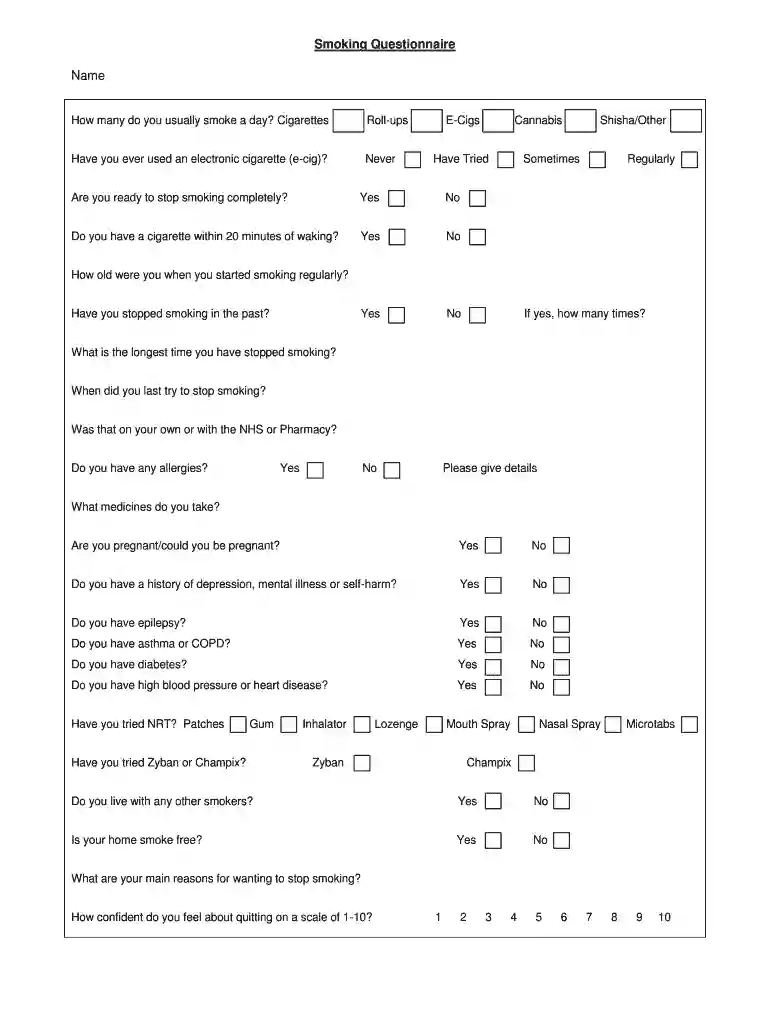
The Smoking Questionnaire - ACE Lifestyle is a comprehensive document used to collect detailed information about an individual's smoking habits, history, and their willingness or readiness to quit smoking. The form typically includes various sections that cover daily cigarette consumption, use of alternative nicotine products like e-cigarettes, and cannabis use. The questionnaire aims to gather actionable data that can be useful for healthcare providers in devising personalized smoking cessation strategies for individuals.

How to Use the Smoking Questionnaire - ACE Lifestyle

When utilizing the Smoking Questionnaire - ACE Lifestyle, the process generally starts with carefully reviewing each section to understand the type of information required. The form is designed for ease of use, asking direct questions that allow respondents to provide clear and concise answers. Each section covers different aspects of smoking behavior, from frequency to past quitting attempts. Respondents are encouraged to fill out the form honestly to ensure that any follow-up strategies or recommendations are accurately aligned with their current situation.

Steps to Complete the Smoking Questionnaire - ACE Lifestyle

  1. Preparation: Before starting the form, gather any relevant personal health data or previous tobacco usage information, as this can assist in providing accurate responses.
  2. Basic Information: Enter personal details such as name, date of birth, and contact information, ensuring that all details are correct.
  3. Smoking Habits: Provide detailed information on current smoking behaviors, including the number of cigarettes smoked daily, use of e-cigarettes, and any cannabis usage.
  4. Health History: Detail any existing health conditions that may be affected by smoking, as well as any past medical advice or interventions related to quitting smoking.
  5. Quitting History: Discuss any previous attempts to quit smoking, including methods used and the outcome of each attempt.
  6. Consent: Indicate consent for healthcare providers to use the information for follow-up communication and personalized treatment planning.

Key Elements of the Smoking Questionnaire - ACE Lifestyle

  • Cigarette Consumption: Questions related to the frequency and quantity of daily cigarette usage.
  • Alternative Nicotine Products: Inquiry about the use of e-cigarettes or other smoking alternatives.
  • Cannabis Use: Assessment of cannabis consumption in relation to smoking habits.
  • Health Conditions: Sections that capture existing health issues influenced by smoking.
  • Quitting History: Areas focusing on attempts made to stop smoking and challenges faced during those episodes.
  • Consent for Communication: Clearly marked consent segments allowing for healthcare provider engagement.

Who Typically Uses the Smoking Questionnaire - ACE Lifestyle

The Smoking Questionnaire - ACE Lifestyle is primarily used by healthcare providers, including doctors and smoking cessation specialists aiming to support individuals on their journey to quit smoking. Additionally, organizations focused on workplace health and wellness may employ this form to assist employees in reducing health risks associated with smoking. This questionnaire can also be utilized by research entities studying smoking behaviors and the effectiveness of various cessation strategies.


decoration image ratings of Dochub

Important Terms Related to Smoking Questionnaire - ACE Lifestyle

  • Nicotine Replacement Therapy (NRT): A treatment approach to help individuals quit smoking by substituting cigarettes with nicotine patches, gums, or lozenges.
  • Behavioral Therapy: Counseling provided to change smoking-related behaviors and develop coping mechanisms.
  • Relapse Prevention: Strategies designed to help individuals maintain quitting success and avoid returning to smoking.
  • Smoke-Free Initiatives: Programs or policies aimed at reducing smoking in specific environments, such as workplaces or public areas.

Legal Use of the Smoking Questionnaire - ACE Lifestyle

In the United States, the completion of the Smoking Questionnaire - ACE Lifestyle must adhere to confidentiality and data protection laws such as the Health Insurance Portability and Accountability Act (HIPAA). The information collected is sensitive and used in compliance with healthcare regulations to prevent unauthorized sharing of personal data. Consent sections within the form ensure that users are aware of their rights regarding information usage.

State-Specific Rules for the Smoking Questionnaire - ACE Lifestyle

Some states may have specific guidelines or mandates in place concerning smoking questionnaires and cessation programs. For example, states with aggressive anti-smoking laws might offer additional resources and support for those using such forms. Understanding these state-specific differences can aid respondents and practitioners in ensuring compliance with regional laws and maximizing the benefits of smoking cessation efforts.

Examples of Using the Smoking Questionnaire - ACE Lifestyle

  • Case Study: A hospital implements the form as part of its pre-surgery routine to assess patients’ smoking status and plan for necessary cessation support pre- and post-operation.
  • Workplace Program: A company introduces a wellness initiative where employees complete the questionnaire to tailor individual smoking cessation plans with health consultants.
  • Research Study: Researchers use anonymized data from the questionnaire to study smoking patterns and success rates of different cessation methods among various demographics.
be ready to get more

Complete this form in 5 minutes or less

Get form

Got questions?

We have answers to the most popular questions from our customers. If you can't find an answer to your question, please contact us.
Contact us
The following are examples of the interview questions: How many packs of cigarettes do you smoke daily? What type of cigarettes do you typically smoke? Could you please describe a situation when you need a cigarette? How long were you smoking before you were incarcerated? How does smoking cigarettes make you feel?
Psychological Symptoms of Tobacco Addiction. The GloverNilsson Smoking Behavioral Questionnaire (GN-SBQ) [14] is an 11-item instrument scored on a Likert-type scale from 0 (not at all/never) to 4 (extremely so/always) that focuses on the behavioral aspects of tobacco addiction.
What got you started smoking? How long have you been smoking? What brand do you usually smoke, and why? Do you smoke socially, or is it a daily habit?
Thinking about your previous quit attempts and the situations that currently cause you to smoke or drink can be helpful in identifying your high-risk situations. Second, make a plan of action for coping with high-risk situations using your ACE strategies AVOID, COPE, OR ESCAPE.
Questionnaire template for smokers How do you prefer to smoke? Have you ever tried an electronic cigarette? What do you smoke? How many cigarettes do you smoke per day? What is your favourite brand of tabacco? How often do you smoke? How much money do you spend each month on tobacco products?

Security and compliance

At DocHub, your data security is our priority. We follow HIPAA, SOC2, GDPR, and other standards, so you can work on your documents with confidence.

Learn more
ccpa2
pci-dss
gdpr-compliance
hipaa
soc-compliance

People also ask

The 5As framework for smoking cessation (Ask, Advise, Assess, Assist, and Arrange) has been widely recommended for the delivery of brief advice in primary care outpatient visits.
Successful intervention begins with identifying users and appropriate interventions based upon the patients willingness to quit. The five major steps to intervention are the 5 As: Ask, Advise, Assess, Assist, and Arrange. Ask - Identify and document tobacco use status for every patient at every visit.

Related links