




01. Edit your form online
Type text, add images, blackout confidential details, add comments, highlights and more.

Type text, add images, blackout confidential details, add comments, highlights and more.

Draw your signature, type it, upload its image, or use your mobile device as a signature pad.

Send it via email, link, or fax. You can also download it, export it or print it out.
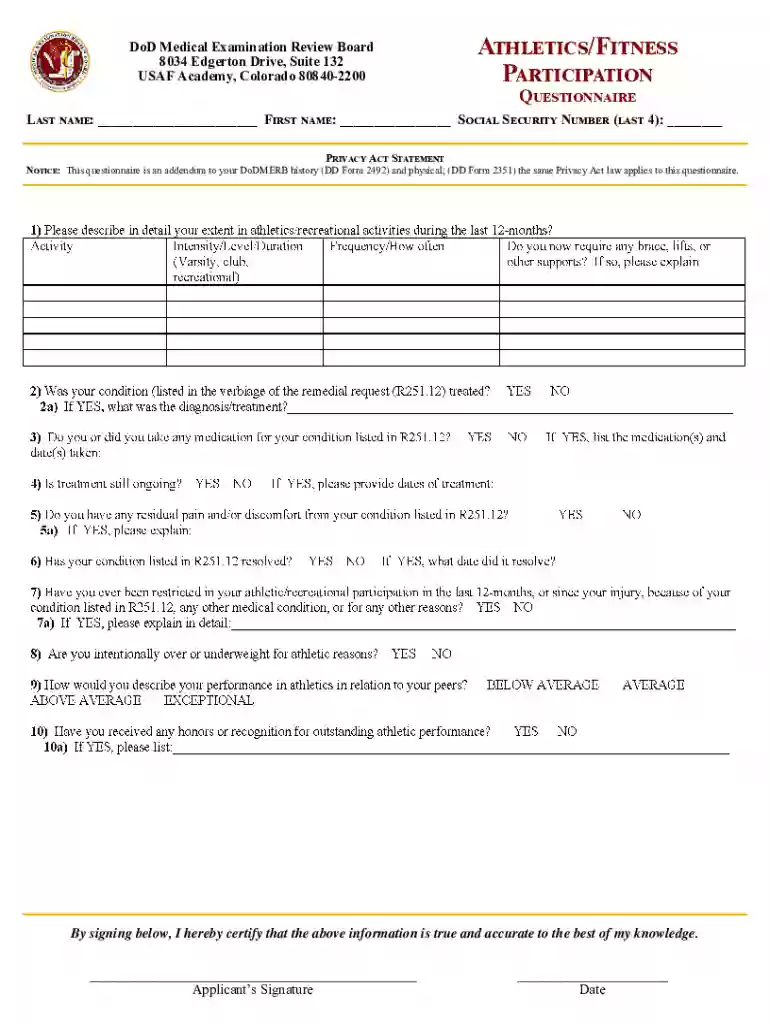
The Athletics-Fitness Questionnaire is a document used by applicants to provide detailed information regarding their medical history and physical fitness. Similar to a medical questionnaire, it collects data pertinent to an individual’s athletic capabilities and any medical conditions that could impact their performance or eligibility. This form is essential in evaluating an athlete’s readiness for certain physical activities and ensuring their safety during participation.
Utilizing the Athletics-Fitness Questionnaire involves following systematic guidelines to ensure completeness and accuracy. First, individuals should carefully read each section of the questionnaire, which usually comprises questions related to past medical history, current physical condition, and any medications or allergies. Specific instructions accompany each question to guide respondents in providing precise and thorough answers. Complete disclosure is necessary to avoid potential health risks associated with incomplete or incorrect information.
Review the Instructions: Start by reading any instructions provided on the first page of the form to understand the requirements and purpose.
Personal Information: Fill in your name, contact information, and identification details as required by the form.
Medical History: Answer questions about your past medical conditions, surgeries, hospitalizations, and family medical history.
Current Physical Health: Provide details regarding any existing medical conditions, current medications, or ongoing treatments.
Submit Physical Examination Reports: Include recent reports from a licensed medical professional, if required.
Certification and Signature: Conclude by signing the form to certify the accuracy of information provided.
Athletes, coaches, and athletic program administrators are the primary users of the Athletics-Fitness Questionnaire. It is commonly used in educational institutions, sports clubs, and competitive athletic programs to ensure that participants meet the necessary fitness criteria and do not pose a risk to themselves or others in a sports environment. Medical professionals may also refer to these questionnaires when assessing an athlete’s health status in the context of sports participation.


Personal Identification: Information such as name, date of birth, and contact details.
Medical History: A comprehensive account of past medical incidents, family medical history, and previous athletic injuries.
Physical and Health Status: Current health conditions, allergies, and a list of medications currently being taken.
Consent and Signature: An acknowledgment signed by the participant, certifying the accuracy of the information provided.
The Athletics-Fitness Questionnaire must adhere to privacy laws and regulations like HIPAA to protect sensitive medical information. It should be completed truthfully to ensure that athletes are not exposed to unnecessary risks during gameplay. Legal consequences may arise from falsifying information or failing to disclose pertinent health details that could endanger the individual's health or the safety of other participants.
Certain states may have additional guidelines or mandatory questions that need to be addressed in the Athletics-Fitness Questionnaire. This may include specific state health requirements, immunization records, or localized health concerns. Coaches and administrators should ensure compliance with both state-specific and federal guidelines to maintain validity.
Consider a high school sports team requiring all athletes to complete an Athletics-Fitness Questionnaire before the start of the season. This practice allows coaches to be aware of any pre-existing conditions, reducing the risk of injuries. Similarly, an adult recreational league might utilize the form to screen for underlying health issues that may affect player performance and safety.
Both digital and paper versions of the Athletics-Fitness Questionnaire are available, each offering unique advantages. The digital form can be filled out online, allowing for electronic submission and streamlined processing, whereas the paper version provides a traditional approach where physical copies are maintained for record-keeping. The choice of format might depend on institutional preference, access to technology, or other logistical considerations.
We've got more versions of the Athletics-Fitness Questionnaire pub form. Select the right Athletics-Fitness Questionnaire pub version from the list and start editing it straight away!
At DocHub, your data security is our priority. We follow HIPAA, SOC2, GDPR, and other standards, so you can work on your documents with confidence.
by J Brumitt 2014 Cited by 30 The purpose of this study was to examine off-season training habits of D III athletes and their relationships to the standing long jump. The purpose of this
by DJ Graham 2010 Cited by 142 Attitudes score is sum of responses to: How much do you care about staying fit and exercising? and How much do you care about doing well in sports?


