







Definition and Meaning
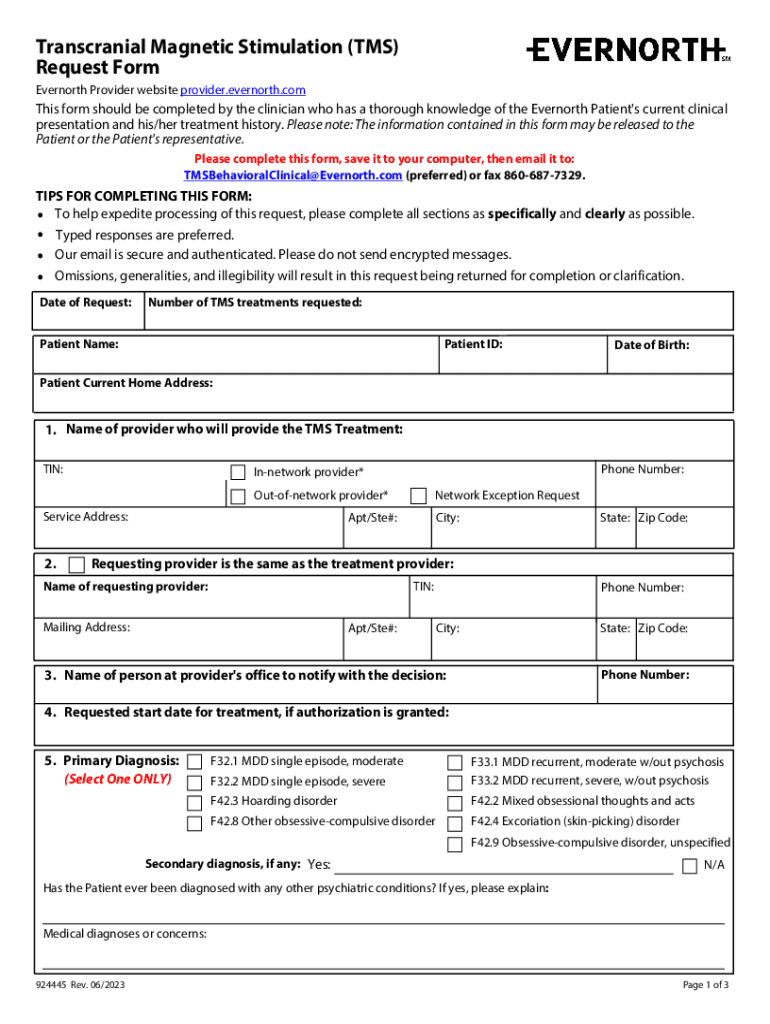
The Tennessee Transcranial Magnetic Stimulation (TMS) Request Form is a specialized document used by healthcare providers to request TMS treatment for patients. TMS is a non-invasive procedure utilized primarily for patients with treatment-resistant depression. The form captures critical data needed to assess the suitability of TMS, including patient history and diagnosis. This ensures that the request aligns with clinical guidelines and insurance policies.
How to Use the Tennessee Transcranial Magnetic Stimulation (TMS) Request Form
- Download the Form: Obtain the TMS request form from a trusted source, often a healthcare provider’s office or insurance company.
- Fill Out Patient Information: Include comprehensive details such as the patient's name, age, and contact information.
- Provide Clinical History: Document the patient’s medical background, focusing on mental health history and previous treatments.
- Detail Current Diagnosis: Clearly indicate the current diagnosis that necessitates TMS.
- Submit Provider Information: Enter the information of the clinician completing the form, including credentials and contact details.
- Submit the Form: Once completed, submit the form as required, whether by mail or electronically, depending on the instructions provided by insurers or healthcare facilitators.
Steps to Complete the Tennessee TMS Request Form
-
Patient Demographics:
- Enter full legal name, date of birth, and social security number.
- Provide home address and contact number.
-
Clinical Details:
- Record the patient's mental health history and previous treatment outcomes.
- Specify the current mental health diagnosis according to DSM-5 standards.
-
TMS Treatment Justification:
- Explain why TMS is being considered, detailing past treatment responses.
- Highlight any co-morbid conditions that affect treatment choice.
-
Form Completion:
- Ensure all sections are filled without leaving mandatory fields blank.
- Sign and date the form to confirm the information's accuracy and authenticity.
Key Elements of the Tennessee TMS Request Form
- Patient Information: Identifying details essential for processing the request.
- Clinical History and Diagnosis: Critical for determining eligibility and tailoring treatment.
- Provider Details: Confirms the qualifications of the practitioner recommending TMS.
- Insurance Information: May be required to facilitate coverage and payment.
Legal Use of the Tennessee TMS Request Form
The form must comply with HIPAA regulations to protect patient privacy during information exchange. It ensures documentation meets insurer requirements to justify the treatment's medical necessity. Clinicians must follow ethical guidelines when completing and submitting it, verifying all provided information is truthful and accurate.
Who Typically Uses the Tennessee TMS Request Form
- Psychiatrists and Mental Health Professionals who propose TMS as a treatment for eligible patients.
- Insurance Companies require the form to process requests for coverage of TMS treatments.
- Patients are indirectly involved as they provide initial information and consent for their healthcare provider to submit the form.


Important Terms Related to the Tennessee TMS Request Form
- TMS (Transcranial Magnetic Stimulation): A neurological procedure involving magnetic fields to stimulate nerve cells in the brain.
- Eligibility Criteria: The set of guidelines determining when a patient qualifies for TMS.
- DSM-5: Diagnostic and Statistical Manual of Mental Disorders, Fifth Edition, used for diagnosis standardization.
- HIPAA: Health Insurance Portability and Accountability Act, safeguarding patient data privacy.
State-Specific Rules for the Tennessee TMS Request Form
While the general structure and use of the form are standardized, certain conditions, such as state-specific mental health statutes and insurance policies, may affect how the form is processed in Tennessee. Patients and providers should review state regulations to ensure complete compliance with local legal requirements.
Examples of Using the Tennessee TMS Request Form
Imagine a 45-year-old patient with major depressive disorder (MDD) whose symptoms persist despite several antidepressant trials. Their psychiatrist recommends TMS as the next step. The psychiatrist completes the Tennessee TMS Request Form, detailing the patient’s medication history, therapy participation, and lack of response, along with their current health status. Upon submission, the form enables the insurance provider to evaluate the claim efficiently, providing a pathway towards the proposed treatment.




