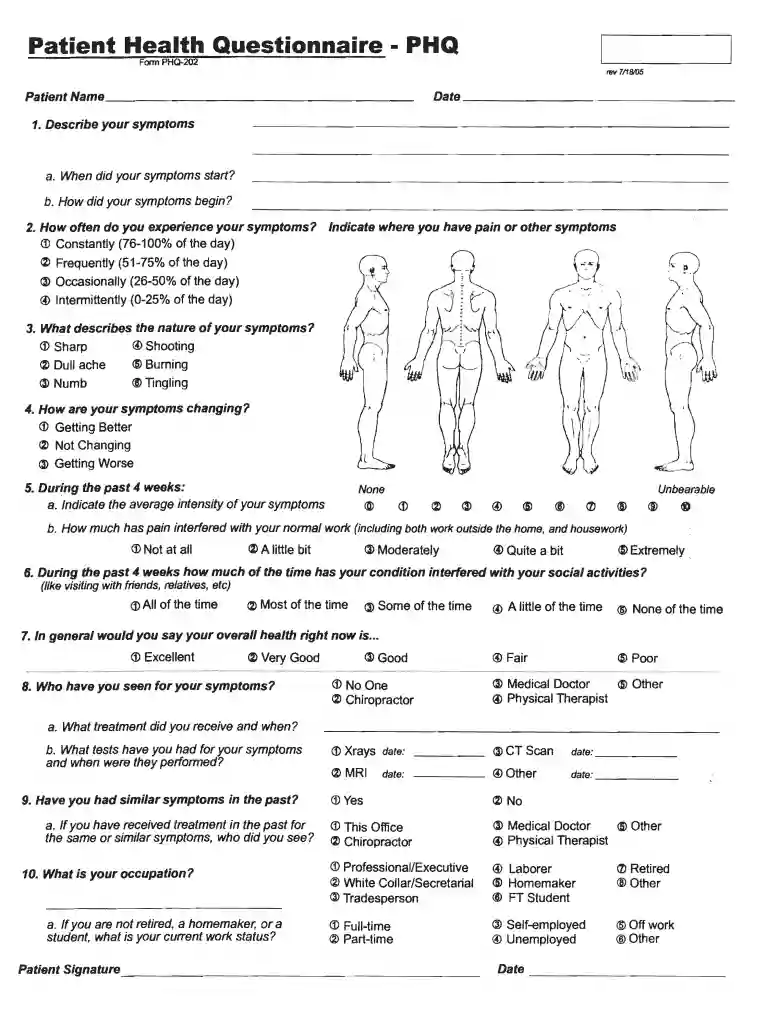
Definition and Meaning
The Patient Health Questionnaire (PHQ) Form PHQ-9 is a self-administered tool used widely in primary care settings to screen, diagnose, monitor, and measure the severity of depression. This form comprises nine questions related to the symptoms and impact of depression over the past two weeks. It is often used as part of a comprehensive health assessment and helps clinicians identify areas of concern that require further evaluation or intervention.
Components of the PHQ-9
- Symptom Assessment: Evaluates the presence and frequency of depressive symptoms.
- Impact Evaluation: Looks at how these symptoms interfere with daily activities.
- Overall Health: Takes into account the patient's perception of their overall wellbeing.
- Treatment History: Includes questions about past interventions or treatments.
- Current Occupation: Considers how symptoms affect work performance or occupational status.
How to Use the Patient Health Questionnaire PHQ Form PHQ-9
Using the PHQ Form PHQ-9 involves understanding and interpreting the form's questions to gain insights into a patient's mental health.
Step-by-Step Usage
- Distribute the Form: Provide the form to the patient to fill out, keeping the setting confidential and supportive.
- Explain the Questions: Briefly go over the types of questions they will encounter and reassure them about the confidentiality of their responses.
- Monitor the Scoring: After completion, score the responses based on the frequency of symptoms – assigning respective numerical values to responses.
- Interpret Results: Review the score with the patient. A higher score suggests more severe depressive symptoms, prompting further investigation or referrals.
- Develop a Care Plan: Based on the results, work with the patient to create an action plan that may include therapy, medication, lifestyle changes, or additional testing.
How to Obtain the Patient Health Questionnaire PHQ Form PHQ-9
The PHQ-9 form is readily available and can be obtained through various channels.
Sources
- Healthcare Providers: Many clinics and hospitals provide the form as part of routine checkups.
- Online Portals: Download the PHQ-9 from reputable medical or mental health websites.
- Mental Health Organizations: Many organizations provide these forms to support awareness and intervention efforts in the community.
Steps to Complete the Patient Health Questionnaire PHQ Form PHQ-9
Completing the PHQ-9 requires attention to detail and an honest self-evaluation from the respondent.
Completion Process
- Read Carefully: Ensure the patient reads each question thoroughly to avoid misunderstandings.
- Reflect on Symptoms: Encourage patients to think about their experiences over the last two weeks, focusing on frequency and severity.
- Answer Each Item: Go through each of the nine questions, selecting responses ranging from ‘not at all’ to ‘nearly every day.’
- Score the Responses: Sum the scores to get a total, which will guide the next steps in treatment or further assessment.
Why You Should Use the Patient Health Questionnaire PHQ-9
Using the PHQ-9 offers several benefits for both patients and healthcare providers.
Benefits of PHQ-9
- Early Detection: Identifies depression symptoms early, enabling timely intervention.
- Monitoring Tool: Regular use tracks changes in mental health and the effectiveness of treatment.
- Standardized Measure: Provides a consistent method for evaluating depressive symptoms, ensuring uniformity across assessments.
- Patient Engagement: Encourages patients to reflect on their mental health and promotes active participation in their treatment plan.
Key Elements of the Patient Health Questionnaire PHQ-9
Understanding the key elements is crucial for effective application and interpretation.
Essential Details
- Nine Items: Each relating to a specific aspect of depression.
- Scoring Ranges: Ranges from 0 to 27, with higher scores indicating more severe depression.
- Frequency Assessment: Frequency options given for each symptom.
- Clinical Thresholds: Established for guiding further action.
Interpretation and Clinical Use of the PHQ-9
Interpreting PHQ-9 results is vital for determining clinical action.
Clinical Application
- Score Analysis: Ranges indicate mild to severe depression and suggest different intervention levels.
- Thresholds for Action: Establish cutoffs that indicate need for further assessment or therapeutic intervention.
- Treatment Planning: Use scores as part of a comprehensive approach, incorporating patient history and preferences.