Method-Statement-for-Demolition-Works docx 2026

Get Form
demolition method statement pdf free download Preview on Page 1

Here's how it works

01. Edit your demolition method statement pdf free download online
Type text, add images, blackout confidential details, add comments, highlights and more.

02. Sign it in a few clicks
Draw your signature, type it, upload its image, or use your mobile device as a signature pad.

03. Share your form with others
Send it via email, link, or fax. You can also download it, export it or print it out.

Definition and Purpose of the Method Statement for Demolition Works

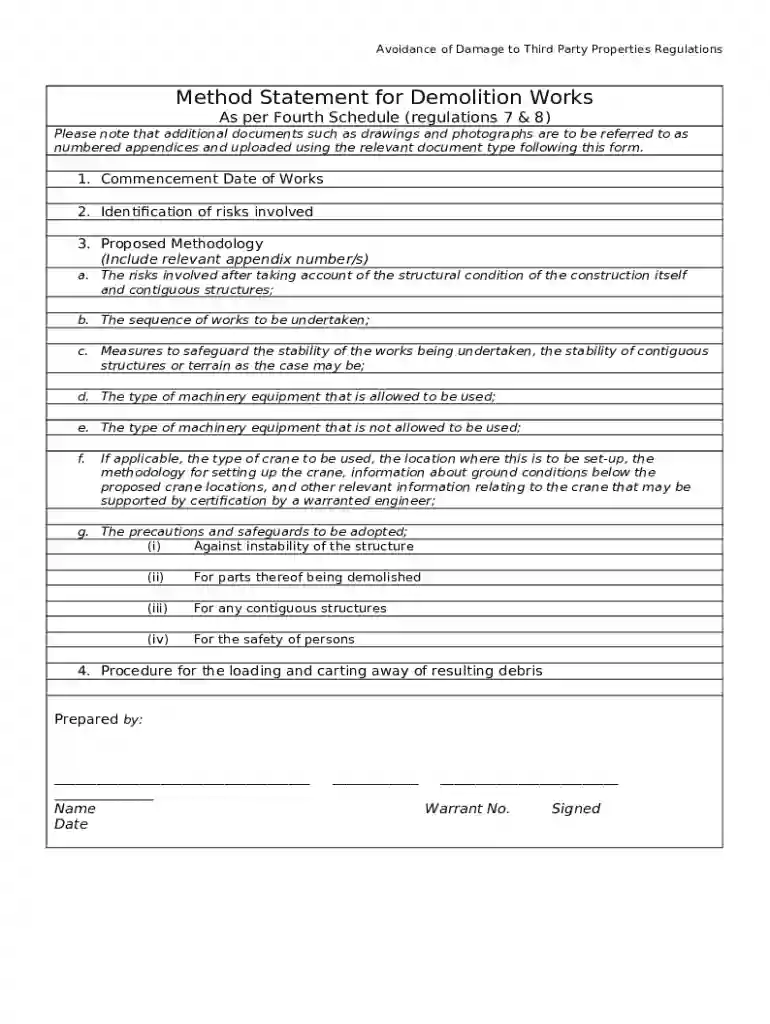
A Method Statement for Demolition Works is a comprehensive document detailing the approach and procedures involved in safely carrying out demolition activities. It aims to outline how demolition tasks will be executed, including the identification of risks, proposed methodologies, safety measures, and equipment usage. This document is crucial in ensuring both the structural stability during the demolition phase and the safety of on-site personnel as well as surrounding structures.

Key Components of the Method Statement

  • Commencement Date: Clearly specifies when the demolition project is set to begin.
  • Risk Identification: Involves a detailed analysis of potential hazards associated with the demolition process.
  • Proposed Methodologies: Includes the technical approach and sequence of demolition activities.
  • Safety Measures: Lists precautions and safety protocols to protect workers and nearby properties.
  • Equipment Usage: Details the machinery and tools necessary for the operation.
  • Debris Removal Procedures: Outlines strategies for the disposal and management of waste material generated from demolition.

How to Use the Method-Statement-for-Demolition-Works Docx

Effectively utilizing the Method Statement for Demolition Works involves understanding each section to ensure compliance and safety. Follow these steps:

  1. Review the Document: Start by thoroughly reading through the document to familiarize yourself with its structure and content.
  2. Risk Assessment: Pay particular attention to the risk identification and safety measures to understand the potential dangers and planned precautions.
  3. Plan Execution: Use the proposed methodologies as a guideline for executing the demolition tasks systematically.
  4. Compliance Verification: Ensure all mentioned safety protocols align with local and national safety regulations.
  5. Alignment with Project Timeline: Cross-reference the commencement date and project timeline with actual site conditions to avoid delays.
  6. Collaborative Engagement: Share the document with all team members involved in the demolition process to ensure a unified understanding.

Who Typically Uses the Method-Statement-for-Demolition-Works Docx

Several professionals utilize this document within their workflows, ensuring that demolition projects are carried out safely and efficiently:


  • Project Managers: Oversee the overall progress of the demolition project and coordinate between different teams.
  • Safety Officers: Focus on maintaining a safe working environment by implementing the outlined safety measures.
  • Engineers and Architects: Use the statement to align the demolition work with structural designs and project plans.
  • Contractors and Subcontractors: Apply the document as a practical guide for executing demolition tasks.
  • Regulatory Inspectors: Review the statement to verify compliance with safety and environmental regulations.
decoration image ratings of Dochub

Steps to Complete the Method-Statement-for-Demolition-Works Docx

Completing the Method Statement requires meticulous attention to detail, and the process is generally oriented toward thoroughness:

  1. Identifying Project Details: Start by filling in the project name, location, and responsible parties.
  2. Risk Analysis: Conduct a detailed assessment of potential risks and document them appropriately.
  3. Define Methodologies: Clearly articulate the planned methodologies and sequence of operations.
  4. Safety Protocols: Specify all safety measures, emergency contacts, and evacuation procedures.
  5. Detail Equipment and Resources: List all necessary equipment, their specifications, and resource allocation.
  6. Debris Management Plan: Provide a comprehensive plan for handling, storing, and removing demolition debris.
  7. Review and Approval: Before finalizing, review the document for any inaccuracies or omissions, then seek approval from the relevant authorities.

Legal Use of the Method-Statement-for-Demolition-Works Docx

The legal framework surrounding the Method Statement is critical in ensuring compliance and avoiding legal ramifications:

  1. Adherence to Regulations: The document must comply with local, state, and federal demolition work safety regulations.
  2. Liability Reduction: By documenting all safety and procedural measures, the method statement can mitigate legal liability in case of accidents.
  3. Insurance Requirements: Often acts as a prerequisite for obtaining necessary insurance coverage for the demolition project.
  4. Contractual Obligations: Serves as a binding document that contractors and subcontractors adhere to, thereby ensuring contractual compliance.

Key Elements of the Method-Statement-for-Demolition-Works Docx

A robust method statement will encapsulate several key elements vital for its efficacy:

  • Contact Information: Lists the contact details of all responsible individuals and emergency contacts.
  • Site Plans and Maps: Visual representations of the site, including critical areas, boundaries, and neighboring structures.
  • Program and Schedule: Detailed timeline with start and end dates for each phase of the demolition.
  • Environmental Protocols: Measures to mitigate environmental impact, such as noise, dust control, and waste disposal.

Variations and Alternatives to the Method-Statement-for-Demolition-Works Docx

While the core structure of a method statement remains consistent, there are variations depending on different project requirements or regions:

  1. Simplified Versions: For minor demolition works, a simplified version may suffice, with reduced detail.
  2. Region-Specific Templates: Tailored to comply with state-specific regulations and requirements.
  3. Industry-Specific Alterations: Modified templates exist for certain industries that demand unique safety and procedural requirements.

Digital vs. Paper Version

There is a growing preference for digital versions due to convenience and integration capabilities:

  • Digital Efficiency: Allows for easy sharing, editing, and collaboration amongst team members through platforms like DocHub.
  • Paper Dependability: Some projects still require physical documentation for legal or contractual validation.
  • Document Management: Digital versions integrate with document management systems for better archiving and retrieval.
  • Version Control: Enhanced through digital means, allowing for the tracking of changes and updates in real-time.

By maintaining a comprehensive and detailed Method Statement, organizations can ensure that demolition works proceed efficiently, safely, and in compliance with all necessary regulations.

be ready to get more

Complete this form in 5 minutes or less

Get form

Got questions?

We have answers to the most popular questions from our customers. If you can't find an answer to your question, please contact us.
Contact us
Installation Costs Demolition work per Hour ($15 - $30 per hour) Room demolition, typical room ($10 - $35 per hour) Room demolition, kitchen ($250 - $500) Room demolition, bathroom ($250 - $500) Building demolition, 1-story wood-framed ($2.5k - $5k) Building demolition, 2-story wood-framed ($5k - $10k)
Here are the steps for writing an effective method statement: Write down the full timeline of the project. Conduct a risk assessment. Collect information on the organisation and job. Detail project hazards and safety procedures. List additional actions. Revise your timeline into step-by-step instruction.
A method statement for demolition should address various aspects, including risk assessment, asbestos removal, accident prevention, and compliance with local regulations. By following these best practices, construction companies can minimize risks and create a safe working environment for their employees.
Use double quotation marks () around a direct quote. A direct quote is a word- for-word report of what someone else said or wrote. You use the exact words and punctuation of the original. Harriet Jacobs writes, She sat down, quivering in every limb (61).
To develop a competitive demolition estimate, remember the following formula: Cost Estimate = (V x ROP x COP) + DC SC. In this formula: DC = Direct Cost; SC = Salvage Credit; V = Volume of Material to be Demolished and Removed from the Project; COP = Cost of Production.

Security and compliance

At DocHub, your data security is our priority. We follow HIPAA, SOC2, GDPR, and other standards, so you can work on your documents with confidence.

Learn more
ccpa2
pci-dss
gdpr-compliance
hipaa
soc-compliance
be ready to get more

Complete this form in 5 minutes or less

Get form

People also ask

Think of manual demolition as reverse engineering construction. In other words, manual demolition consists of systematically dismantling a building piece by piece, bit by bit. Its commonly done with hand tools, including jackhammers, sledgehammers, picks, and more.
To write a demolition estimate, start by assessing the scope of the demolition project, including the size of the structure, type of materials, and location. List the necessary labor, equipment, and disposal costs. Include a breakdown of any permits or environmental regulations that need to be adhered to.
A contractor quote template should include a cover page, detailed scope of work, proposal images, project summary, contract, proposal terms, and a thank you section. Each component makes sure you take care of clarity and professionalism.

Related links