




01. Edit your non represented party online
Type text, add images, blackout confidential details, add comments, highlights and more.

Type text, add images, blackout confidential details, add comments, highlights and more.

Draw your signature, type it, upload its image, or use your mobile device as a signature pad.

Send victoria verification identity form via email, link, or fax. You can also download it, export it or print it out.
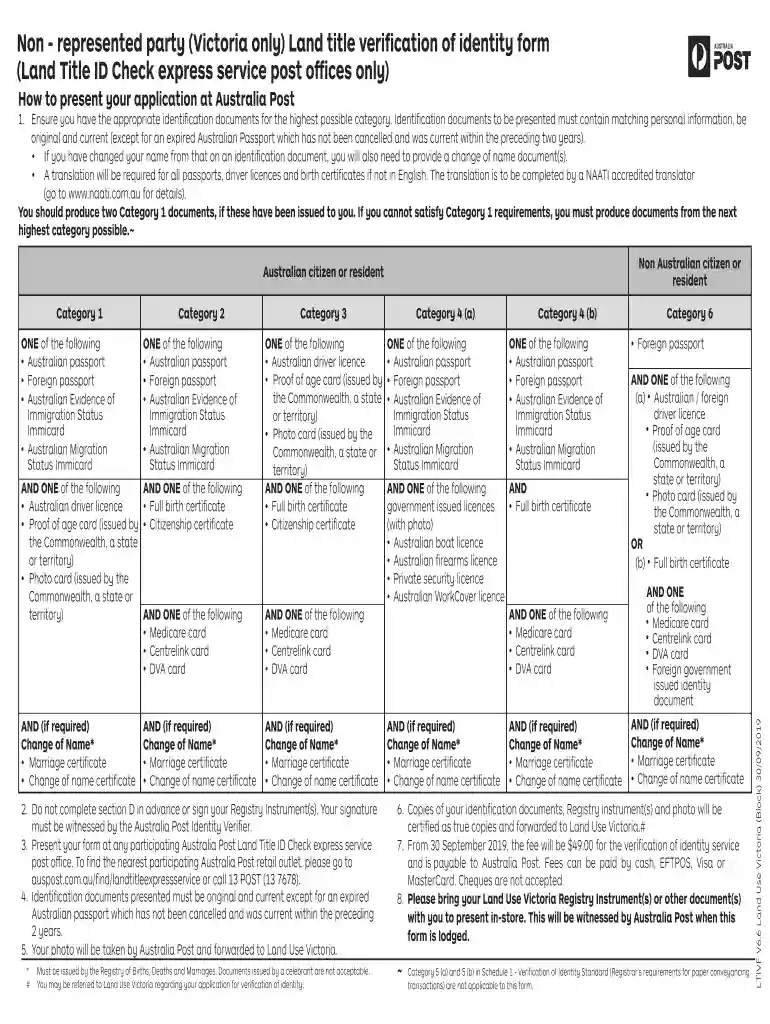
The "non represented party (Victoria only) Land title verification form at at 30 September 2019" is a crucial document used in Victoria, Australia, to verify the identity of individuals involved in land title transactions without a legal representative. It ensures that all parties in such transactions can authenticate their identities, thereby preventing fraud and ensuring legitimacy in the land title registration process.
To complete the non represented party verification form, you will need to provide original or certified copies of identification documents. These are categorized into primary and secondary IDs:
The form can be acquired through several methods:
Choose the most convenient method based on your location and access to resources.
The form includes several vital sections that must be completed accurately:
Ensure each section is filled accurately to avoid processing issues.
The form allows for various submission methods to cater to different needs:
This form serves as a legal measure for identity verification in land title transactions, ensuring:
Using the form correctly is crucial for legally binding land title processes.
While the form itself is not digital, it's important to consider how software can aid in completing it:
Understanding these software options can aid in efficient form management.
The form is specific to Victoria and follows these particular regulations:
This form is primarily used by individuals involved in land transactions without legal representation, including:
Understanding the user categories helps identify the form's audience and application scenarios.


Failure to comply with the requirements of the form could lead to:
Ensure compliance to avoid these potential penalties and ensure smooth transaction processing.
We've got more versions of the non represented party form. Select the right non represented party version from the list and start editing it straight away!
At DocHub, your data security is our priority. We follow HIPAA, SOC2, GDPR, and other standards, so you can work on your documents with confidence.


